
Compare the finished analysis before you choose a platform
See the report CodePulse produces from read-only GitHub workflow data, or connect your own repositories and evaluate the fit with real evidence.
Read-only GitHub · Your code stays yours · Team-level by default · No credit card
"Graphite vs GitHub" is a strange comparison, because Graphite runs on GitHub. Every Graphite pull request is a real GitHub PR; the product is a workflow layer, not a replacement. The real question buyers are asking is sharper: now that GitHub is absorbing stacked PRs, merge queues, and AI review into the platform itself, is the layer still worth $20-40 per user per month?
Graphite vs GitHub: which should you use?
You use both or just GitHub - Graphite is a layer on top of GitHub, not an alternative to it. Pay for Graphite ($20-40/user/month) if your team ships work in dependent chains and wants stacked PRs, a stack-aware merge queue, and a faster review UI today. Stay on plain GitHub if your PRs are mostly independent, since GitHub's merge queue has been GA since 2023, Copilot code review went GA in April 2025, and native stacked PRs entered private preview in April 2026. Either way, measure review flow before and after - a workflow tool you cannot see working is a subscription, not an improvement.
Is Graphite Actually a GitHub Alternative?
No. Graphite (graphite.com - the old graphite.dev domain redirects there) is built on GitHub's APIs and works only with GitHub. When you create a stack with its gt CLI, each change in the stack becomes an ordinary GitHub pull request that your teammates can review in either interface. Branch protection, CODEOWNERS, CI checks, and permissions all stay on GitHub. Graphite adds four things on top: stacked PR management, an AI code reviewer, a stack-aware merge queue, and a PR inbox that replaces GitHub's notification page.
Graphite is not competing with GitHub for your repos. It is competing with GitHub's product roadmap for your budget - and the roadmap keeps moving toward it.
The company behind it was founded in 2020 by ex-Meta and ex-Airbnb engineers who missed the internal stacked-diff tooling those companies run. It raised roughly $81M, including a $52M Series B in March 2025 led by Accel with Menlo Ventures' Anthology Fund (backed by Anthropic), at a reported ~$290M valuation after 20x revenue growth in 2024. Then, on December 19, 2025, it was acquired by Cursor (Anysphere). More on what that means below.
What Does Graphite Add on Top of GitHub?
The core idea is stacking: instead of one 800-line PR, you ship a chain of small, dependent PRs that can be reviewed in parallel and merged in order. The gt CLI handles the painful part - when you amend the bottom of the stack, it restacks everything above it automatically. Practitioners who adopt it tend to be emphatic. One Hacker News commenter put it this way in 2023: "Stacking code changes has been such a game changer that I wouldn't even consider working at a company where this developer workflow doesn't exist."
Around the stack sit three more pieces. The review UI is fast and keyboard-driven - in the December 2025 acquisition thread, one user judged it "at least 3x better than GitHub, and also somehow loads faster." The merge queue understands stacks, so a five-PR chain lands as a unit instead of five racing merges. And there is an AI reviewer with a naming history worth knowing: it launched as Graphite Reviewer, became "Diamond" in March 2025, and was renamed Graphite Agent on October 7, 2025. Reception is more measured than for the core product - the same HN commenter who praised the UI added, "Their AI review is sub par, but everything else is really good."
What Does Graphite Cost?
Pricing is published at graphite.com/pricing (billed annually):
| Plan | Price | What gates it |
|---|---|---|
| Hobby | Free | Personal repositories only |
| Starter | $20/user/month | Org repos, core stacking and review workflow |
| Team | $40/user/month | Stack-aware merge queue unlocks here |
| Enterprise | Custom | SAML, GitHub Enterprise Server support |
Two things stand out. The free tier excludes work repos entirely, so there is no meaningful team trial lane below $20. And the merge queue - arguably the feature that most separates Graphite from a GitHub-plus-CLI setup - sits on the $40 tier. Price pushback is not new; a 2023 Hacker News commenter argued "the pricing is disproportionate to the value add." For a 100-person org, Team is $48,000 a year, which is real money for a workflow layer on a platform you already pay for.
Is GitHub Absorbing Graphite's Ideas?
Steadily. GitHub's merge queue has been generally available since July 2023 - free for public org repos, with private repos requiring GitHub Enterprise Cloud. Copilot code review went GA in April 2025, gained agentic capabilities in March 2026, and moved to usage-based "GitHub AI Credits" billing from June 1, 2026. The biggest move came on April 13, 2026, when GitHub opened a private preview of native stacked pull requests - waitlist at gh.io/stacksbeta, with a gh-stack CLI extension.
The preview is early. The Hacker News announcement thread (516 points) flagged that the beta does not play well with squash-merge workflows, which is how a large share of teams merge. Graphite still has years of polish on stack ergonomics. But the direction is clear: each Graphite differentiator is becoming a platform feature, and the layer's value increasingly rests on execution quality rather than exclusivity.
What Does the Cursor Acquisition Change?
On December 19, 2025, Cursor announced it was acquiring Graphite, stating that Graphite "will maintain independent operations with its existing team and product intact." Terms were undisclosed; Fortune reported the price was "way over" the $290M Series B valuation. Strategically it makes sense - Cursor generates code at high volume, and review is the bottleneck that volume creates.
For buyers, the acquisition cuts both ways. Graphite now has the resources of one of the fastest-growing companies in software behind it. It also has a new owner whose priorities may shift - commenters in the acquisition thread raised Cursor's earlier Supermaven acquisition, where the acquired product was eventually sunset, as a reason for caution. That is community concern rather than evidence of a plan, but it belongs in any annual-contract conversation: ask about the standalone roadmap and what happens to the GitHub-only commitment inside a company building its own ecosystem.
🔥 Our Take
Buy Graphite for stacking or do not buy it at all. If your team ships dependent chains of changes every week, the layer earns its price today, and GitHub's preview is at least a year from matching it. If you want it for the AI reviewer or the nicer inbox, GitHub's own versions are already bundled into spend you have committed.
And time-box the decision. Native stacked PRs are in preview, Copilot review ships with the platform, and Graphite's ownership just changed. A 12-month contract with a measured checkpoint beats a multi-year commitment to a layer whose moat is being drained from below.
How Do You Tell Whether the Workflow Layer Pays Off?
Whichever review UI your team uses, the PRs land on GitHub - which means the outcome is measurable in the same place. Before adopting Graphite (or deciding against it), baseline your review flow: cycle time and its phases, time to first review, how concentrated review load is on a few seniors, and how often approvals arrive with no comments at all. Then check the same numbers a quarter later. Stacking should show up as smaller PRs, faster pickup, and broader reviewer participation; if it does not, the workflow change did not take, whatever the tooling invoice says.
CodePulse measures exactly that layer - review analytics on top of GitHub data, independent of which client created the PRs. Our GitHub pull request analytics guide covers the metrics to baseline, the code review platforms comparison maps where Graphite sits among workflow and measurement tools, and the optimal reviewer count guide covers the research on who should review those newly stacked PRs.
Frequently Asked Questions
It depends on how much your team ships in dependent chains. Teams that live in stacked PRs report the workflow is transformative - one Hacker News commenter said they "wouldn't even consider working at a company where this developer workflow doesn't exist." Teams that mostly ship independent, small PRs get less from it, and GitHub now covers merge queues natively and is previewing stacked PRs. Run the math: 50 engineers on the Team plan is $24,000 a year. If stacking cuts your review wait time measurably, that pays for itself; if you cannot measure the change, you are buying a nicer UI.
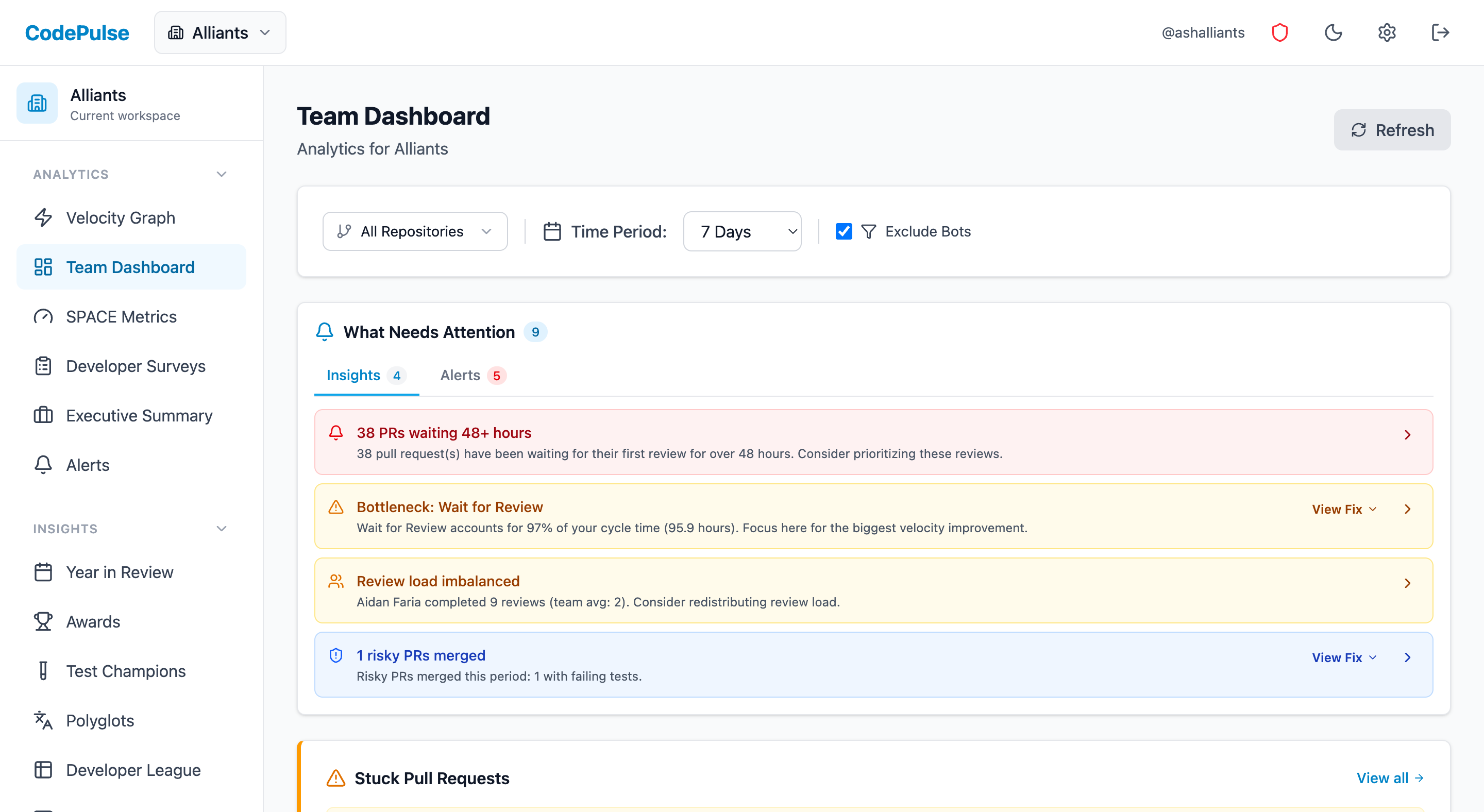
Evaluate CodePulse against your own delivery history
A comparison table only goes so far. Connect read-only GitHub in about five minutes and judge the output on your repositories, at one flat price, with no per-seat math.
Read-only GitHub · Your code stays yours · Team-level by default · No credit card
See These Features in Action
Break down cycle time into coding, waiting, review, and merge phases.
Interactive graph of review relationships and workload distribution.
Related Guides
Best Code Review Tools 2026: GitHub, Graphite +4
Compare code review platforms and approaches, from GitHub native features to specialized tools and analytics solutions. Includes stacked PR tools, review benchmarks from 803K PRs, and a 6-tool feature matrix.
GitHub Pull Request Analytics: From Raw Data to Team Insights
GitHub gives you PR data. It does not give you analytics. How to turn merge times, review patterns, and cycle time into decisions that improve your team.
The Exact Number of Reviewers Per PR (Research Says 2, But...)
Research-backed guidance on how many reviewers you need per pull request, with strategies for matching review depth to risk level.
Best DORA Metrics Tools for 2026: 8 Platforms Compared
An opinionated comparison of the 8 best tools for automated DORA metrics reporting, ranked by automation depth, setup speed, metric accuracy, pricing transparency, and real-world usefulness for engineering leaders.
Evaluating GitHub as a Code Collaboration Platform
An engineering leader's evaluation of GitHub as a code collaboration and DevOps platform: what it does well, where it falls short, and what analytics to layer on top.