
Compare the finished analysis before you choose a platform
See the report CodePulse produces from read-only GitHub workflow data, or connect your own repositories and evaluate the fit with real evidence.
Read-only GitHub · Your code stays yours · Team-level by default · No credit card
Effective code review is essential for maintaining code quality, sharing knowledge, and catching bugs before production. But the right tooling can make the difference between reviews that feel like a bottleneck and reviews that accelerate your team.
This guide compares code review platforms and approaches, from GitHub's native features to specialized tools, helping you choose what fits your team's needs.
What are the best code review tools and platforms?
For small teams (under 15 engineers), GitHub's native review features are sufficient. For stacked PR workflows, Graphite leads with automated rebasing and merge coordination. For review analytics and bottleneck detection, CodePulse surfaces wait times, reviewer load imbalance, and review depth across your organization. LinearB adds workflow automation through gitStream rules. The best tool depends on your team size and whether your primary pain point is review workflow, review visibility, or review automation.
GitHub Native Review: Strengths and Limitations
What GitHub Provides
GitHub's pull request review system is where most teams start. It's deeply integrated with your code and includes:
- Line-by-line comments: Comment on specific lines with context
- Review status: Approve, request changes, or comment
- Suggested changes: Propose specific code modifications reviewers can apply with one click
- CODEOWNERS: Automatically request reviews from the right people
- Branch protection: Require approvals before merging
- Status checks: Block merges until CI passes
Where GitHub Falls Short
GitHub's native review works well for basic workflows but has limitations:
- Limited analytics: No built-in metrics for review time, coverage, or patterns
- No smart routing: CODEOWNERS is static; can't balance load or rotate
- Basic notifications: Easy to miss reviews in busy inboxes
- No queue management: No way to prioritize which PRs need attention
- Limited context: Can't see historical patterns or reviewer expertise
Specialized Code Review Platforms
Graphite
Best for: Teams using stacked PRs (dependent changes in sequence)
Graphite focuses on making stacked workflows manageable. If your team regularly has PRs that depend on other PRs, Graphite automates the rebasing and coordination. Graphite was acquired by Cursor (Anysphere) in December 2025; Cursor says it will maintain independent operations with the product intact.
- Stacked PR creation and management
- Automatic rebasing when base branches change
- CLI-first workflow
- Review queue prioritization
Limitations: Focused specifically on stacking workflow; less useful if your team doesn't use stacked PRs.
Reviewable
Best for: Teams wanting granular review tracking
Reviewable enhances GitHub's review interface with better diff visualization and review progress tracking.
- Better diff viewer with per-line review tracking
- Disposition system (mark lines as reviewed)
- Review state persistence
- Keyboard shortcuts for faster reviewing
Limitations: Adds another tool to your stack; some learning curve.
Gerrit
Best for: Large organizations needing fine-grained access control
Gerrit is a self-hosted code review system popular in enterprise environments, originally developed by Google.
- Change-based workflow (each commit is reviewed separately)
- Fine-grained permissions
- Strong audit trail
- Integrates with CI systems
Limitations: Significant operational overhead; different workflow from GitHub; steep learning curve.
Phabricator (Archived)
Note: Phabricator was discontinued in 2021. If you're still using it, consider migrating to GitHub native reviews or one of the alternatives above.
GitHub Code Review Tools
GitHub dominates the code hosting market, so most code review tooling is built around its pull request model. But GitHub's native review capabilities have meaningful gaps that third-party tools fill in different ways.
Why GitHub Teams Need Additional Tooling
The CodePulse Code Review Study 2025 analyzed 803,000 pull requests and found patterns that GitHub's native features cannot surface:
- 71% self-merge rate: Nearly three-quarters of PRs are merged by the author without any review, meaning CODEOWNERS rules and branch protection are either not enforced or routinely bypassed.
- 68% of "reviewed" PRs get zero comments: Even when a reviewer approves, most reviews leave no feedback, raising questions about review depth.
- First-time contributors wait 10.9x longer: New team members face dramatically longer wait times for review, a pattern invisible without analytics.
These numbers point to a visibility problem, not a tooling gap in the traditional sense. GitHub gives you the mechanics of review (comments, approvals, branch protection). What it does not give you is awareness of whether those mechanics are actually working.
GitHub-Specific Tools Compared
| Feature | GitHub Native | Graphite | CodePulse | LinearB |
|---|---|---|---|---|
| Review assignments | CODEOWNERS | Auto-routing | Analytics | gitStream |
| PR stacking | Limited | Core feature | N/A | Partial |
| Wait time visibility | No | No | Yes | Yes |
| Reviewer load balance | No | No | Yes | Partial |
| Review bottleneck alerts | No | No | Yes | Yes |
| Pricing | Included | Free / Team | Free / Pro | Free / Pro |
Each tool fills a different gap. Graphite changes how you create and manage PRs.CodePulse and LinearB change how you measure and improve the review process. They are not mutually exclusive: a team using Graphite for stacked PRs can also use CodePulse to track whether reviews are actually happening.
Stacked PRs and Modern Review Workflows
Stacked PRs (also called stacked diffs) are a workflow where a developer breaks a large change into a chain of dependent, small pull requests that can be reviewed independently. Instead of one 2,000-line PR, you ship five 400-line PRs where each builds on the previous one.
Why Stacked PRs Matter
The case for smaller PRs is backed by data. The CodePulse 2025 Engineering Benchmarks found that PRs over 1,000 lines changed receive meaningful review only 10% of the time, and large PRs get 20x less scrutiny per line compared to PRs under 200 lines. Stacking addresses this directly by keeping each individual PR small enough to review thoroughly.
"PRs over 1,000 lines get 90% less review coverage. Stacking is not a workflow preference; it is a quality control mechanism."
Stacked PR Tools
- Graphite: The market leader for stacked PR workflows on GitHub, acquired by Cursor in December 2025. CLI-first tool that handles rebasing, merge ordering, and review coordination. Free for personal repos; team plans run $20-40/user/month billed annually.
- ghstack (Facebook): Open-source tool from Meta that pushes each commit as a separate PR. Lightweight but requires comfort with Git internals.
- Aviator: Merge queue and stacking tool that also handles CI orchestration. Useful for teams with flaky tests or complex merge requirements.
- ReviewStack: AWS-backed open-source alternative focused on the review experience for stacked changes.
Stacked PR Trade-offs
| Advantage | Disadvantage |
|---|---|
| Smaller PRs get more thorough review | Steeper learning curve for the team |
| Faster time to first review | Rebase conflicts multiply across the stack |
| Unblocks parallel work on dependent features | Requires tooling (Graphite, ghstack) for ergonomics |
| Easier to revert individual changes | CI runs multiply per stack (cost and time) |
| Cleaner git history | Not all teams benefit (small changes don't need stacking) |
Code Review Benchmarks
Before choosing a tool, it helps to know what "normal" looks like. The CodePulse Code Review Study 2025 analyzed 803,000 pull requests across hundreds of engineering teams to establish baseline benchmarks for code review.
| Metric | Benchmark | What It Means |
|---|---|---|
| Time to first review | Median 0.6 hours | For PRs that receive review, the first look happens fast |
| Review coverage | 14.6% of PRs | Only 1 in 7 PRs receives any review at all |
| Zero-comment reviews | 68% of reviewed PRs | Most "reviews" are rubber stamps with no written feedback |
| Self-merge rate | 71% globally, 52% for reviewed PRs | Authors merge their own code without external approval |
| First-time contributor wait | 10.9x longer than tenured | New hires face dramatically longer review queues |
"68% of 'reviewed' PRs receive zero comments. Review coverage is a vanity metric without review depth."
These benchmarks suggest that the biggest opportunity for most teams is not faster reviews but more reviews. Tools that surface review coverage and depth (like reviewer load balancing) address a more fundamental gap than tools that optimize the mechanics of reviewing.
Our Take
The code review tools market splits into two camps: tools that change how you review (Graphite, Reviewable) and tools that measure whether you review (CodePulse, LinearB, Swarmia). Most teams need the measurement layer first. You cannot fix a review process you cannot see. Once you have visibility into where reviews are breaking down, then invest in workflow tools for the specific bottleneck you identified.
Analytics-First Tools
What Analytics Tools Provide
Rather than replacing GitHub's review interface, analytics tools add visibility into review patterns, bottlenecks, and team health. This category includes CodePulse, LinearB, Jellyfish, and others.
Key capabilities:
- Review time tracking: How long do PRs wait for review? Where are the bottlenecks?
- Reviewer load: Is review work distributed fairly?
- Coverage metrics: What percentage of code gets reviewed?
- Trend analysis: Is your review process improving or degrading?
- Alerts: Get notified when PRs are stuck or reviewers are overloaded
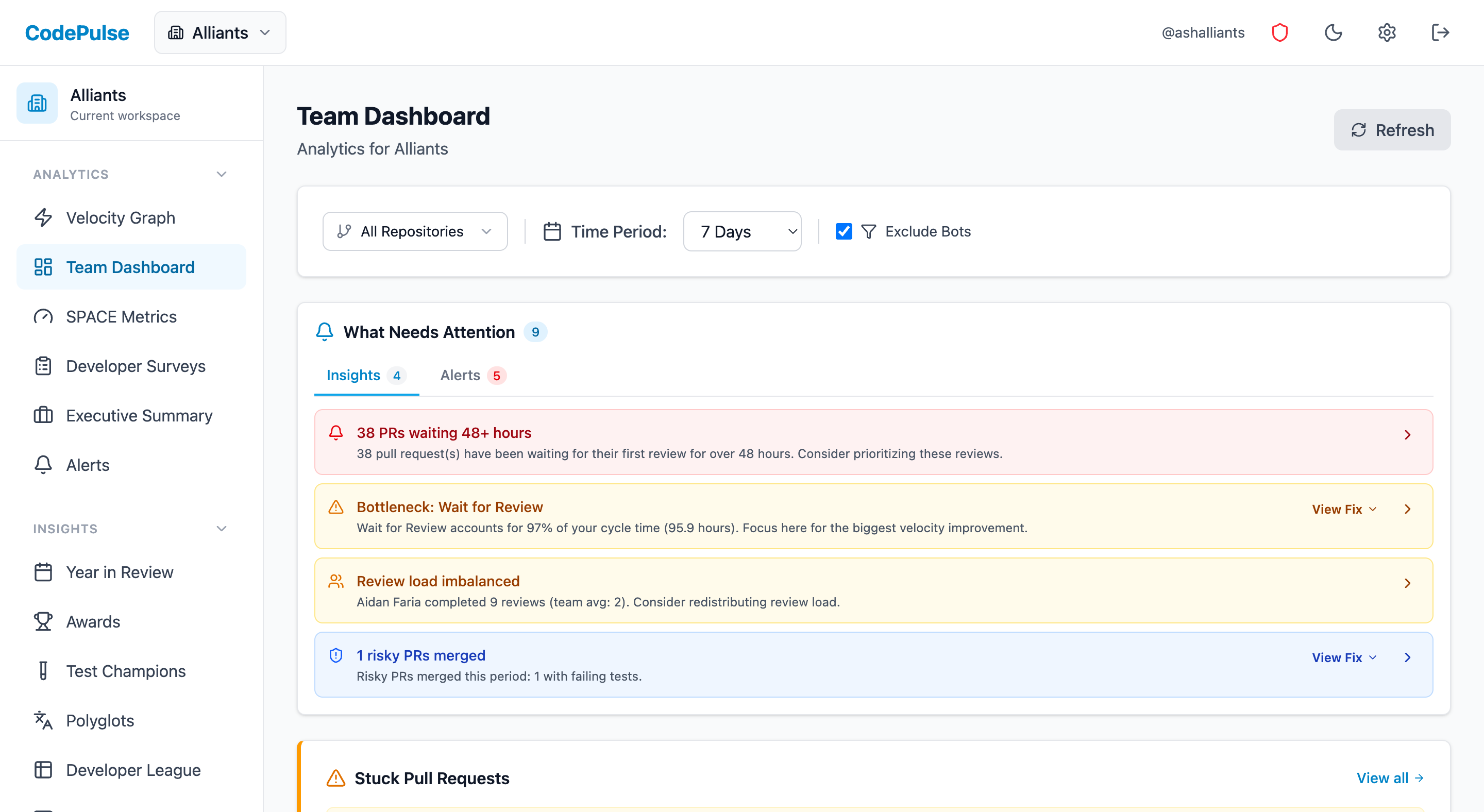
📊 How to See This in CodePulse
CodePulse provides comprehensive review analytics:
- Dashboard - Review time breakdown in your cycle time metrics
- Review Network - Visualize who reviews whose code
- Alerts - Configure notifications for stuck PRs
When to Add Analytics
Consider analytics tools when:
- You don't have visibility into review bottlenecks
- PRs regularly sit waiting for review too long
- You want data to improve your review process
- Leadership needs metrics on engineering health
See our comprehensive engineering analytics tools comparison for detailed vendor analysis.
Comprehensive Feature Comparison Matrix
This matrix covers six tools across the code review ecosystem: the platform itself, workflow enhancers, and analytics layers. No single tool covers every column; the right combination depends on your team's biggest gap.
| Feature | GitHub Native | Graphite | Reviewable | CodePulse | LinearB | Swarmia |
|---|---|---|---|---|---|---|
| Line comments | Yes | Via GitHub | Enhanced | Via GitHub | Via GitHub | Via GitHub |
| Suggested changes | Yes | Via GitHub | No | Via GitHub | Via GitHub | Via GitHub |
| CODEOWNERS | Yes | Extends | N/A | Analyzes | gitStream rules | N/A |
| Stacked PRs | Manual | Core feature | No | N/A | Partial | No |
| Review analytics | No | Limited | No | Comprehensive | Yes | Yes |
| Wait time visibility | No | No | No | Yes | Yes | Yes |
| Reviewer load balance | No | No | No | Yes | Partial | Yes |
| Automated routing | CODEOWNERS only | Auto-assign | No | No | gitStream | No |
| CI integration | GitHub Actions | Merge queue | Status checks | Reads CI data | CI/CD insights | CI/CD insights |
| Pricing | Included | Free / $32/user/mo | Free / $10/user/mo | Free / Pro tiers | Free / Pro tiers | From $20/user/mo |
Source: Vendor pricing and feature pages as of early 2025. Verify current pricing directly with each vendor.
Choosing Based on Team Size
Small Teams (5-15 Engineers)
Recommendation: Start with GitHub native features.
At this size, communication is easy and bottlenecks are visible without tooling. Focus on establishing good review habits first. Add analytics when you notice PRs waiting too long or want to quantify improvement.
Medium Teams (15-50 Engineers)
Recommendation: GitHub + analytics tooling.
As teams grow, patterns become harder to see. You need data to identify:
- Which teams have review bottlenecks
- Who is overloaded as a reviewer
- Whether review quality is consistent
Consider specialized tools if you have specific workflow needs (stacked PRs, cross-team reviews).
Large Teams (50+ Engineers)
Recommendation: GitHub + analytics + possibly specialized tooling.
At scale, review processes need active management. You likely need:
- Comprehensive analytics for leadership visibility
- Alerting for stuck PRs and overloaded reviewers
- Cross-team review coordination
- Possibly specialized tools for complex workflows
Integration Considerations
Data Access and Permissions
Any tool that accesses your GitHub data needs appropriate permissions. Consider:
- What data does the tool access?
- Is data stored or processed transiently?
- Does the tool meet your security requirements?
- Can you limit access to specific repositories?
See our security and compliance guide for detailed security evaluation criteria.
Workflow Integration
The best tool is one your team actually uses. Consider:
- Does it integrate with your existing notifications (Slack, Teams)?
- Does it fit your existing workflow or require changes?
- What's the learning curve for your team?
- Can you start small and expand usage over time?
Cost vs Value
Most tools charge per user. Calculate the value:
- If a tool saves 2 hours of waiting time per developer per week, that's 100+ hours per year per developer
- Compare tool cost to engineer salary cost of waiting
- Factor in the value of the visibility you gain for process improvement
Read our engineering analytics ROI guide for a detailed framework.
Frequently Asked Questions
The best code review tools for GitHub depend on your team size and pain points. GitHub's native review features (line comments, suggested changes, CODEOWNERS) are sufficient for small teams under 15 engineers. For stacked PR workflows, Graphite is the standout choice. For review analytics and bottleneck detection, CodePulse provides visibility into wait times, reviewer load, and review depth. LinearB offers workflow automation through gitStream rules. Most teams at scale combine GitHub native reviews with an analytics layer.
Evaluate CodePulse against your own delivery history
A comparison table only goes so far. Connect read-only GitHub in about five minutes and judge the output on your repositories, at one flat price, with no per-seat math.
Read-only GitHub · Your code stays yours · Team-level by default · No credit card
See These Features in Action
Interactive graph of review relationships and workload distribution.
Measure review thoroughness and feedback quality across the team.
Related Guides
5 Signs Your Code Review Culture Is Toxic (Fix #3 First)
Assess and improve your code review culture. Identify toxic patterns and build psychological safety in your engineering team.
Your Best Engineer Is About to Quit (Check Review Load)
Learn how to identify overloaded reviewers, distribute review work equitably, and maintain review quality without burning out your senior engineers.
We Cut PR Cycle Time by 47%. Here's the Exact Playbook
A practical playbook for engineering managers to identify bottlenecks, improve review processes, and ship code faster - without sacrificing review quality.
Jellyfish vs LinearB vs Swarmia: Full 2026 Comparison
Compare Jellyfish, LinearB, Swarmia, Allstacks, Haystack and more engineering analytics tools. Features, pricing, cycle time benchmarks, and integrations.
The ROI Template That Gets Developer Tools Approved
The exact ROI calculation and business case template that gets CFOs to approve developer tool purchases.
Getting Started with CodePulse: Your First 30 Minutes
A practical walkthrough for new CodePulse users - from your first dashboard view to finding quick wins your team can act on immediately.
Graphite vs GitHub: What the Workflow Layer Buys You
Graphite is a layer on top of GitHub, not a replacement - so the real question is whether stacked PRs, a merge queue, and a faster review UI are worth $20-40/user/month while GitHub absorbs the same ideas.
Azure DevOps vs GitHub: 2026 Comparison (Both Tested)
Azure DevOps vs GitHub compared: pricing, CI/CD, AI features, project management, analytics, and migration paths. Side-by-side guide for engineering leaders choosing between Microsoft platforms.
Your PR Cycle Time Is Fine (Here's the Benchmark)
What is a good PR cycle time? Benchmarks and targets based on team size, industry, and engineering maturity.