
Compare the finished analysis before you choose a platform
See the report CodePulse produces from read-only GitHub workflow data, or connect your own repositories and evaluate the fit with real evidence.
Read-only GitHub · Your code stays yours · Team-level by default · No credit card
Your engineering team lives in GitHub. Your dashboards live in spreadsheets. This guide connects the two, covering GitHub App setup, API integration, webhook configuration, and the exact data pipeline that turns raw GitHub events into actionable metrics.
How do I connect GitHub to an engineering dashboard?
Install a GitHub App from an analytics platform like CodePulse (5-minute setup, read-only access, 6-month historical backfill). For custom dashboards, use the GitHub GraphQL API to pull PR lifecycle data into Grafana or Metabase. Avoid building from scratch unless you need metrics that no commercial tool provides, as maintenance overhead typically exceeds the cost of a SaaS tool.
Your Three Options
There are three ways to get GitHub data into a dashboard. Each involves a different trade-off between setup time, maintenance, and flexibility.
| Approach | Setup Time | Maintenance | Best For |
|---|---|---|---|
| SaaS Analytics Platform | 5-30 minutes | None | Teams wanting insights quickly |
| GitHub API + BI Tool | 1-2 weeks | 2-4 hours/month | Teams with custom metric needs |
| GitHub Webhooks + Data Pipeline | 2-4 weeks | 4-8 hours/month | Real-time event-driven dashboards |
🔥 Our Take
Build custom only if you have metrics no commercial tool supports. Otherwise you are paying 10x in engineer time what a SaaS tool costs.
We have seen teams spend 3 months building a custom GitHub metrics dashboard that a 5-minute CodePulse setup would have replaced. The custom dashboard then needs ongoing maintenance when GitHub changes their API. Unless your requirements are genuinely unique, start with SaaS.
Option 1: SaaS Analytics Platform (Recommended)
The fastest path from GitHub data to useful dashboards. Here is the setup process:
- Install the GitHub App. Sign up for CodePulse and authorize the GitHub App. It requests read-only access to repository metadata, pull requests, commits, and reviews.
- Select repositories. Choose which repos to analyze. Start with your team's most active repositories. You can add more later.
- Wait for the initial sync. CodePulse backfills 6 months of historical data. For repos with moderate activity, this takes 5-15 minutes. Large repos with thousands of PRs may take up to an hour.
- View your dashboard. Navigate to the Dashboard to see cycle time breakdown, review coverage, and team velocity.
Option 2: GitHub API + BI Tool
For teams that need custom metrics or want to combine GitHub data with other sources in an existing BI tool (Grafana, Metabase, Looker, Tableau).
GitHub GraphQL API (Recommended over REST)
The GraphQL API is more efficient than REST for analytics because you can fetch exactly the fields you need in a single request. Example query for PR lifecycle data:
query {
  repository(owner: "your-org", name: "your-repo") {
    pullRequests(last: 100, states: [MERGED]) {
      nodes {
        title
        createdAt
        mergedAt
        additions
        deletions
        reviews(first: 10) {
          nodes { submittedAt state author { login } }
        }
      }
    }
  }
}
Rate Limits
GitHub allows 5,000 API requests per hour for authenticated requests. The GraphQL API counts by query cost, not request count. For a team with 10 repos and 500 PRs/month, you will stay well within limits with hourly polling.
Option 3: Webhooks for Real-Time Data
Webhooks push events to your server as they happen. Useful for real-time dashboards or triggering automated workflows.
Which events to subscribe to:
pull_request- PR opened, closed, merged, reopenedpull_request_review- Reviews submittedpush- Commits pushed (high volume, filter carefully)deploymentanddeployment_status- For DORA deployment frequency
Security considerations:
- Always validate webhook signatures using the secret token
- Use HTTPS endpoints only
- Implement idempotent event processing (webhooks can fire more than once)
- For GitHub Enterprise Server behind a firewall, you may need to allowlist IP ranges or set up a reverse proxy
GitHub Enterprise Server Considerations
Teams on GitHub Enterprise Server (self-hosted) face additional setup requirements:
- Network access: Your analytics tool needs network access to your GitHub instance. SaaS tools require outbound connectivity from your GitHub server or a VPN bridge.
- Authentication: GitHub Enterprise Server supports GitHub Apps, personal access tokens, and OAuth. GitHub Apps are preferred for least-privilege access.
- API compatibility: Enterprise Server runs a specific GitHub version. Check that your analytics tool supports your version (some features in GitHub.com are not available in older Enterprise Server releases).
- Data residency: If data cannot leave your network, self-hosted tools like Apache DevLake or custom Grafana pipelines may be required.
Backfilling Historical Data
New dashboard setups need historical data for meaningful trends. Here is what to expect:
| Tool | Default Backfill | Method |
|---|---|---|
| CodePulse | 6 months | Automatic on first sync |
| LinearB | 3-6 months | Automatic |
| Custom (API) | Unlimited | Paginate through GitHub API (rate-limited) |
| Apache DevLake | Configurable | API collection tasks |
When backfilling via the API, start from most recent and work backward. Process in batches of 100 PRs. Save checkpoints so you can resume if rate-limited. CodePulse handles all of this automatically with watermark-based incremental sync.
Getting Started
- Start with SaaS. Connect CodePulse to GitHub in 5 minutes. See if the built-in dashboards answer your questions before investing in custom infrastructure.
- Identify gaps. After 2 weeks, note which questions the SaaS dashboard does not answer. Those gaps define whether you need custom data pipelines.
- Only build custom if needed. If the SaaS tool covers 80%+ of your needs, the 20% gap is usually not worth weeks of custom development plus ongoing maintenance.
Related guides: Engineering metrics dashboard guide, GitHub metrics guide, Slack alerts for engineering metrics.
Frequently Asked Questions
The fastest path is a GitHub App integration. Tools like CodePulse install as a GitHub App with read-only access and pull PR lifecycle data, commit history, and review patterns automatically. Setup takes under 5 minutes. For custom dashboards, use the GitHub REST or GraphQL API to pull events into Grafana, Metabase, or a data warehouse.
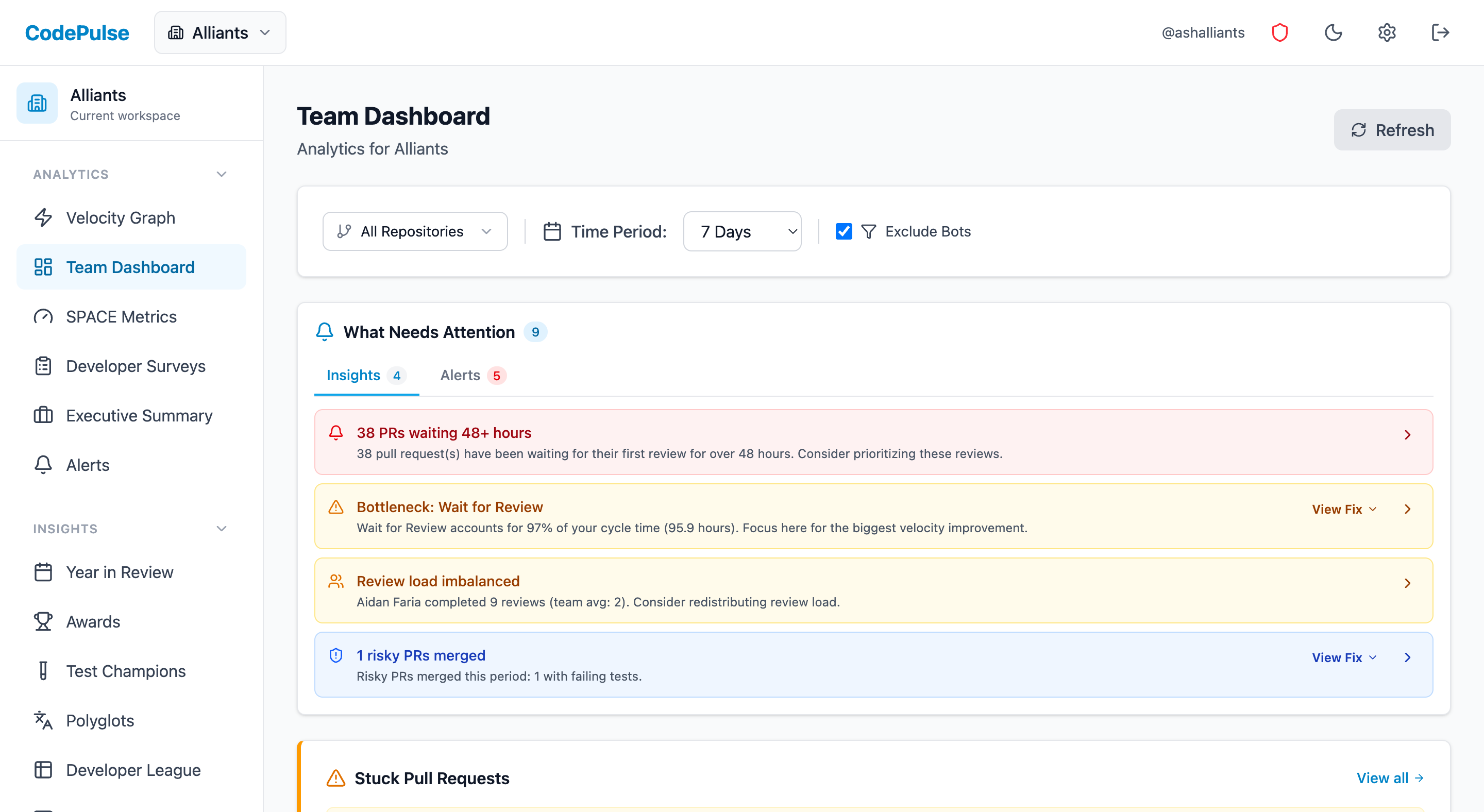
Evaluate CodePulse against your own delivery history
A comparison table only goes so far. Connect read-only GitHub in about five minutes and judge the output on your repositories, at one flat price, with no per-seat math.
Read-only GitHub · Your code stays yours · Team-level by default · No credit card
See These Features in Action
Board-ready engineering performance in a single page.
Break down cycle time into coding, waiting, review, and merge phases.
Related Guides
Engineering Metrics Dashboard: The 7 Metrics You Need
Skip vanity metrics. Here are the 7 engineering metrics VPs actually need to track team performance, delivery, and quality.
GitHub Metrics That Matter: A No-Vanity Shortlist
GitHub is a goldmine of engineering data. This guide shows which GitHub metrics actually matter (PR cycle time, review load, knowledge distribution), how to build a useful dashboard, and which vanity metrics to avoid.
The Slack Alert That Catches Stuck PRs Before Standup
How to configure alerts for stuck PRs, review SLA breaches, and key metric changes to stay informed without constant dashboard checking.
Getting Started with CodePulse: Your First 30 Minutes
A practical walkthrough for new CodePulse users - from your first dashboard view to finding quick wins your team can act on immediately.