

Turn this metric into a baseline for your team
Preview a system-level engineering health report, then connect GitHub when you are ready to compare this metric with your own delivery history.
Read-only GitHub · Your code stays yours · Team-level by default · No credit card
Pull requests, commits, and reviews already capture how your team really works. The GitHub metrics worth tracking distill that into four signals: PR cycle time, review coverage, deployment frequency, and code churn. Together they show how fast you ship, whether code gets real review, and where work stalls. This guide covers those metrics, the vanity numbers to ignore, and how to turn them into a dashboard your team acts on.
What GitHub metrics should engineering teams track?
The most useful GitHub metrics are PR cycle time (time from open to merge), review coverage (percentage of PRs with at least one review), deployment frequency (PRs merged per day), and code churn rate (percentage of code changed within 2 weeks of being written). These four metrics cover velocity, quality, and stability. Avoid vanity metrics like commit counts or lines of code. CodePulse extracts all of these from your GitHub data automatically with a 5-minute setup.
"GitHub already tracks everything. The question isn't what data you have - it's which data you should pay attention to."
Why Track GitHub Metrics?
GitHub metrics give you objective visibility into your engineering process:
- Understand delivery flow - How fast does code move from PR to production?
- Identify bottlenecks - Where does work get stuck?
- Balance workload - Who's overloaded with reviews?
- Spot risks - Which code areas lack expertise?
- Track improvement - Are process changes working?
Unlike self-reported metrics (story points, time estimates), GitHub data is objective and automatic. It captures what actually happened, not what people remember or want to report. For building your own dashboard, see our GitHub stats dashboard guide and Git metrics deep dive.
Essential GitHub Metrics
Pull Request Metrics
| Metric | What It Measures | Why It Matters |
|---|---|---|
| PR Cycle Time | Time from first commit to merge | Overall delivery speed |
| Time to First Review | How long PRs wait for initial review | Review responsiveness |
| Time in Review | Duration of the review process | Review efficiency |
| PR Size | Lines changed per PR | Smaller PRs = faster reviews |
| PR Throughput | PRs merged per time period | Team output capacity |
| Merge Rate | % of PRs that get merged (vs closed) | Work quality/alignment |
Code Review Metrics
| Metric | What It Measures | Why It Matters |
|---|---|---|
| Reviews per PR | Average number of reviewers | Review coverage |
| Review Comments | Comments per PR | Review depth (with caveats) |
| Review Load | Reviews per person | Workload distribution |
| Self-Merge Rate | PRs merged without review | Process compliance |
Contributor Metrics
| Metric | What It Measures | Why It Matters |
|---|---|---|
| Active Contributors | Unique authors in period | Team engagement |
| Knowledge Distribution | Code ownership spread | Bus factor risk |
| Review Network | Who reviews whose code | Collaboration patterns |
/// Our Take
The most valuable GitHub metric is PR cycle time - specifically, the breakdown of where time is spent: coding, waiting for review, in review, and waiting to merge. This tells you exactly where to focus improvement.
Avoid tracking individual commit counts or lines of code. These metrics are easily gamed and don't correlate with actual value delivered. Focus on flow metrics at the team level.
Building a GitHub Dashboard
Dashboard Layout
GITHUB METRICS DASHBOARD
═══════════════════════════════════════════════════════════

┌─────────────────────────────────────────────────────────┐
│  TEAM: Engineering  │  PERIOD: Last 30 days            │
│  REPOS: 12          │  ACTIVE CONTRIBUTORS: 18         │
└─────────────────────────────────────────────────────────┘

DELIVERY FLOW
┌─────────────────────────┐  ┌─────────────────────────┐
│  PR CYCLE TIME          │  │  PR THROUGHPUT          │
│  Median: 18 hours       │  │  This month: 145 PRs    │
│  vs last month: -22% ✓  │  │  vs last month: +12% ✓  │
│  [sparkline trend]      │  │  [sparkline trend]      │
└─────────────────────────┘  └─────────────────────────┘

CYCLE TIME BREAKDOWN
┌─────────────────────────────────────────────────────────┐
│  Coding        ████████░░░░░░░░░░░░░░  35% (6.3h)      │
│  Waiting       ██████████████░░░░░░░░  52% (9.4h)  ⚠️  │
│  In Review     ██░░░░░░░░░░░░░░░░░░░░   8% (1.4h)      │
│  Merge         █░░░░░░░░░░░░░░░░░░░░░   5% (0.9h)      │
└─────────────────────────────────────────────────────────┘

CODE REVIEW HEALTH
┌─────────────────────────┐  ┌─────────────────────────┐
│  TIME TO FIRST REVIEW   │  │  REVIEW LOAD BALANCE    │
│  Median: 4.2 hours      │  │  Top reviewer: 28 PRs   │
│  Target: < 8 hours ✓    │  │  Bottom: 8 PRs          │
└─────────────────────────┘  └─────────────────────────┘

PR SIZE DISTRIBUTION
┌─────────────────────────────────────────────────────────┐
│  XS (<50)   ████████████  32%                          │
│  S (50-200) ████████████████  45%  ✓ Good             │
│  M (200-500)████████  18%                              │
│  L (>500)   ██  5%  ⚠️ Review these                    │
└─────────────────────────────────────────────────────────┘
Key Dashboard Principles
- Show trends, not just numbers - Is it getting better or worse?
- Highlight anomalies - What needs attention right now?
- Keep it focused - 6-8 metrics maximum
- Team-level only - No individual leaderboards
- Update automatically - Daily refresh minimum
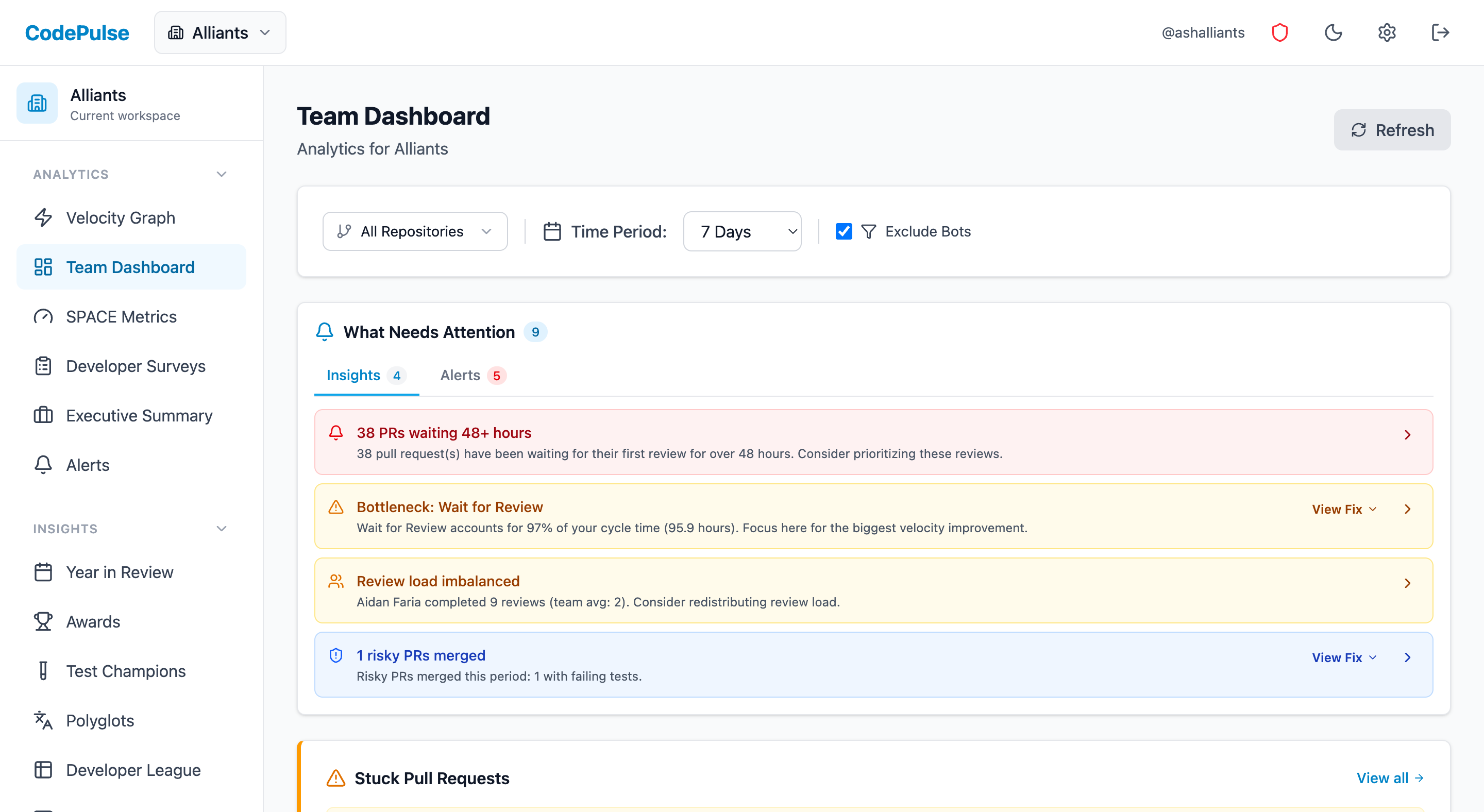
📊 How to See This in CodePulse
CodePulse builds your GitHub dashboard automatically:
- Dashboard for PR cycle time, throughput, and size distribution
- Review Network for review load and collaboration patterns
- Knowledge Silos for code ownership and bus factor
- File Hotspots for high-churn code areas
GitHub Insights vs. Dedicated Tools
GitHub provides some built-in analytics, but they have limitations:
| Feature | GitHub Insights | Dedicated Tools |
|---|---|---|
| PR cycle time breakdown | ❌ Not available | ✅ Detailed breakdown |
| Cross-repo analytics | ❌ Per-repo only | ✅ Organization-wide |
| Review load balancing | ❌ Not available | ✅ Visual network |
| Historical trends | ⚠️ Limited | ✅ Long-term tracking |
| Custom alerts | ❌ Not available | ✅ Configurable |
| Team comparisons | ❌ Not available | ✅ Benchmarking |
| DORA metrics | ❌ Not available | ✅ Full support |
GitHub Metrics by Role
For Engineering Managers
- PR cycle time - Are we delivering efficiently?
- Review load distribution - Is workload balanced?
- PR throughput trends - Is output stable?
- Time to first review - Are PRs getting stuck?
For Tech Leads
- PR size distribution - Are PRs reviewable?
- Knowledge silos - Do we have bus factor risk?
- Code hotspots - Which areas need attention?
- Review depth - Is quality being maintained?
For VPs of Engineering
- Deployment frequency - How often are we shipping?
- Lead time trends - Are we getting faster?
- Cross-team comparisons - Which teams need support?
- Overall health score - Executive summary view
"Different roles need different views of the same underlying data. A VP doesn't need to see individual PR sizes; an EM does."
Common Insights from GitHub Data
Insight: Review Bottleneck
Signal: High "waiting for review" time, uneven review load
Action: Add review SLAs, redistribute review responsibilities, consider review rotation
Insight: Large PR Problem
Signal: Many PRs over 400 lines, long review times
Action: Set PR size guidelines, encourage incremental commits, use feature flags for partial work
Insight: Knowledge Concentration
Signal: Single contributor owns critical code areas
Action: Pair programming rotation, mandatory cross-reviews, documentation sprints
Insight: Slow Merge Process
Signal: PRs approved but not merged for hours/days
Action: Check CI/CD pipeline speed, review merge requirements, enable auto-merge
GitHub Metrics Anti-Patterns
Tracking Lines of Code
LOC rewards verbosity and punishes refactoring. A developer who deletes 1000 lines of dead code looks "less productive" than one who adds 100 unnecessary lines.
Commit Count Leaderboards
Encourages meaningless commits ("fix typo", "update", "wip"). Measures activity, not value. Destroys trust.
Individual PR Rankings
Creates competition instead of collaboration. Encourages gaming (split one PR into five to look more productive).
Ignoring Context
Comparing a team doing greenfield work to one doing legacy maintenance isn't fair. Context matters for interpreting metrics.
Related Guides
- GitHub Stats Team Dashboard - Building team-level GitHub analytics
- GitHub Team Analytics Guide - Deeper dive into team metrics
- GitHub Repository Metrics - Per-repo analytics
- Reduce PR Cycle Time - Acting on cycle time insights
Conclusion
GitHub metrics provide objective visibility into your engineering process. Focus on flow metrics (cycle time, throughput) rather than activity metrics (commits, lines of code). Build a dashboard that shows trends and highlights where attention is needed.
- Start with PR cycle time - the most actionable metric
- Track at team level - not individual rankings
- Focus on trends - direction matters more than absolutes
- Keep it simple - 6-8 metrics maximum
- Act on insights - metrics without action are waste
Get started with CodePulse to see your GitHub metrics in minutes. Connect your repositories and get cycle time breakdown, review analytics, and team insights without building anything yourself.
"The best GitHub dashboard is one that makes you ask 'why?' and then helps you find the answer. Data should drive curiosity, not just reports."
Frequently Asked Questions
The most useful metrics are PR cycle time, review coverage, deployment frequency, and code churn rate. These cover velocity, quality, and stability without rewarding volume. Avoid vanity metrics like commit counts or lines of code.
Now measure this metric on your own repositories
Connect read-only GitHub in about five minutes and get your baseline, your trend, and the constraint behind it. Your fourteen usable trial days start when the first repository finishes syncing.
Read-only GitHub · Your code stays yours · Team-level by default · No credit card
See These Features in Action
Board-ready engineering performance in a single page.
Break down cycle time into coding, waiting, review, and merge phases.
Related Guides
GitHub Stats Are Broken. Build This Dashboard Instead
Go beyond GitHub Insights with team-level analytics. Learn what metrics matter, how to build a team dashboard, and how to turn GitHub stats into actionable insights.
GitHub Insights Is Useless. Here's What to Use Instead
Learn how to get meaningful team-level analytics from GitHub, including delivery metrics, collaboration patterns, and cross-team insights.
GitHub Is Hiding Your Repo's Real Health Score
Learn which repository-level metrics matter for engineering managers and staff engineers, how to track them across multiple repos, and when to intervene based on health signals.
We Cut PR Cycle Time by 47%. Here's the Exact Playbook
A practical playbook for engineering managers to identify bottlenecks, improve review processes, and ship code faster - without sacrificing review quality.
Cycle Time vs Lead Time: The Real Difference
Cycle time and lead time sound interchangeable but measure different windows of your delivery pipeline. Here is what each one covers, where DORA lead time for changes fits, and which to track.
Azure DevOps vs GitHub: 2026 Comparison (Both Tested)
Azure DevOps vs GitHub compared: pricing, CI/CD, AI features, project management, analytics, and migration paths. Side-by-side guide for engineering leaders choosing between Microsoft platforms.
Evaluating GitHub as a Code Collaboration Platform
An engineering leader's evaluation of GitHub as a code collaboration and DevOps platform: what it does well, where it falls short, and what analytics to layer on top.