
Turn this metric into a baseline for your team
Preview a system-level engineering health report, then connect GitHub when you are ready to compare this metric with your own delivery history.
Read-only GitHub · Your code stays yours · Team-level by default · No credit card
"Engineering productivity" is one of the most searched - and most misunderstood - topics in software leadership. This guide cuts through the noise: what productivity actually means in engineering, why most measurement attempts fail, and frameworks that work without creating surveillance culture.
The challenge isn't that engineering productivity can't be measured - it's that most organizations measure the wrong things. They track outputs (commits, story points, lines of code) when they should track outcomes (customer value, system health, sustainable pace). This guide shows you how to do it right.
What is Engineering Productivity?
Engineering productivity is the relationship between the value your engineering team creates and the resources (time, people, money) required to create it. It's not about how much code gets written - it's about how effectively your team turns effort into outcomes that matter to the business.
🔥 Our Take
The phrase "engineering productivity" is a trap.
It implies engineers are like factory workers with countable outputs. They're not. Software development is creative knowledge work. The productivity metaphor leads to bad metrics (LOC, commit counts, story points) and worse management. Better framing: "engineering effectiveness" or "delivery capability." These terms encourage measuring outcomes rather than activity.
That said, "engineering productivity" is what people search for, so let's define it properly. True engineering productivity encompasses:
- Delivery velocity: How quickly can you turn an idea into working software in production?
- Quality and stability: Does the software work? Does it stay working?
- Developer experience: Can your team sustain this pace without burning out?
- Business impact: Is the work actually moving metrics that matter?
"Productivity measures motion. Effectiveness measures progress. The busiest teams aren't always the most valuable."
The Productivity Measurement Problem
Most attempts to measure engineering productivity fail - not because measurement is impossible, but because organizations measure inputs rather than outcomes. Here's what doesn't work and why:
Metrics That Fail
| Bad Metric | Why It Fails | Better Alternative |
|---|---|---|
| Lines of Code | Rewards verbosity; deletions are often more valuable than additions | Cycle time, deployment frequency |
| Commit Counts | Encourages small, meaningless commits; easy to game | PR throughput with quality gates |
| Story Points Velocity | Inconsistent across teams; inflates over time; measures estimates, not value | Lead time, customer outcomes |
| Hours Worked | Measures presence, not productivity; encourages unsustainable pace | Output per sustainable work week |
| Tickets Closed | Not all tickets are equal; gaming by splitting or cherry-picking | Value delivered, customer impact |
🔥 Our Take
Lines of code is embarrassing in 2026.
The fact that anyone still tracks lines of code is embarrassing. In the age of AI coding assistants generating code, it's not just useless - it's counterproductive. A developer who deletes 500 lines while maintaining functionality has done better work than one who adds 500 lines of bloat.
The Root Problem: Goodhart's Law
"When a measure becomes a target, it ceases to be a good measure." This applies forcefully to engineering metrics. The moment you tell developers they'll be evaluated on cycle time, you'll get optimized cycle time - and everything else (code quality, documentation, mentoring) will suffer.
The solution isn't to stop measuring. It's to:
- Measure multiple dimensions simultaneously (speed AND quality AND satisfaction)
- Use metrics for understanding, not judgment
- Focus on team-level metrics, not individual comparisons
- Treat metrics as conversation starters, not scorecards
Frameworks for Measuring Engineering Productivity
Rather than inventing your own metrics, start with proven frameworks. Each has strengths and limitations. For the deeper systems-level view - how the frameworks connect to data pipelines, dashboards, and tooling - see our engineering analytics systems guide.
DORA Metrics
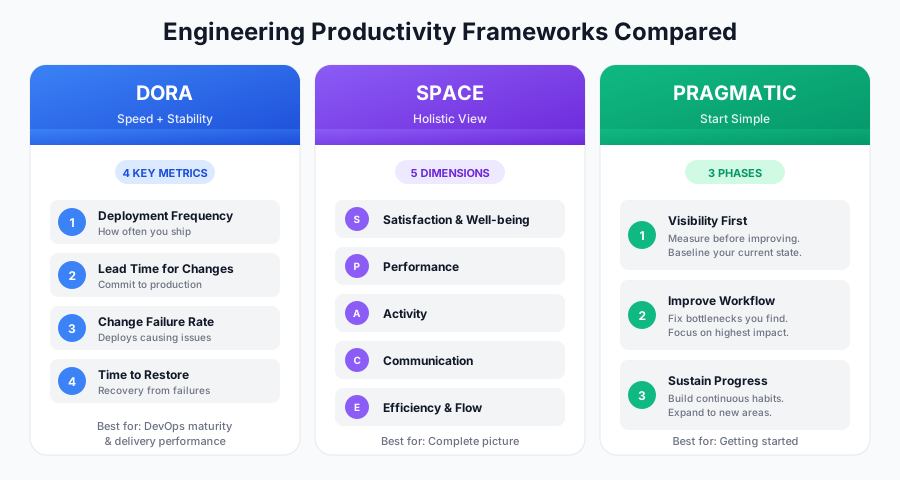
The DevOps Research and Assessment (DORA) framework measures software delivery performance through four key metrics: deployment frequency, lead time for changes, change failure rate, and mean time to restore.
Strengths: Well-researched, widely adopted, correlates with business outcomes. Limitations: Focuses on delivery mechanics; doesn't capture developer experience or business value directly.
For implementation guidance, see our DORA Metrics Guide and Four Keys Implementation Guide.
SPACE Framework
The SPACE framework from Microsoft Research provides a more holistic view across five dimensions: Satisfaction & well-being, Performance, Activity, Communication & collaboration, and Efficiency & flow.
Strengths: Comprehensive, includes developer well-being, balances multiple dimensions. Limitations: Complex to implement fully; some dimensions require surveys that are hard to scale.
For detailed implementation, see our SPACE Framework Guide.
The Pragmatic Approach
For teams just starting with engineering productivity measurement, we recommend a simpler three-phase approach:
- Visibility First: Before improving anything, understand your current state. Measure cycle time, PR throughput, and deployment frequency. Don't set targets - just observe.
- Improve Workflow: Based on what you observe, identify the biggest bottleneck. Is it review time? CI duration? Unclear requirements? Fix one thing at a time.
- Sustain Progress: Once you've improved one area, build the habit of continuous measurement and improvement. Expand to additional metrics gradually.
🔥 Our Take
Velocity should never be a goal.
The moment velocity becomes a goal, it stops being useful. You'll get more PRs, but they'll be smaller, simpler, and less valuable. You'll hit your numbers while missing your targets. Velocity is an output, not an input. You improve velocity by removing friction, not by demanding more.
The Engineering Productivity Stack
Engineering productivity tools and practices fall into four categories. Most organizations need something in each:
Visibility Layer
Tools that help you understand what's happening across engineering:
- Engineering metrics dashboards (DORA, cycle time, throughput)
- Code review analytics
- Repository health monitoring
- Incident correlation with code changes
📊 CodePulse in the Stack
CodePulse provides the visibility layer by connecting to your GitHub organization:
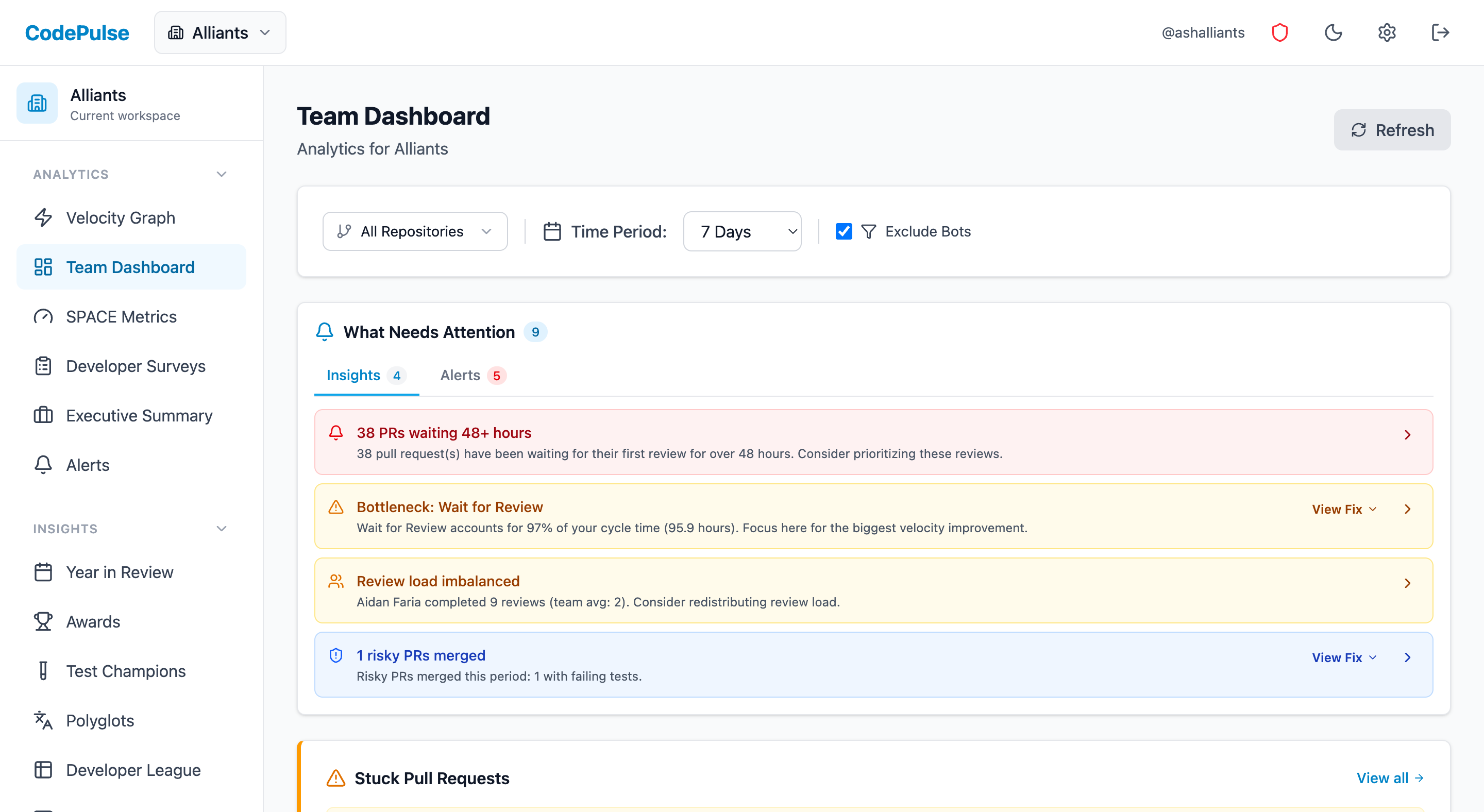
- Dashboard → Cycle time breakdown, throughput trends
- Executive Summary → Engineering health grade at a glance
- Review Network → Collaboration patterns and bottlenecks
- File Hotspots → Risk areas and knowledge silos
Workflow Layer
Tools that reduce friction in day-to-day development:
- CI/CD pipelines and automation
- Code review tools and automation
- Development environment management
- Feature flags and progressive delivery
Collaboration Layer
Tools and practices that improve how teams work together:
- Code ownership and review assignment systems
- Knowledge management and documentation
- Async communication practices
- Incident response coordination
Quality Layer
Tools that ensure work output meets standards:
- Automated testing frameworks
- Code quality and security scanning
- Error monitoring and observability
- Architecture governance
"The most important engineering work is unmeasurable: architecture decisions that prevented problems, mentorship that made someone better, documentation that saved hours of confusion. If you only track what's countable, you'll undervalue what matters."
Building an Engineering Productivity Practice
Here's a 90-day roadmap for building a sustainable engineering productivity practice:
Days 1-30: Establish Visibility
- Connect your engineering analytics tool to your repositories
- Baseline your current metrics (cycle time, throughput, review coverage)
- Identify 3-5 initial observations - don't act yet, just understand
- Share observations with engineering leadership (data, not blame)
Days 31-60: Address One Bottleneck
- Pick the single highest-impact bottleneck from your observations
- Form a hypothesis about how to improve it
- Implement a small intervention (e.g., review SLA, CI parallelization)
- Monitor the impact through your visibility layer
Days 61-90: Institutionalize
- Document what worked (and what didn't)
- Establish a regular review cadence (weekly metrics review, monthly deep-dive)
- Expand to the next bottleneck
- Share wins with the broader organization
Common Pitfalls to Avoid
- Surveillance culture: Using metrics to monitor individuals creates distrust. Focus on team-level insights. See our Engineering Metrics Trust guide.
- Vanity metrics: Metrics that look good but don't drive improvement. Always ask: "If this metric changes, what action will we take?"
- Tool sprawl: Your team doesn't need 7 analytics tools. They need one good one, used consistently. Every tool adds cognitive load.
- Optimization without context: Improving cycle time doesn't help if you're shipping the wrong features. Connect engineering metrics to business outcomes.
For related guidance on specific productivity dimensions, see:
- Developer Productivity Metrics - specific metrics for individual and team productivity
- Engineering Efficiency - optimizing how work flows through your organization
- Engineering Metrics Dashboard - building dashboards for visibility
- Measuring Without Micromanaging - building trust while improving visibility
Now measure this metric on your own repositories
Connect read-only GitHub in about five minutes and get your baseline, your trend, and the constraint behind it. Your fourteen usable trial days start when the first repository finishes syncing.
Read-only GitHub · Your code stays yours · Team-level by default · No credit card
See These Features in Action
Board-ready engineering performance in a single page.
Compare contribution patterns for coaching, not surveillance.
Related Guides
DORA Metrics Explained: The 4 Keys Without the Hype
A complete breakdown of the four DORA metrics - deployment frequency, lead time, change failure rate, and MTTR - with honest benchmarks and gaming traps to avoid.
Why Microsoft Abandoned DORA for SPACE (And You Should Too)
Learn how to implement the SPACE framework from Microsoft and GitHub research to measure developer productivity across Satisfaction, Performance, Activity, Communication, and Efficiency.
5 Silent Killers Destroying Your Engineering Efficiency
Learn how to measure and improve engineering efficiency without burning out your team. Covers the efficiency equation, bottleneck identification, and sustainable improvement.
Developer Productivity Metrics That Don't Backfire
Stop treating engineers like factory workers. Learn which developer productivity metrics destroy trust, why lines of code fail, and how to measure productivity, including with AI tools, without surveillance.
What is Developer Productivity? (It's Not What You Think)
Developer productivity means sustainable delivery with team health - not lines of code. Learn the frameworks, dimensions, and what NOT to measure.
Improve Developer Productivity Without Burnout
A practical guide to improving developer productivity through friction reduction, not pressure. The 5 highest-impact interventions that actually work.