
Understand the system around the team, not a developer leaderboard
Preview team-level workload, collaboration, and delivery signals designed for process improvement rather than performance grading.
Read-only GitHub · Your code stays yours · Team-level by default · No credit card
Your CEO asks "where does the engineering budget go?" and your answer takes 3 hours to assemble from Jira, GitHub, and spreadsheets. This guide shows you how to build portfolio reports that answer executive questions in minutes, with the exact framing that translates engineering work into business language.
How do you create engineering portfolio reports for executives?
An engineering portfolio report translates development activity into business language. Include 4 sections: investment allocation (feature/maintenance/debt percentages), delivery predictability (commitments hit rate), efficiency trend (cost per feature or cycle time improvement), and team health (capacity, attrition risk). Use CodePulse's Executive Summary page to automate data collection, then frame findings around cost, throughput, and risk for non-technical stakeholders.
Why Portfolio Reporting Matters Now
Engineering organizations that cannot articulate where their budget goes get their budgets cut. This was true during the 2022-2023 tech downturn and remains true in 2026. CFOs increasingly expect engineering leaders to report with the same rigor as sales or marketing.
The problem is not that engineering lacks data. Git repositories, CI/CD pipelines, and issue trackers contain everything. The problem is that engineering data is stored in formats that finance teams cannot interpret. "We merged 247 PRs this quarter" means nothing to a CFO. "We delivered 83% of committed features at $12,400 average cost per feature, down from $15,200 last quarter" starts a productive conversation.
"Engineering leaders who speak finance get budgets. Engineering leaders who speak code get audits."
The 4-Section Portfolio Report
Every engineering portfolio report should answer these 4 questions. One section per question. One slide per section if presenting to a board.
Section 1: Where does the budget go? (Investment Allocation)
Show engineering effort as a pie chart or stacked bar: new features vs. maintenance vs. technical debt vs. incidents. This is the slide that resonates most with boards because it maps directly to how they think about budget allocation in every other department.
The target ratio varies by company stage: startups should be 70-80% features, mature products 50-60% features. If maintenance exceeds 40%, flag it as a risk with a plan to reduce it. See our feature vs. maintenance balance guide for benchmarks.
Section 2: Are we delivering? (Predictability)
Show commitments made vs. commitments delivered. This is not about velocity. It is about trust. If engineering commits to 10 features and delivers 8, that is 80% predictability. Boards care more about predictability than raw speed.
Track this quarterly. Improving from 60% to 85% predictability is a stronger narrative than "we shipped 20% more features" because predictability implies control.
Section 3: Are we getting more efficient? (Cost Trend)
Show cost per feature delivered trending downward, or cycle time improving quarter over quarter. This is the efficiency narrative that justifies continued or increased investment.
Calculate cost per feature as: (total engineering spend / features delivered). Compare quarter over quarter. If the number is stable or declining while headcount grows, you are scaling efficiently. CodePulse's Executive Summary provides the underlying cycle time and delivery data.
Section 4: Is the team healthy? (Risk Indicators)
Show attrition risk signals, overtime patterns, and capacity utilization. This is the section that prevents surprises. If 3 senior engineers are showing burnout signals (weekend work, declining review quality, narrowing code ownership), the board needs to know before they leave.
Use CodePulse's burnout signals from Git data to surface early warnings automatically.
🔥 Our Take
Portfolio reports are not about proving engineering is busy. They are about proving engineering is predictable.
Boards do not fire engineering leaders because velocity is low. They fire engineering leaders because delivery is unpredictable and nobody can explain why. A VP who reports "we are slower than we want to be, here is exactly why, and here is the plan to fix it" is 10x more trusted than one who says "everything is great, we just need more people."
Translating Metrics for Finance Teams
Finance teams think in cost, throughput, and margins. Here is the translation table:
| Engineering Metric | Finance Translation | Why It Resonates |
|---|---|---|
| Cycle time | Time-to-market per feature | Shorter = faster revenue realization |
| Investment allocation | Budget allocation by category | Same framework they use for every department |
| Technical debt | Maintenance tax (% of budget) | Quantifies the cost of deferral |
| Deployment frequency | Release cadence | Faster = more responsive to market |
| Change failure rate | Quality defect rate | Lower = less rework cost |
| Headcount efficiency | Cost per feature delivered | Directly comparable to sales efficiency ratios |
"Never present a metric without a trend. A number in isolation is trivia. A number over time is a story."
Automating the Reporting Pipeline
Manual report assembly is a waste of VP time. Here is how to automate 80% of the work:
- Connect your data sources. Set up CodePulse to pull GitHub data automatically. If you use Jira or Linear, connect those too for investment classification.
- Set up weekly email digests. Configure alert rules to send weekly summaries to your inbox with key metrics.
- Build a quarterly template. Create a 4-slide deck template (one per section above) that pulls data from the Executive Summary page. Update screenshots quarterly.
- Export data as needed. Use CSV export or the API for custom analysis in the tools your finance team already uses.
5 Portfolio Reporting Mistakes
- Reporting activity instead of outcomes. "We merged 300 PRs" is activity. "We delivered 12 of 14 committed features" is an outcome.
- Using engineering jargon. "Sprint velocity increased by 15 points" means nothing to a CFO. "We delivered 15% more features per dollar" does.
- Only reporting when things go well. Credibility comes from honest reporting. If you missed targets, explain why and what changed.
- No forward-looking section. Every report should end with a capacity forecast: what the team can deliver next quarter based on current velocity and planned headcount changes.
- Assembling the report manually every time. If it takes more than 30 minutes to produce, automate the data collection. Your time is better spent on the narrative, not the numbers.
Getting Started
Build your first portfolio report this week:
- Connect CodePulse to get automated delivery and investment data.
- Open the Executive Summary and screenshot the 4 key views.
- Drop them into the 4-section template above with one sentence of narrative per section.
- Present to your VP or board. Iterate based on which questions they ask.
For more on executive communication, see our board-ready engineering metrics, engineering QBR template, and VP of Engineering metrics guide.
Frequently Asked Questions
An engineering portfolio report should include: investment allocation (feature vs. maintenance vs. debt as percentages), delivery predictability (commitments met vs. missed), velocity trend (cycle time improvement quarter over quarter), team health indicators (attrition risk, overtime patterns), and a forward-looking capacity forecast. Skip story points and commit counts.
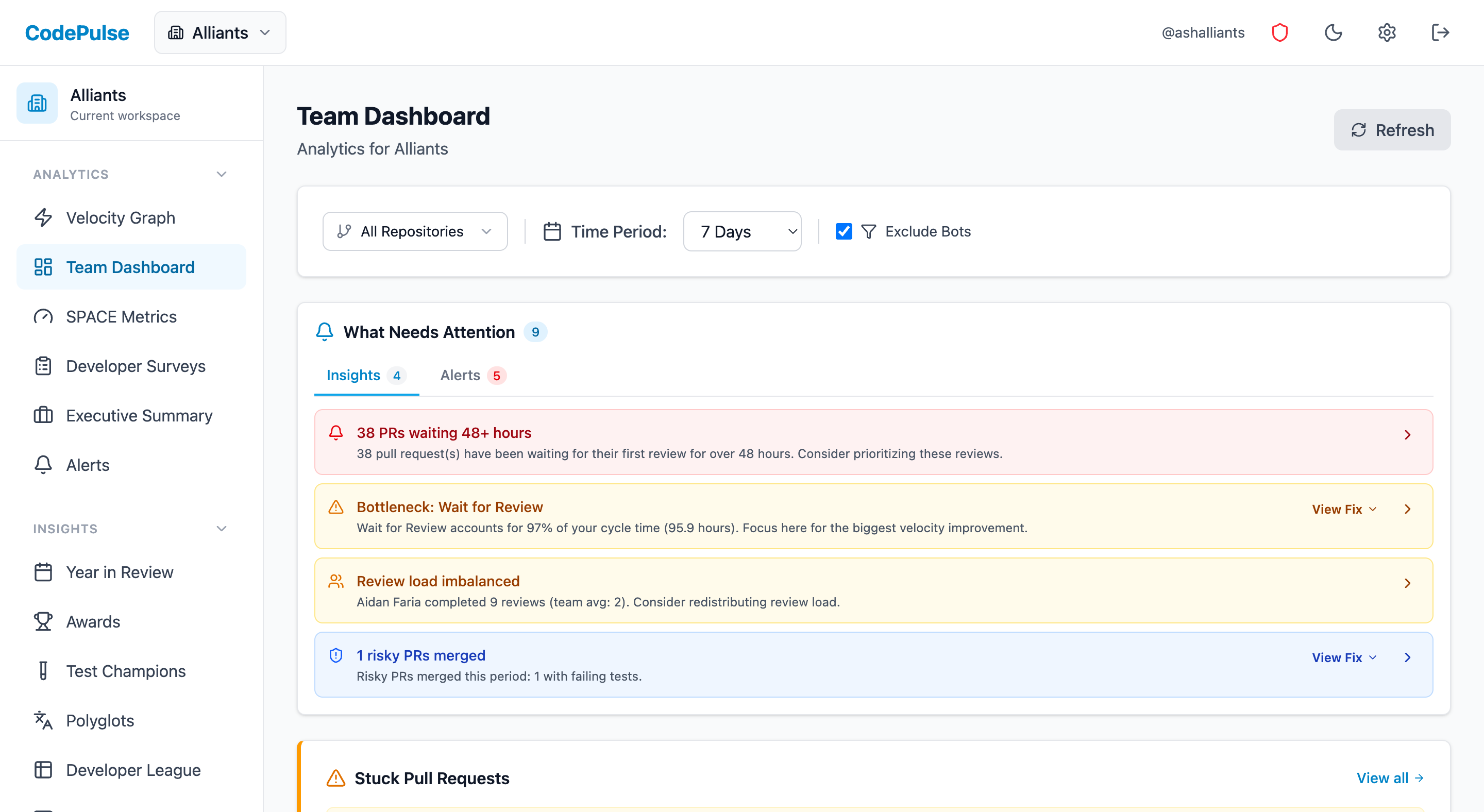
Get this view for your own teams
Connect GitHub for team-level workload, review distribution, and delivery signals. Individual views stay off unless your organisation explicitly turns them on.
Read-only GitHub · Your code stays yours · Team-level by default · No credit card
See These Features in Action
Board-ready engineering performance in a single page.
See where engineering effort goes across features, maintenance, and debt.
Related Guides
I Got $2M in Budget With These 5 Engineering Metrics
Learn how to create engineering metrics presentations that resonate with board members, investors, and C-suite executives.
VP Engineering Board Metrics: 7 Numbers That Defend Headcount
The 7 metrics VPs of Engineering need for board presentations: delivery predictability, investment allocation, and team health - with the language to present them.
Engineering QBR Template: Quarterly Business Review for Engineering
A complete engineering QBR template with the 4 pillars of quarterly reporting. Present velocity without gaming, build board credibility, and drive data-informed decisions.
Why the 70/30 Rule Is Killing Your Engineering Team
Find the right balance between shipping new features and maintaining existing code using engineering metrics and data-driven strategies.