
Turn this metric into a baseline for your team
Preview a system-level engineering health report, then connect GitHub when you are ready to compare this metric with your own delivery history.
Read-only GitHub · Your code stays yours · Team-level by default · No credit card
Most startup founders think engineering analytics is for enterprises with 200+ engineers and dedicated DevOps teams. They're wrong. The startups that wait until Series B to add visibility into their engineering organization spend years operating blind - making hiring decisions on gut feel, missing bottlenecks that slow delivery, and burning out their best engineers without knowing it.
This guide is for startup CTOs and engineering leads at Seed through Series A companies who want to make data-informed decisions without building enterprise bureaucracy. We'll cover which metrics actually matter at each stage, free and low-cost options, and when you should (and shouldn't) invest in paid analytics tools.
"The best time to add engineering visibility was six months ago. The second best time is right after your third engineer joins. Everything after that is catching up."
Why Startups Need Engineering Analytics (Earlier Than You Think)
Here's the uncomfortable truth: most early-stage startups operate on vibes. The CTO "feels" like they're shipping fast. The founding engineers "sense" when someone is struggling. Standups are used to guess at blockers rather than surface them systematically.
This works until it doesn't. And when it stops working, you've usually lost months of runway to invisible inefficiency.
The 5-Engineer Inflection Point
At 2-3 engineers, you can hold the entire system in your head. You know who's working on what, who's blocked, and who's about to burn out. At 5 engineers, this becomes impossible. You start making assumptions that turn out to be wrong:
- "We're shipping fast" - but PRs sit in review for days because everyone assumes someone else will review them
- "The team is fine" - but your senior engineer has been working weekends for six weeks and is about to quit
- "We don't have bottlenecks" - but 70% of reviews go through one person who's now a single point of failure
Early-stage engineering analytics isn't about process or bureaucracy. It's about not flying blind when the stakes are highest.
🔥 Our Take
Startups that wait until "we're bigger" to add visibility are optimizing for the wrong thing.
The argument is always "we're too small for process." But basic visibility isn't process - it's information. You wouldn't run your business without a P&L. Why run engineering without any metrics? The startups that win are the ones that know when they're fast versus when they just feel fast. That knowledge compounds: fix a bottleneck at 5 engineers, save months at 50.
The Real Cost of Operating Blind
Let's quantify what "we'll add analytics later" actually costs:
| Hidden Cost | Impact at Seed (5 eng) | Compounded at Series A (15 eng) |
|---|---|---|
| Review delays | 1-2 days lost per PR | 3-5 days, queuing effects |
| Invisible burnout | 1 engineer at risk | Turnover costs $150k+ |
| Knowledge silos | Founder dependency | 6-week new hire ramp time |
| Misallocated effort | 20% work on wrong things | 20% of $2M eng budget |
A seed-stage startup with $2M runway and 5 engineers is spending roughly $70k/month on engineering. If 20% of that effort is misdirected due to lack of visibility, that's $14k/month - $168k/year - lost to inefficiency you can't even see.
The Startup Metrics Stack: Essential vs Nice-to-Have
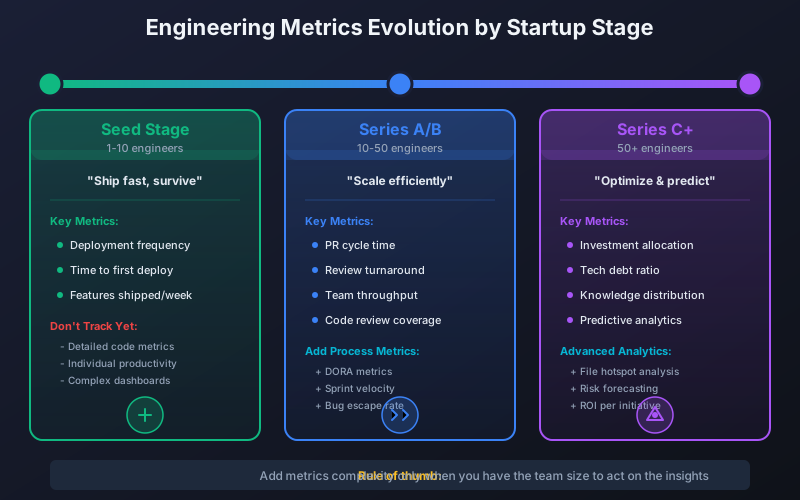
Not every metric matters at every stage. Tracking the wrong things creates noise and process overhead without value. Here's what to focus on at each funding stage.
Seed Stage (3-10 Engineers)
At seed, you're optimizing for speed and learning. Heavy process kills you. But zero visibility kills you slower and more painfully.
| Metric | Priority | Why It Matters at Seed |
|---|---|---|
| PR Cycle Time | Essential | Catches hidden delays before they compound |
| Review Distribution | Essential | Prevents founder becoming bottleneck |
| After-Hours Work | Essential | Early warning on burnout risk |
| Deployment Frequency | Nice-to-Have | Useful but often tracked informally |
| Code Churn | Skip for Now | Normal to iterate heavily at this stage |
| DORA Metrics | Skip for Now | Too heavyweight; premature optimization |
"At seed stage, your metrics should fit on one screen and take 30 seconds to check. Anything more is overhead you can't afford."
Series A (10-30 Engineers)
Series A is where informal coordination starts breaking. You've probably added your first engineering manager. Teams are forming. The founder can't review every PR anymore.
| Metric | Priority | Why It Matters at Series A |
|---|---|---|
| PR Cycle Time (with breakdown) | Essential | Need to know where delays happen |
| Team-Level Velocity | Essential | Compare team performance fairly |
| Review Load Balance | Essential | Senior engineers often overloaded |
| Onboarding Velocity | Essential | Hiring faster means ramping faster |
| Knowledge Distribution | Nice-to-Have | Silos becoming problematic |
| Investment Profile | Nice-to-Have | Track feature vs maintenance ratio |
| Individual Metrics | Avoid | Creates gaming, erodes trust |
Series B (30-75 Engineers)
At Series B, you need real systems. The metrics stack here is covered extensively in our Series B Engineering Metrics Handbook, but the key shift is from ad-hoc visibility to operational cadence.
| Metric | Priority | Why It Matters at Series B |
|---|---|---|
| DORA Metrics | Essential | Board expects industry benchmarks |
| Tiered Dashboards | Essential | Exec, Manager, Team views |
| Alert Rules | Essential | Proactive issue detection |
| Investment Profile | Essential | Board asks "where is effort going?" |
| Code Hotspots/Silos | Essential | Technical debt becomes strategic |
| Change Failure Rate | Essential | Quality at scale matters |
Free and Low-Cost Options Compared
Before reaching for a paid tool, know what you can get for free. At early stages, free options often provide 80% of the value.
GitHub Insights (Free)
GitHub provides basic metrics out of the box if you know where to look:
- Pulse: Activity summary, PR metrics, contributor activity
- Insights > Contributors: Contribution graphs per developer
- Insights > Code Frequency: Additions vs deletions over time
- PR Analytics: Time to merge, review requests
Pros: Free, no setup, already using it
Cons: No cycle time breakdown, no review load analysis, no team aggregation, limited historical data
Build Your Own (Time Cost)
Many startups try to build a basic dashboard using GitHub API + a spreadsheet or simple script. This can work for a while:
# Basic PR metrics script example
gh pr list --state merged --limit 100 --json createdAt,mergedAt \
  | jq '[.[] | {
      created: .createdAt,
      merged: .mergedAt,
      cycle_hours: (((.mergedAt | fromdateiso8601) -
                    (.createdAt | fromdateiso8601)) / 3600)
    }] | {
      avg_cycle_hours: (map(.cycle_hours) | add / length),
      total_prs: length
    }'
Pros: Free (excluding time), customizable, no vendor dependency
Cons: Takes 20-40 hours to build something basic, ongoing maintenance, no alerting, easy to abandon when busy
Comparison Table
Engineering Analytics Options for Startups
- GitHub Insights: Basic activity metrics
- Custom scripts: Flexible but time-intensive
- Spreadsheet tracking: Manual but free
- Limited cycle time breakdown
- No automated alerting
- Requires maintenance time
- Full cycle time breakdown
- Review load analysis
- Team and repo comparisons
- Automated alerts and trends
- Historical data retention
- Monthly cost (varies by tool)
When to Invest in Paid Analytics
Free options work until they don't. Here are the signals that it's time to invest in dedicated tooling.
Signals You Need Paid Analytics
Time to Invest Checklist
You're past 8-10 engineers
- GitHub Insights stops scaling at team level
- Manual tracking takes hours per week
- You can't see cross-team patterns
You've lost visibility into flow
- You don't know your actual cycle time
- Review bottlenecks emerge by surprise
- PRs get stuck and nobody notices for days
You're hiring fast
- Onboarding velocity matters and you can't measure it
- New hires create more review load than expected
- Knowledge transfer is happening (or isn't) invisibly
Leadership is asking questions
- Board wants engineering metrics in deck
- CEO asks "why are we slow?" and you can't answer
- You're making headcount decisions without data
You've had a preventable incident
- A senior engineer burned out and you didn't see it coming
- Critical code was owned by one person who left
- A bottleneck persisted for months before anyone noticed
When NOT to Invest (Yet)
Don't waste money on analytics if:
- You're pre-product-market fit: Your engineering process will change dramatically. Measure loosely, optimize later.
- You have 3-4 engineers: You can still hold everything in your head. Use that time to ship, not to build dashboards.
- Nobody will look at it: A tool you don't use is worse than no tool. Make sure someone owns the metrics practice.
- You're solving process problems with measurement: Metrics surface problems; they don't fix them. If you're not ready to act on data, don't collect it.
🔥 Our Take
The "we're too early for metrics" crowd usually regrets it by Series A.
The cost of a basic analytics tool is less than half an engineer-month. The cost of operating blind for 18 months - making bad hiring calls, missing bottlenecks, burning out your best people - is often 10x that. Startups that track early compound their learnings. Those that wait spend their Series A "discovering" problems that were there all along.
Cost-Benefit at Each Stage
| Stage | Eng Spend/Year | Tool Cost (Typical) | ROI Threshold |
|---|---|---|---|
| Seed (5 eng) | $750k-1M | $0-2k/year | Save 2 hours/week |
| Series A (15 eng) | $2-3M | $3-10k/year | Save 5 hours/week |
| Series B (40 eng) | $6-8M | $15-30k/year | Save 10 hours/week |
At Series A, a $6k/year tool needs to save 5 hours of engineering time per week to break even. Given that the average delayed PR costs 30-60 minutes in context switching alone, most teams hit ROI within the first month.
📊How to See This in CodePulse
CodePulse is designed for startups that want visibility without enterprise overhead:
- 5-minute setup: Connect GitHub and see metrics immediately
- Free tier: Full feature access for small teams
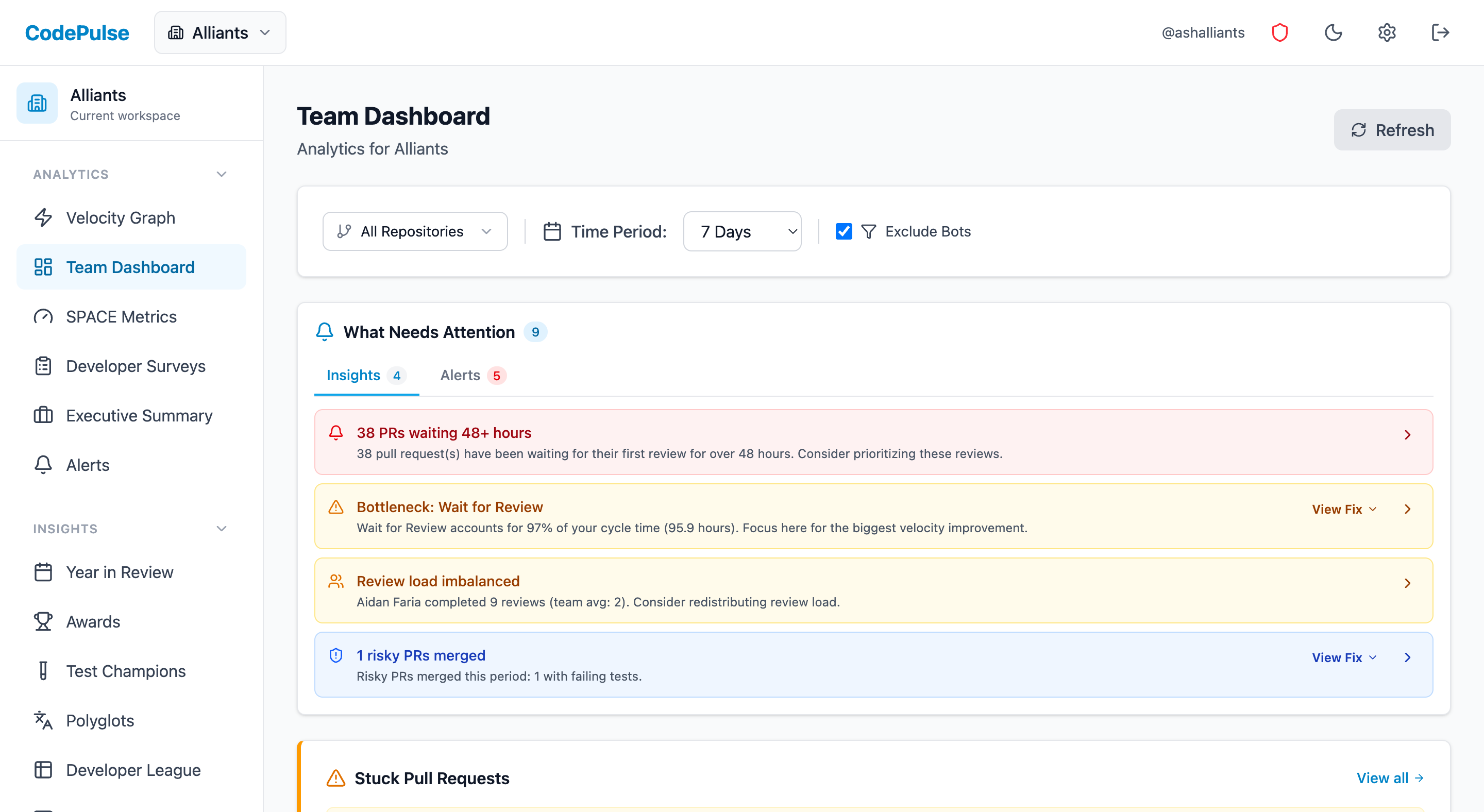
- Dashboard shows cycle time, review load, and team health at a glance
- Developer Analytics reveals after-hours patterns and review distribution
- Alert Rules notify you when cycle time spikes or reviews pile up
- No complex setup, no mandatory training, no enterprise sales process
Scaling Your Metrics as You Grow
The metrics that matter at 5 engineers are different from 50. Here's how to evolve your practice without creating bureaucracy.
Stage-by-Stage Evolution
Metrics Evolution Roadmap
Seed Stage (3-10 engineers)
- Track: Cycle time, review distribution, after-hours
- Review: Founder checks weekly (10 min)
- Action: Fix obvious bottlenecks only
- Avoid: Team comparisons, individual metrics
Early Series A (10-20 engineers)
- Add: Team-level views, onboarding velocity
- Review: Engineering lead checks weekly
- Action: Distribute review load, spot slow ramps
- Introduce: Light review cadence with new EMs
Late Series A (20-30 engineers)
- Add: Knowledge silos, investment tracking
- Review: Weekly EM sync uses dashboard
- Action: Cross-train on critical code, balance feature/maintenance
- Introduce: Quarterly metrics in board deck
Series B (30+ engineers)
- Add: Full DORA metrics, alert rules, trends
- Review: Tiered cadence (weekly/monthly/quarterly)
- Action: Systematic improvement programs
- Mature: Metrics become part of planning process
Avoiding Metrics Debt
The biggest risk as you scale is accumulating "metrics debt" - tracking things nobody looks at, building dashboards that go stale, creating process around measurement that doesn't improve outcomes.
Rules to avoid metrics debt:
- One owner per metric: If nobody owns it, delete it
- Action or delete: If a metric hasn't driven a decision in 90 days, stop tracking it
- Dashboards decay: Review your dashboard quarterly; remove unused views
- Team-level by default: Individual metrics only for 1:1 coaching, never for evaluation
"The best metrics practice is the one your team actually uses. A simple dashboard checked weekly beats an enterprise system nobody opens."
Frequently Asked Questions
No. The founder or tech lead should own basic visibility from day one. An EM inheriting an organization with existing metrics practices has a much easier job than one building from scratch while also managing people.
Getting Started Today
Don't overthink it. Here's how to add basic visibility in the next hour:
- Check GitHub Insights: Look at your Pulse and Contributors views. Note your recent PR velocity and who's contributing.
- Identify your biggest blind spot: Is it cycle time? Review distribution? After-hours work? Pick one.
- Set up one metric: Use a script, a free tool, or just a weekly manual check. Consistency beats sophistication.
- Schedule a 15-minute weekly review: Put it on your calendar. Look at the one metric. Act on anything alarming.
That's it. You now have more engineering visibility than 80% of seed-stage startups. Build from there as you grow.
For more detailed guidance as you scale, see our Series B Engineering Metrics Handbook, Engineering Metrics Dashboard Guide, and Engineering Analytics ROI Guide.
Now measure this metric on your own repositories
Connect read-only GitHub in about five minutes and get your baseline, your trend, and the constraint behind it. Your fourteen usable trial days start when the first repository finishes syncing.
Read-only GitHub · Your code stays yours · Team-level by default · No credit card
See These Features in Action
Board-ready engineering performance in a single page.
Break down cycle time into coding, waiting, review, and merge phases.
Related Guides
The 50-Engineer Cliff: Why Everything Breaks After Series B
The definitive guide to engineering metrics for the Series B transition. Learn why Hero Mode breaks at 50 engineers, how to build a tiered metrics stack, what boards actually want to see, and when to hire vs. optimize.
Engineering Metrics Dashboard: The 7 Metrics You Need
Skip vanity metrics. Here are the 7 engineering metrics VPs actually need to track team performance, delivery, and quality.
Engineering Analytics ROI: The Budget Approval Playbook
Calculate the ROI of engineering analytics tools with formulas for time savings, payback period, and a business case template tailored to CFOs, CTOs, and CEOs.
Engineering Strategy Execution Tracking: From Vision to Delivery
Track engineering strategy execution with measurable outcomes. Map strategy to leading indicators, build an investment-to-outcome pipeline, and prove initiative impact.