
Turn this metric into a baseline for your team
Preview a system-level engineering health report, then connect GitHub when you are ready to compare this metric with your own delivery history.
Read-only GitHub · Your code stays yours · Team-level by default · No credit card
Every engineering organization has a strategy. Few can tell you if it's working. You've set ambitious goals: shift 30% of capacity toward new product development, reduce technical debt by Q3, or become "AI-first" by year-end. But six months later, you're in a board meeting explaining why progress feels slow, armed with nothing but gut feelings and optimistic Jira reports. Strategy without execution tracking is hallucination - a comfortable story you tell yourself while reality drifts in a different direction.
"If you can't measure where your engineering effort actually goes, your strategy is just a wish list with a PowerPoint deck."
This guide shows you how to bridge the gap between strategic intent and operational reality. You'll learn to map high-level objectives to measurable engineering outcomes, distinguish leading from lagging indicators, and build a system that tells you - before it's too late - whether your strategy is on track or drifting into expensive failure.
Strategy Without Execution is Hallucination
Let's be brutally honest about what happens in most engineering organizations. Leadership sets a strategic direction: "We need to move faster." "We need to pay down technical debt." "We need to invest in platform capabilities." Then everyone goes back to their desks and continues doing exactly what they were doing before.
Six months later, someone asks "How's that platform initiative going?" and the answer is a vague "We've made good progress" supported by nothing but a few completed tickets and a general sense that something must have happened.
This isn't because people are lazy or incompetent. It's because strategy execution fails at the translation layer:
- Strategy is expressed in business language: "Increase innovation velocity," "Reduce time-to-market," "Build scalable infrastructure."
- Work is executed in engineering language: PRs, commits, sprints, tickets, deployments.
- The gap between them is where strategy dies: Nobody has built the bridge that connects "become AI-first" to actual patterns in Git and Jira.
🔥 Our Take
Your strategy isn't real until it shows up in your investment allocation.
Every engineering hour is a capital allocation decision. If your stated strategy is "accelerate innovation" but 60% of your PRs are maintenance and bug fixes, then your actual strategy is "keep the lights on." The numbers don't lie. The numbers don't care what your slides say. The only strategy that matters is the one reflected in where engineers actually spend their time - and that's measurable.
The Strategy Execution Gap
Consider a real scenario: A VP of Engineering announces the strategic priority for the year is "Platform Modernization." The goal is to reduce dependencies on legacy systems and enable teams to ship independently. Everyone nods. OKRs are written. Roadmaps are drawn.
Six months later, a rigorous analysis reveals:
- 75% of engineering effort still went to feature work on the legacy monolith
- The "platform team" spent most of their time on production support
- Only 8% of total engineering investment actually touched modernization work
- The strategic initiative was, functionally, abandoned after Q1
This isn't unusual. It's typical. Without execution tracking, strategy doesn't get executed - it gets talked about until something more urgent comes along.
Mapping Strategy to Measurable Outcomes
Effective strategy execution tracking starts with translation. You need to convert strategic objectives into operational metrics that can be measured from actual work.
The Strategy Translation Framework
For each strategic objective, define these four elements:
| Element | Definition | Example |
|---|---|---|
| Strategic Intent | The high-level business goal | "Increase engineering velocity" |
| Investment Category | How work maps to the strategy | Feature work, Tech debt, Platform, KTLO |
| Leading Indicators | Early signals of progress | % of PRs in target category |
| Lagging Indicators | Outcome confirmation | Cycle time reduction, Feature throughput |
Translating Common Strategic Objectives
Here's how to translate typical engineering strategies into measurable execution:
| Strategy | What to Measure | Success Looks Like |
|---|---|---|
| "Ship features faster" | Cycle time, Feature PR %, Deployment frequency | Cycle time down 30%, Feature allocation up |
| "Reduce technical debt" | Tech debt PR %, Code churn, Hotspot trends | 15%+ of effort in debt work, Churn decreasing |
| "Build platform capabilities" | Infrastructure PR %, Shared service PRs | Increasing platform investment quarter-over-quarter |
| "Improve quality" | Review coverage, Bug fix %, PR readiness | Bug fixes trending down, Review coverage up |
| "Increase innovation" | Feature PR %, New capability launches | 60%+ of effort in feature/innovation work |
"If your 'innovation strategy' doesn't show up in your work classification data, you don't have an innovation strategy. You have innovation aspirations."
The Investment-to-Outcome Pipeline
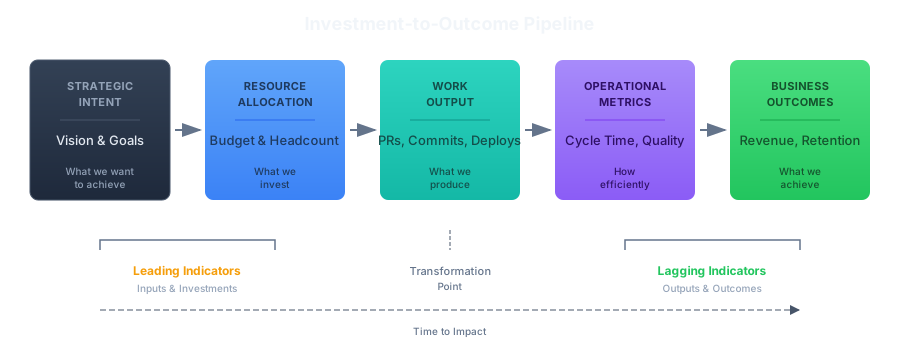
Strategy execution isn't a single measurement - it's a pipeline that flows from investment decisions through operational metrics to business outcomes. Understanding this pipeline is critical for both tracking and improving execution.
The Five Stages
THE INVESTMENT-TO-OUTCOME PIPELINE

Stage 1: STRATEGIC INTENT
         ↓
         What leadership says matters
         "Accelerate time-to-market for new features"

Stage 2: INVESTMENT ALLOCATION
         ↓
         Where engineering hours actually go
         60% Feature | 20% KTLO | 15% Tech Debt | 5% Platform

Stage 3: OPERATIONAL METRICS
         ↓
         How work flows through the system
         Cycle time, Throughput, Quality signals

Stage 4: EXECUTION OUTCOMES
         ↓
         What the investment produced
         Features shipped, Capabilities delivered

Stage 5: BUSINESS IMPACT
         What changed for the business
         Revenue, Market position, Customer satisfaction
Most organizations only measure Stage 5 (business impact) and try to infer everything else. But by the time you see business impact, you're 6-12 months behind the decisions that caused it. Effective execution tracking requires visibility at every stage.
Where Strategy Dies in the Pipeline
Strategy execution fails at predictable points:
- Stage 1 → Stage 2: Strategic intent never translates to investment allocation. "Innovation" is announced but KTLO absorbs all capacity.
- Stage 2 → Stage 3: Investment is allocated but operational friction prevents throughput. Engineers are assigned to platform work but spend 70% of their time in meetings and support.
- Stage 3 → Stage 4: Work flows but doesn't produce outcomes. PRs are merged but features don't ship because of integration failures or dependencies.
- Stage 4 → Stage 5: Outcomes are delivered but don't create business impact. The feature shipped but customers didn't use it.
Each failure point requires different interventions. You can't fix a Stage 2 problem (allocation) with Stage 3 tools (process optimization).
Leading vs Lagging Indicators for Strategy
The difference between effective and ineffective strategy tracking comes down to one thing: leading indicators. Lagging indicators tell you what happened. Leading indicators tell you what's about to happen - in time to do something about it.
The Leading Indicator Advantage
| Leading Indicators | Lagging Indicators |
|---|---|
| Investment allocation % shifting toward strategy | Strategic initiative completed |
| PRs in target category trending up | Quarterly objectives met/missed |
| Cycle time in strategic areas improving | Time-to-market for features |
| Active contributors on strategic work increasing | Headcount utilization reports |
| Code churn in targeted areas decreasing | Technical debt quantified |
| Review bottlenecks clearing in priority areas | Feature release announcements |
Building Your Leading Indicator Dashboard
For each strategic initiative, identify 2-3 leading indicators that will signal progress (or problems) weeks before outcomes materialize:
STRATEGY: "Shift 30% of capacity to platform work"

LEADING INDICATORS (check weekly):
  ✓ Platform-tagged PRs as % of total PRs
  ✓ Active contributors on platform repos
  ✓ Platform team cycle time (is work flowing?)
  ✓ Cross-team dependency PRs declining

LAGGING INDICATORS (check quarterly):
  ○ Total platform capabilities delivered
  ○ Team autonomy improvements (measured by surveys)
  ○ Deployment independence metrics

EARLY WARNING SIGNALS:
  ⚠ Platform PR % drops below 25% for 2+ weeks
  ⚠ Platform team cycle time increasing
  ⚠ Key platform contributors pulled to other work
"By the time a lagging indicator shows your strategy failed, you've wasted a quarter. Leading indicators give you weeks to course-correct."
The Execution Scorecard
Combine leading and lagging indicators into an execution scorecard that gives you a complete picture of strategy health:
| Strategic Initiative | Investment % (Target) | Investment % (Actual) | Trend | Status |
|---|---|---|---|---|
| Platform Modernization | 30% | 22% | ↑ +3% from last month | At Risk |
| Feature Velocity | 50% | 48% | ↔ Stable | On Track |
| Tech Debt Reduction | 15% | 8% | ↓ -4% from last month | Off Track |
Tracking Strategy Execution in CodePulse
Work classification and investment tracking transform strategy from aspiration to accountability. Here's how to use CodePulse to track whether your engineering strategy is actually being executed.
📊How to See This in CodePulse
CodePulse provides the tools you need for strategy execution tracking:
- Investment Allocation: Investment Profile shows exactly where engineering effort goes across Feature, Maintenance, Tech Debt, Bug Fix, Infrastructure, and Support categories
- Trend Forecasting: Forecasting projects where your metrics are heading based on current trends - see if your strategy is on track before outcomes materialize
- Historical Trends: The dashboard shows investment allocation over time, letting you see if strategic shifts are actually happening
- Repository Filtering: Filter investment data by repository to see if strategic initiatives are getting proper attention
Setting Up Strategy Tracking
Follow this process to connect your strategy to measurable execution:
- Define your strategic initiatives: What are the 3-5 things that matter most this quarter or year?
- Map initiatives to work categories: Which of CodePulse's work classifications (Feature, Maintenance, Tech Debt, Bug Fix, Infrastructure, Support) align with each initiative?
- Set investment targets: What percentage of effort should go to each strategic priority?
- Monitor weekly: Check the Investment Profile weekly to see if allocation matches targets.
- Use forecasting for early warning: The Forecasting page shows where trends are heading - catch drift before it becomes a missed OKR.
Work Classification as Strategy Signal
CodePulse's work classification system (feature, maintenance, tech_debt, bug_fix, infrastructure, support) maps directly to strategic intent:
| Work Category | Strategic Signal | Watch For |
|---|---|---|
| Feature | Innovation and growth investment | Should trend up if "innovation" is strategic |
| Maintenance | Operational overhead / KTLO | Should be stable or declining; spikes indicate problems |
| Tech Debt | Investment in future productivity | Should be 10-20% if "debt reduction" is strategic |
| Bug Fix | Quality issues demanding attention | High % indicates quality strategy is failing |
| Infrastructure | Platform and scalability investment | Should trend up if "platform" is strategic |
| Support | Customer-driven reactive work | High % means engineering is in reactive mode |
Frequently Asked Questions
Weekly for leading indicators, monthly for trend analysis, quarterly for strategic recalibration. The key is catching drift early - a 5% allocation slip in week 2 is easy to fix; a 20% miss discovered in month 3 is a failed quarter.
🔥 Our Take
Strategy execution tracking isn't about control - it's about honesty.
The organizations that execute strategy best aren't the ones with the most sophisticated tracking systems. They're the ones with the courage to look at the data honestly and course-correct when reality diverges from intent. Every engineering leader can articulate a strategy. Few can show you - with data - that it's actually being executed. Be one of the few.
Your Strategy Execution Action Plan
This Week
- Document your strategic priorities: What are the 3-5 things engineering must accomplish this quarter or year?
- Map to investment categories: Which work categories (feature, tech debt, infrastructure, etc.) align with each priority?
- Check your current allocation: Use CodePulse's Investment Profile to see where effort actually goes today.
This Month
- Set allocation targets: What percentage of effort should go to each strategic priority?
- Identify leading indicators: What signals will show progress or problems before outcomes materialize?
- Establish weekly review: Add strategy execution metrics to your weekly leadership review.
This Quarter
- Build the execution scorecard: Track investment allocation vs targets for each strategic initiative.
- Use forecasting for early warning: Identify strategies at risk before they fail.
- Report to leadership: Present strategy execution data alongside business outcomes.
For more on connecting engineering metrics to strategic outcomes, see our guides on KTLO vs Innovation Investment Profile, Engineering Metrics Dashboard Guide, and Stop Estimating, Start Forecasting.
Now measure this metric on your own repositories
Connect read-only GitHub in about five minutes and get your baseline, your trend, and the constraint behind it. Your fourteen usable trial days start when the first repository finishes syncing.
Read-only GitHub · Your code stays yours · Team-level by default · No credit card
See These Features in Action
Board-ready engineering performance in a single page.
See where engineering effort goes across features, maintenance, and debt.
Related Guides
The Slide That Changed How Our Board Sees Engineering
Stop talking about "maintenance" and start talking about "investment." How to measure and present your engineering investment profile to the board.
Engineering Metrics Dashboard: The 7 Metrics You Need
Skip vanity metrics. Here are the 7 engineering metrics VPs actually need to track team performance, delivery, and quality.
Story Points Are a Scam. Here's What Actually Works
Story points are often waste. Learn how to use historical throughput and cycle time to forecast delivery dates with higher accuracy and less meeting time.
McKinsey Developer Productivity Metrics: How to Respond
McKinsey's 2023 article on measuring developer productivity sparked industry backlash. Here's what they got right, what they got wrong, and a better approach for VPs facing pressure to implement their recommendations.