

Compare the finished analysis before you choose a platform
See the report CodePulse produces from read-only GitHub workflow data, or connect your own repositories and evaluate the fit with real evidence.
Read-only GitHub · Your code stays yours · Team-level by default · No credit card
People search "Datadog DORA metrics pricing" and find nothing - because there is nothing to find. Datadog does not sell DORA metrics. It sells the plumbing that feeds them, and the plumbing is where your budget goes. Here is exactly what the feature does, what it actually costs to light up, and where it stops being an engineering analytics answer.
What does Datadog DORA Metrics cost?
DORA Metrics is a free feature of Datadog's Software Delivery suite - "free to use if you're already a Datadog customer" per Datadog's own blog. The real cost is the feeder products: APM at $31-40/host/month for deployment tracking, Incident Management or Incident Response at $30-40/seat/month for failure data, and CI Pipeline Visibility at $8/committer/month. A 50-engineer team building the stack from scratch lands around $30,000-50,000 a year; GitHub-native alternatives like CodePulse automate the same four metrics for $2,388 a year flat.
What Is Datadog DORA Metrics?
DORA Metrics sits inside Datadog's Software Delivery suite (under Delivery Performance, next to Deployment Visibility). It tracks the four industry-standard delivery metrics, in Datadog's naming: deployment frequency, change lead time, change failure rate, and failed deployment recovery time. Note the last one - Datadog measures recovery from failed deployments specifically, not general MTTR, per its own documentation.
Deployment data arrives from one of three sources: APM Deployment Tracking (the flagship path - requires instrumented services with unified service tagging), a DORA Metrics API you post events to, or the datadog-ci CLI called from CI pipelines. Failure data comes from Datadog Incident Management, PagerDuty, or custom API events. Change lead time breaks into five stages - time to PR ready, review time, merge time, time to deploy, deploy time - when repository metadata comes from GitHub, GitLab, or Azure DevOps. The feature shipped at DASH in June 2024 and, as of DASH 2026, has seen no major additions since the Internal Developer Portal picked up a DORA summary report in 2025.
What Does Datadog DORA Metrics Cost?
The pricing question has an unusual answer: there is no SKU. DORA Metrics appears nowhere on Datadog's pricing list and nowhere in its billing documentation. Datadog's May 2025 blog states it plainly: "DORA Metrics is free to use if you're already a Datadog customer."
The operative words are already a Datadog customer. The feature is a reporting layer over paid telemetry. What the feeder products cost, per Datadog's published price list (July 2026, annual billing):
| Feeder product | What it feeds | Published price |
|---|---|---|
| APM / APM Pro / APM Enterprise | Deployment tracking (the automatic path) | $31 / $35 / $40 per host/month |
| Infrastructure (prerequisite for APM) | Host monitoring baseline | $15-23 per host/month |
| Incident Management / Incident Response | Change failure rate + recovery time | $30 / $40 per seat/month |
| CI Pipeline Visibility (optional) | Pipeline-based deployment events | $8 per active committer/month |
| DORA Metrics API / datadog-ci CLI | Self-pushed deployment events | $0 - but manual instrumentation |
Model that for a 50-engineer team building the stack from scratch: APM on 50 production hosts runs about $1,550 a month, the infrastructure baseline adds $750-1,150, and Incident Response for 20 on-call responders adds $800. That is roughly $3,100-3,500 a month - $37,000-42,000 a year - to feed a free feature. The API/CLI path costs nothing but reduces the product to a dashboard you instrument yourself.
Datadog's DORA metrics are free the way an airport lounge is free: the entry ticket is the expensive part, and it renews annually.
One more number belongs in any Datadog cost conversation: the $65 million annual bill disclosed on Datadog's own Q1 2023 earnings call and later attributed to Coinbase by The Pragmatic Engineer. Nobody reading this will spend that. But usage-based observability billing is famously hard to predict, and bolting your engineering metrics to it inherits that property.
What Does Setup Actually Require?
The product page pitches DORA "without custom instrumentation" - true only if your services already meet the prerequisites. The automatic path requires APM instrumentation on every service you want counted, unified service tagging with a version tag, entries in the Service Catalog, and traces tagged with repository URL and commit SHA. Change failure rate needs an incident signal: Datadog Incidents (recovery time is the duration an incident spends active), PagerDuty via webhook, or custom API events - or rollback detection from version metadata.
- Lead-time stage breakdown: GitHub, GitLab, or Azure DevOps PR and commit metadata
- No lead time for first deployments or deployments more than 60 days apart
- Maximum 5,000 commits per deployment; same-second deployments of one service collide
- Not available on Datadog government sites
None of this is unreasonable for an observability platform - but it means "free" arrives after a per-service configuration project, and the metrics only cover services you have wired up.
Where Does It Stop Being Engineering Analytics?
Datadog's data model for this feature contains deployment, pull request, commit, and incident events - and the PR data is the boundary worth understanding. PRs appear as components of a deployment's lead time, with author, reviewers, and durations. What the product does not attempt: review-network analysis, reviewer load balance, cycle-time analytics for unmerged or undeployed work, file hotspots, knowledge silos, investment allocation, or developer surveys. It measures the pipeline, not the organization.
🔥 Our Take
DORA metrics are signals, not a product. Datadog treating them as a free reporting layer is honest - more honest than vendors selling four numbers as a platform. The trap is buying the plumbing for the signal.
If you run Datadog APM and Incident Response today, turn the feature on this afternoon; it costs nothing and lives where your on-call team already looks. If you are not a Datadog shop, do the arithmetic before anyone says "it's free" in a meeting: the prerequisite SKUs cost more per year than every dedicated engineering analytics platform on the market.
Who Is Datadog DORA Metrics Right For?
The honest segmentation: teams already paying for Datadog APM with disciplined service tagging, plus Datadog Incident Response, get real value for zero marginal cost - especially platform and SRE teams whose world is deployments and incidents. Notably, Datadog publishes no customer case studies for DORA Metrics as of July 2026, and the feature has seen little public iteration since 2024 - reasonable signals of how central it is to their roadmap.
Engineering leaders who need delivery answers beyond the pipeline - why cycle time is rising, who carries the review load, where knowledge concentrates - need the Git and PR record, which is a different product category. That is where dedicated DORA and engineering analytics tools live.
📊 How CodePulse Handles DORA
CodePulse computes all four DORA metrics from your GitHub PR and deployment events - no agent, no per-service instrumentation, no incident-product dependency:
- Connect your work GitHub org; Dashboard shows DORA plus the four-phase cycle time breakdown the same afternoon
- Real deployment data where available, PR-based heuristics as fallback
- Elite/High/Medium/Low benchmarking against industry data
- $199/month flat to 50 developers - published, no per-host arithmetic
Related reading: our complete DORA metrics guide, the 8-tool DORA comparison, and DORA metrics tools compared.
Frequently Asked Questions
DORA Metrics itself has no price - Datadog's own blog says it is "free to use if you're already a Datadog customer", and it appears nowhere on the pricing list or billing docs. The cost is the products that feed it data: APM for deployment tracking ($31-40 per host per month annual), Incident Management or Incident Response for failure data ($30-40 per seat per month), and optionally CI Pipeline Visibility ($8 per active committer per month). A team already deep in Datadog pays roughly nothing extra; a team buying Datadog to get DORA realistically stacks $30,000-50,000 a year of prerequisite products.
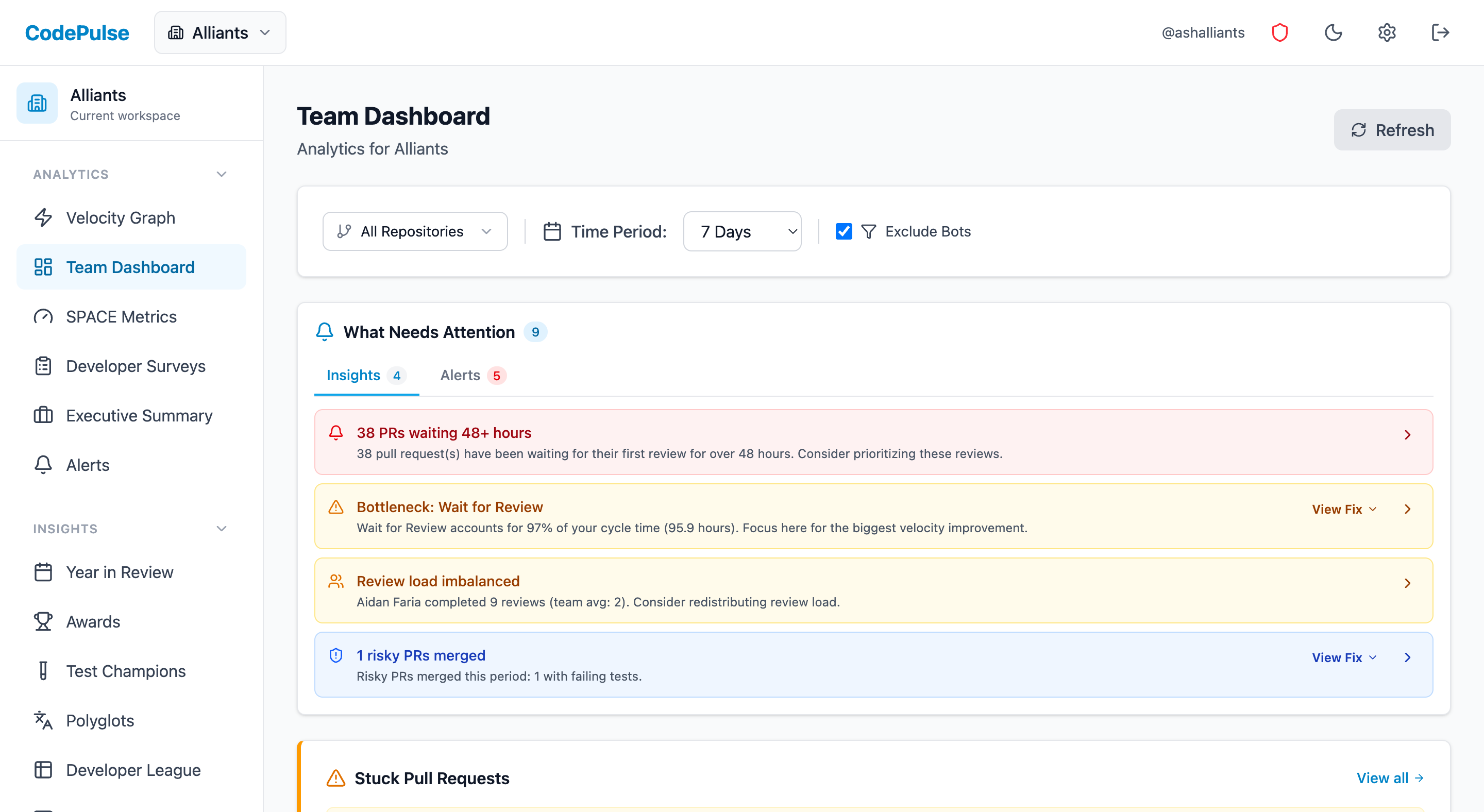
Evaluate CodePulse against your own delivery history
A comparison table only goes so far. Connect read-only GitHub in about five minutes and judge the output on your repositories, at one flat price, with no per-seat math.
Read-only GitHub · Your code stays yours · Team-level by default · No credit card
See These Features in Action
Explore all featuresRelated Guides
Best DORA Metrics Tools for 2026: 8 Platforms Compared
An opinionated comparison of the 8 best tools for automated DORA metrics reporting, ranked by automation depth, setup speed, metric accuracy, pricing transparency, and real-world usefulness for engineering leaders.
DORA Metrics Explained: The 4 Keys Without the Hype
A complete breakdown of the four DORA metrics - deployment frequency, lead time, change failure rate, and MTTR - with honest benchmarks and gaming traps to avoid.
11 DORA Metrics Tools Ranked for 2026 (+ Pricing)
Compare the top DORA metrics tools including commercial platforms, open-source options, and native DevOps integrations. Find the right tool for your team size and needs.