
Compare the finished analysis before you choose a platform
See the report CodePulse produces from read-only GitHub workflow data, or connect your own repositories and evaluate the fit with real evidence.
Read-only GitHub · Your code stays yours · Team-level by default · No credit card
Choosing the right tool to track DORA metrics can be overwhelming. From open-source solutions to enterprise platforms, there are dozens of options. This guide compares the leading DORA metrics tools so you can make an informed decision.
The four DORA metrics - deployment frequency, lead time for changes, change failure rate, and mean time to recovery - have become the industry standard for measuring software delivery performance. Use our DORA metrics calculator for a quick assessment, or read on to choose the right tooling for ongoing measurement.
One update before you compare: DORA now publishes five metrics, adding deployment rework rate (the ratio of deployments that are unplanned and happen because of a production incident) and renaming mean time to recovery to failed deployment recovery time. When a tool below says it covers "all four DORA metrics", that means the original four, so ask each vendor whether it reports rework rate too.
What are the best tools for tracking DORA metrics?
For GitHub-centric teams wanting fast setup, CodePulse provides all four DORA metrics in 5 minutes with a free tier. For teams needing workflow automation alongside metrics, LinearB adds gitStream for automated routing. For enterprise organizations needing executive reporting and business alignment, Jellyfish is the top choice. For self-hosted requirements, Apache DevLake is the leading open-source option.
DORA Metrics Tool Categories
Tools for DORA metrics fall into several categories:
| Category | Pros | Cons |
|---|---|---|
| Engineering Analytics Platforms | Purpose-built, full-featured, low setup effort | Subscription cost, potential vendor lock-in |
| DevOps Platform Native | Built-in, no additional cost, direct data access | Limited to one platform, often premium tier |
| Open Source | Free, customizable, no vendor dependency | Requires maintenance, setup complexity |
| Build Your Own | Complete control, exact requirements | Engineering time, ongoing maintenance |
Engineering Analytics Platforms
These purpose-built platforms specialize in engineering metrics including DORA. If you want a shorter, opinionated shortlist rather than the full comparison below, our best DORA metrics tools roundup highlights the handful that consistently deliver on the promise for different team sizes.
CodePulse
Best for: Small to mid-size GitHub-centric teams wanting all four DORA metrics with 5-minute setup.
Pros:
- All four DORA metrics with automated calculation from Git data
- 5-minute setup to first insights with GitHub OAuth
- Deep code health signals: review network visualization, file hotspots, knowledge silos
- Generous free tier (50 developers) with transparent pricing
Cons:
- GitHub-only (no GitLab or Bitbucket support currently)
- Jira integration not as deep as LinearB or Jellyfish
Starting price: Free for up to 50 developers; Pro from $199/month (annual billing).
CodePulse provides DORA metrics alongside deeper engineering insights like review patterns and code ownership analysis. It's designed for teams that want actionable insights, not just dashboards.
LinearB
Best for: Mid-to-large teams wanting workflow automation alongside DORA metrics and Jira integration.
Pros:
- All four DORA metrics with cross-industry benchmarking
- gitStream workflow engine for automated code review routing
- Broad integration support: GitHub, GitLab, Bitbucket, Jira, Slack
- WorkerB automations reduce manual process overhead
Cons:
- Pricing can be high for smaller teams on paid tiers
- Setup complexity due to many configuration options
- Gamification focus may not suit all team cultures
Starting price: Free tier available; paid plans from ~$20/developer/month.
Jellyfish
Best for: Enterprise engineering organizations (200+ engineers) needing executive reporting and business alignment.
Pros:
- All four DORA metrics with strategic alignment views
- Business context correlation ties engineering work to business outcomes
- Investment allocation analysis for board-level reporting
- Broad integrations: Git, Jira, roadmapping, incident, and calendar tools
Cons:
- Enterprise pricing not accessible for small or mid-size teams
- Complex onboarding process that can take weeks
- Overkill for teams not doing strategic portfolio management
Starting price: Enterprise contracts, typically $100,000+/year.
If that price or the weeks-long onboarding rules Jellyfish out, our Jellyfish alternatives guide ranks the lighter-weight options that still cover DORA.
Swarmia
Best for: Teams focused on developer experience alongside DORA and SPACE framework metrics.
Pros:
- All four DORA metrics plus SPACE framework coverage
- Working agreements let teams define and enforce their own standards
- Investment balance tracking (features vs. maintenance vs. bugs)
- Good integrations: GitHub, GitLab, Jira, Linear, Slack
Cons:
- Pricing requires sales conversation for larger teams
- Less depth on code quality signals (hotspots, silos) compared to specialized tools
- Limited executive reporting compared to Jellyfish
Starting price: ~$15-25/developer/month, per-seat pricing.
Faros AI
Best for: Large enterprises needing custom metrics, extensibility, and a data warehouse approach.
Pros:
- Standard DORA metrics plus a custom metric builder
- 200+ data source connectors for broad coverage
- Data warehouse approach enables fully custom dashboards
- Used by Box, Coursera, GoFundMe, and Salesforce
Cons:
- Requires significant engineering investment to customize
- Enterprise pricing, not transparent
- Overkill for teams that just need standard DORA tracking
Starting price: Enterprise contracts; contact sales for pricing.
DevOps Platform Native Tools
If your organization is standardized on one DevOps platform, native tools may be the simplest option:
GitLab (Value Streams Dashboard)
Best for: Teams fully committed to the GitLab ecosystem wanting native DORA tracking with zero additional tooling.
Pros:
- All four DORA metrics built-in, no third-party setup
- Data flows directly from the same platform you develop on
- Value stream analytics provides end-to-end visibility
Cons:
- Requires GitLab Ultimate tier subscription
- Assumes GitLab-only workflow with no external integrations
- Limited customization compared to dedicated analytics platforms
Starting price: GitLab Ultimate at $99/user/month (DORA requires this tier).
GitHub (Insights)
Best for: Teams wanting basic repository-level insights without leaving the GitHub UI.
Pros:
- Built into the platform you already use
- Contributor activity and code frequency graphs included
- No additional vendor or security review needed
Cons:
- No native DORA dashboard; requires third-party actions or tools for full coverage
- Some features require GitHub Enterprise subscription
- Lacks cross-repo aggregation and team-level views
Starting price: Included with GitHub; Enterprise features from $21/user/month.
Datadog (DORA Metrics)
Best for: Teams already using Datadog for observability who want DORA metrics correlated with infrastructure data.
Pros:
- All four DORA metrics with fully customizable dashboards
- Correlate delivery metrics with infrastructure and APM data
- Builds on your existing Datadog investment and expertise
Cons:
- Requires CI/CD pipeline integration setup (not plug-and-play)
- DORA is an add-on to an already expensive observability platform
- Less focus on engineering-specific insights (review patterns, code health)
Starting price: DORA Metrics included in DevSecOps plans; Datadog pricing starts at $23/host/month.
Jira (with Plugins)
Best for: Teams heavily invested in Jira who want to add DORA tracking without adopting a new platform.
Pros:
- Keeps metrics within the existing Jira workflow teams already use daily
- Multiple plugin options (Velocity, Jira Align, third-party add-ons)
- Familiar interface reduces adoption friction
Cons:
- Partial DORA coverage; requires multiple plugins for full four-metric tracking
- Plugin costs add up and create maintenance overhead
- Complex setup and configuration across plugins
Starting price: Jira Premium from $17.65/user/month; plugins add $2-10/user/month each.
Open Source Options
Apache DevLake
Best for: Organizations with DevOps resources that need a self-hosted, open-source DORA metrics solution.
Pros:
- All four DORA metrics with pre-built Grafana dashboards
- Self-hosted: full data control and no vendor dependency
- Broad integrations: GitHub, GitLab, Jira, Jenkins, and more
- Completely free and open source (Apache 2.0 license)
Cons:
- Requires self-hosted infrastructure and ongoing maintenance
- Setup complexity is significantly higher than commercial tools
- Community support only; no dedicated customer success team
Starting price: Free (open source); infrastructure costs vary by hosting environment.
Grafana + Prometheus
Best for: Teams already using Grafana for observability who want to build DORA dashboards in a familiar environment.
Pros:
- Maximum flexibility: build exactly the dashboards you need
- Builds on existing Grafana and Prometheus infrastructure
- Free and open source with a large community
Cons:
- Significant engineering effort to set up DORA-specific dashboards
- Requires CI/CD instrumentation to emit metrics
- No pre-built DORA views; everything is custom
Starting price: Free (open source); Grafana Cloud from $29/month for managed hosting.
💡 Build vs. Buy Considerations
Building your own DORA metrics dashboard seems attractive - you get exactly what you want. But consider: a dedicated platform costs ~$5-20 per developer per month. Building and maintaining your own takes engineering time worth far more. Unless you have unique requirements, buying usually wins. If you do build, start from what a DevOps dashboard should actually show.
Feature Comparison Matrix
| Feature | CodePulse | LinearB | Jellyfish | DevLake |
|---|---|---|---|---|
| All 4 DORA Metrics | Yes | Yes | Yes | Yes |
| Cycle Time Breakdown | Yes | Yes | Yes | Partial |
| Review Analytics | Yes | Yes | Yes | Limited |
| Knowledge Silos | Yes | No | No | No |
| Setup Time | 5 min | 15 min | Days | Hours+ |
| Self-Hosted Option | No | No | No | Yes |
| Free Tier | Yes | Yes | No | Yes (OSS) |
How to Choose the Right Tool
Choose CodePulse If:
- You want fast setup with immediate value
- You need insights beyond just DORA (review patterns, code ownership)
- You're a small to mid-size team
- You use GitHub as your primary Git platform
Choose LinearB If:
- You want workflow automation alongside metrics
- You need broad integration support (GitLab, Bitbucket)
- You want gitStream for automated code review routing
Choose Jellyfish If:
- You're an enterprise with 200+ engineers
- You need executive-level reporting and business alignment
- Budget isn't a primary constraint
Choose Apache DevLake If:
- You have DevOps resources for setup and maintenance
- You need self-hosted/on-premise deployment
- You want maximum customization
- Cost is the primary driver
Choose GitLab/Datadog Native If:
- You're already standardized on that platform
- You want everything in one place
- You have the required subscription tier
DORA Implementation Tips
Start Simple
Don't try to measure everything at once. Start with deployment frequency and lead time - they're easiest to measure and immediately actionable.
Define Your Metrics Clearly
What counts as a "deployment"? A PR merge? A production release? A feature flag enable? Define this before choosing a tool, and make sure the tool supports your definition.
Focus on Trends, Not Absolutes
Your exact numbers matter less than whether they're improving. A tool that shows trends over time is more valuable than one that just shows current state.
Connect to Incidents
Change failure rate and MTTR require incident data. Make sure your tool can integrate with your incident management system (PagerDuty, Opsgenie, etc.).
Getting Started
- Audit your current state: What tools do you already use? What integrations matter?
- Define requirements: Must-haves vs. nice-to-haves. Self-hosted requirement? Budget constraints?
- Trial 2-3 tools: Most platforms offer free trials. Try them with real data.
- Evaluate setup experience: How long to get first insights? Is it maintainable?
- Consider growth: Will this tool scale with your team?
The best DORA metrics tool is one your team actually uses. Prioritize ease of adoption over feature lists. A simple tool that gets used beats a powerful tool that collects dust.
* Engineering Benchmarks
Based on our analysis of 803,000+ merged PRs across 1,200+ repositories: 90% of PRs over 1,000 lines ship without meaningful review. Median PR cycle time is 3 hours for reviewed PRs. 92% of cycle time is waiting for the first review. Source: CodePulse Engineering Benchmarks
Frequently Asked Questions
The leading automated DORA metrics tools are CodePulse, LinearB, Jellyfish, Swarmia, and Apache DevLake (open source). CodePulse offers the fastest setup (5 minutes) for GitHub-centric teams. LinearB adds workflow automation via gitStream. Jellyfish targets enterprise organizations needing executive reporting. Swarmia combines DORA with SPACE framework metrics. DevLake is the strongest open-source option for teams that want self-hosted infrastructure.
Evaluate CodePulse against your own delivery history
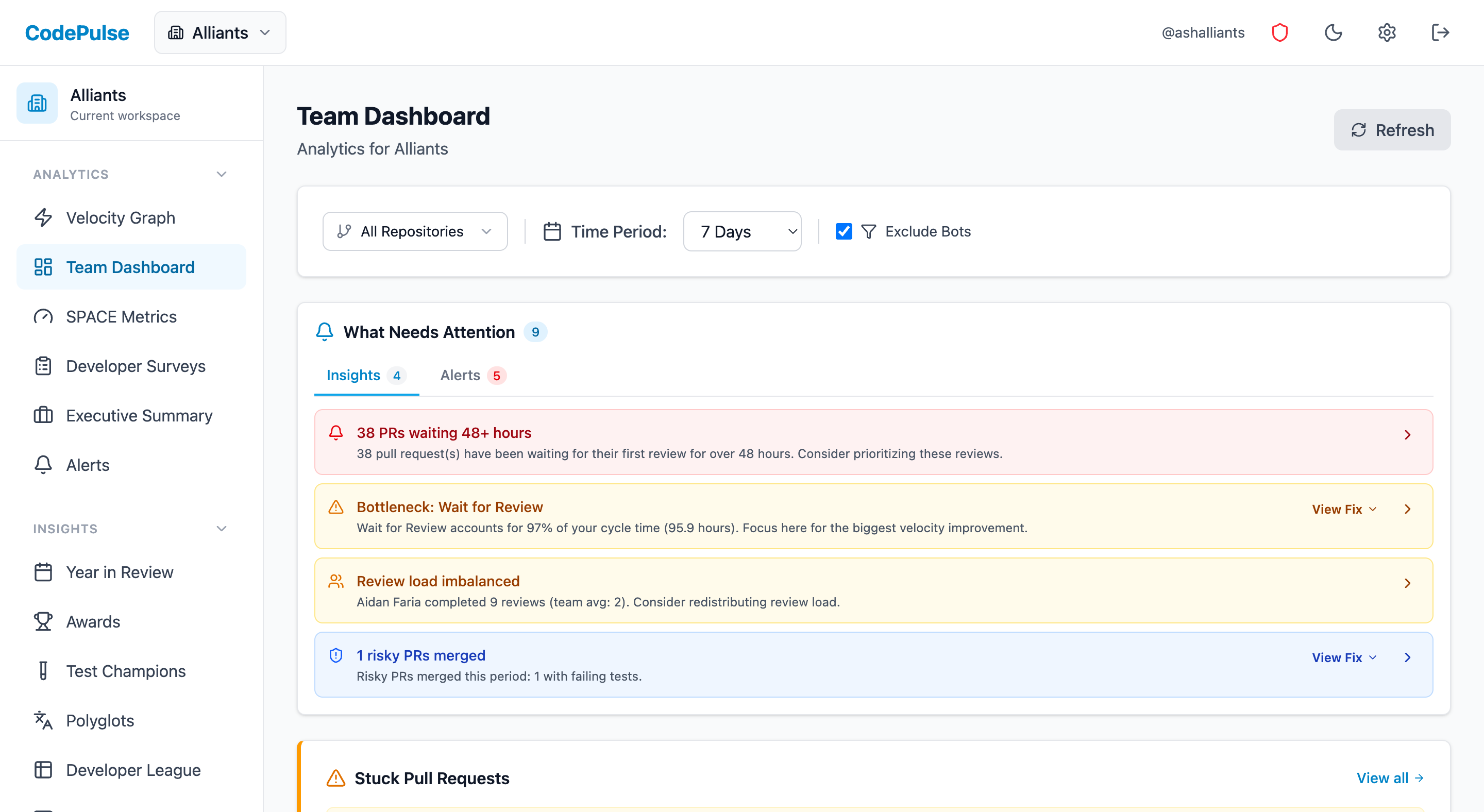
A comparison table only goes so far. Connect read-only GitHub in about five minutes and judge the output on your repositories, at one flat price, with no per-seat math.
Read-only GitHub · Your code stays yours · Team-level by default · No credit card
See These Features in Action
Explore all featuresRelated Guides
DORA Metrics Explained: The 4 Keys Without the Hype
A complete breakdown of the four DORA metrics - deployment frequency, lead time, change failure rate, and MTTR - with honest benchmarks and gaming traps to avoid.
Jellyfish vs LinearB vs Swarmia: Full 2026 Comparison
Compare Jellyfish, LinearB, Swarmia, Allstacks, Haystack and more engineering analytics tools. Features, pricing, cycle time benchmarks, and integrations.
5 LinearB Alternatives for 2026 (With Pricing)
An honest comparison of CodePulse vs LinearB. We tell you when to choose LinearB instead, because the best tool is the one that makes the right trade-offs for your situation.
The ROI Template That Gets Developer Tools Approved
The exact ROI calculation and business case template that gets CFOs to approve developer tool purchases.
Best DORA Metrics Tools for 2026: 8 Platforms Compared
An opinionated comparison of the 8 best tools for automated DORA metrics reporting, ranked by automation depth, setup speed, metric accuracy, pricing transparency, and real-world usefulness for engineering leaders.
Pluralsight Flow Pricing in 2026: Is the Bundle Worth It?
Pluralsight Flow bundle math for 25/50/100 engineers, the post-GitPrime product velocity timeline, and whether the learning + analytics platform justifies the premium over standalone tools.
Datadog DORA Metrics: What It Costs and Where It Stops
Datadog does not sell DORA metrics - it sells the plumbing. What the free feature requires, what the feeder products cost, and where it stops being engineering analytics.
Azure DevOps vs GitHub: 2026 Comparison (Both Tested)
Azure DevOps vs GitHub compared: pricing, CI/CD, AI features, project management, analytics, and migration paths. Side-by-side guide for engineering leaders choosing between Microsoft platforms.