
Compare the finished analysis before you choose a platform
See the report CodePulse produces from read-only GitHub workflow data, or connect your own repositories and evaluate the fit with real evidence.
Read-only GitHub · Your code stays yours · Team-level by default · No credit card
Many engineering managers start tracking metrics in Google Sheets or Excel. It works for a while. Then the team grows, the data goes stale, and the weekly metrics update becomes a dreaded chore. This guide quantifies the real cost of spreadsheet-based engineering metrics and helps you decide when to switch to purpose-built analytics.
Spreadsheets are the default because they're free, familiar, and flexible. Nobody needs a purchase approval to open a Google Sheet. But that flexibility becomes a liability when your team depends on the data for decisions. According to a Forrester Research study, 88% of spreadsheets contain errors. Engineering metrics spreadsheets are no exception.
"The spreadsheet isn't the problem. The 3 hours every Monday morning copying data from GitHub into it is the problem."
The True Cost of DIY: The Spreadsheet Tax Calculator
Most teams underestimate how much time goes into maintaining engineering metrics spreadsheets. Here's the breakdown, based on patterns across teams of 20-50 developers:
THE SPREADSHEET TAX - Weekly Time Cost

Data collection:
- Export PR data from GitHub:             30-45 min
- Cross-reference with Jira/Linear:       20-30 min
- Update contributor stats:               15-20 min
- Bot filtering (manual):                 10-15 min
Subtotal:                                 1.5-2 hours/week

Data cleanup:
- Fix formatting issues:                  15-20 min
- Reconcile duplicates:                   10-15 min
- Validate formulas aren't broken:        10-15 min
Subtotal:                                 35-50 min/week

Reporting:
- Build weekly summary slide/doc:         30-45 min
- Answer ad-hoc questions from leadership: 20-30 min
Subtotal:                                 50-75 min/week

TOTAL:                                    3-4 hours/week
ANNUAL COST (at $85/hr fully-loaded EM):  $13,260 - $17,680/year
That's 150-200 hours per year of an engineering manager's time spent on data entry instead of coaching, planning, and unblocking. And this assumes one person owns the spreadsheet. When multiple people update it, errors compound.
Seven Things Spreadsheets Cannot Do
Even with unlimited time for data entry, spreadsheets structurally cannot provide:
| Capability | Spreadsheet | CodePulse |
|---|---|---|
| Real-time data | Stale by definition (manual refresh) | Auto-syncs every 15 minutes |
| Cycle time decomposition | Requires GitHub API scripting | 4-phase breakdown out of the box |
| Review network graph | Not feasible in a spreadsheet | Interactive who-reviews-whom visualization |
| Knowledge silo detection | Would need custom file-author analysis | Bus factor scoring per file/directory |
| Proactive alerts | No alerting capability | Slack/email alerts for SLA breaches |
| Bot filtering | Manual identification and exclusion | Automatic detection and toggle |
| Historical trend comparison | Requires consistent manual entry over months | Automatic 6-month backfill on first sync |
🔥 Our Take
Spreadsheets for engineering metrics are a sign of organizational maturity, not failure. The problem is staying there too long.
Every team that takes metrics seriously starts with a spreadsheet. That's healthy. It means someone cares enough to track something. The mistake is treating the spreadsheet as the permanent solution once you've proven that metrics matter. The spreadsheet was the prototype. Now ship the real thing.
How Spreadsheet Metrics Fail: Three Patterns
Spreadsheet-based metrics don't fail dramatically. They decay slowly, which makes the failure harder to detect.
Pattern 1: The Stale Data Spiral
Week 1, someone updates the spreadsheet diligently. Week 5, they're out sick and nobody backfills. Week 8, leadership asks for metrics and gets "we'll have it by Friday." Week 12, the spreadsheet is two months stale and nobody trusts it. The Data Quality in Engineering Metrics guide covers why stale data is worse than no data.
Pattern 2: The Formula Breakage
Someone adds a row in the middle of the data range. Three VLOOKUP formulas silently break. The cycle time average now includes blank rows as zeros, making your metrics look 50% better than reality. Nobody notices for weeks because the numbers "look reasonable."
Pattern 3: The Single Owner Problem
One EM owns the spreadsheet. They leave the company. The new EM opens it and finds 14 tabs, undocumented formulas, and conditional formatting that encodes business logic. They start a new spreadsheet from scratch. The cycle repeats.
"Every engineering metrics spreadsheet has a half-life. After 3 months without a dedicated owner, trust in the data drops below usefulness."
When Spreadsheets Genuinely Work
Spreadsheets are the right tool in specific situations. Use one if:
- Team of fewer than 10 developers: The data volume is manageable, and one person can maintain it in 30 minutes per week
- You're proving that metrics matter: Before buying a tool, validate that leadership actually uses the data. A spreadsheet is the cheapest way to test demand
- Highly custom metrics: If you track domain-specific metrics that no tool supports (compliance audit dates, on-call rotation fairness), a spreadsheet is flexible enough
- One-off analysis: For a quarterly deep dive or ad-hoc investigation, exporting data to a spreadsheet is faster than configuring a tool
The inflection point is roughly 10-15 developers, 5+ active repositories, and leadership expecting weekly or biweekly reporting. Below that threshold, spreadsheets work. Above it, they become a maintenance burden that degrades data quality.
The ROI of Switching: A Real Calculation
Here's the math for a team of 30 developers:
SPREADSHEET COST (30-developer team, annual):
- EM time for data entry:          $15,000/year (3.5 hrs/week × $85/hr × 50 weeks)
- Stale data decisions (estimated): $5,000-$20,000 (delayed bottleneck detection)
- Reporting overhead:               $4,000/year (ad-hoc requests, slide prep)
- Total spreadsheet cost:           $24,000 - $39,000/year

CODEPULSE COST (30-developer team, annual):
- Subscription:                     Fraction of one engineer's salary
- Setup time:                       ~30 minutes (one-time)
- Weekly review time:               10 min/week (vs 3.5 hours)
- Total tool cost:                  Significantly less than spreadsheet overhead

NET SAVINGS:                        $15,000 - $30,000+/year
PLUS: Real-time data, alerts, review network, knowledge silo detection
For a detailed ROI framework, see the Engineering Analytics ROI Guide and the Developer Tooling ROI Guide.
Migrating From Spreadsheets to CodePulse
The transition doesn't require a big bang. Run both in parallel for 2-4 weeks to validate data accuracy, then sunset the spreadsheet.
📊 How to Migrate in CodePulse
Replace your spreadsheet workflow step by step:
- Weekly PR data export → replaced by Dashboard (auto-updating)
- Manual reviewer tracking → replaced by Review Network
- Monthly leadership slide → replaced by Executive Summary (shareable link)
- Ad-hoc "why is X slow" investigation → replaced by Alert Rules (proactive notification)
- CSV export for custom analysis → still available via CSV export
"The spreadsheet was the proof of concept. Now automate it."
Frequently Asked Questions
Yes. CodePulse supports CSV export for all metrics. If you need to run custom analysis in a spreadsheet, you can export and analyze without manual data collection.
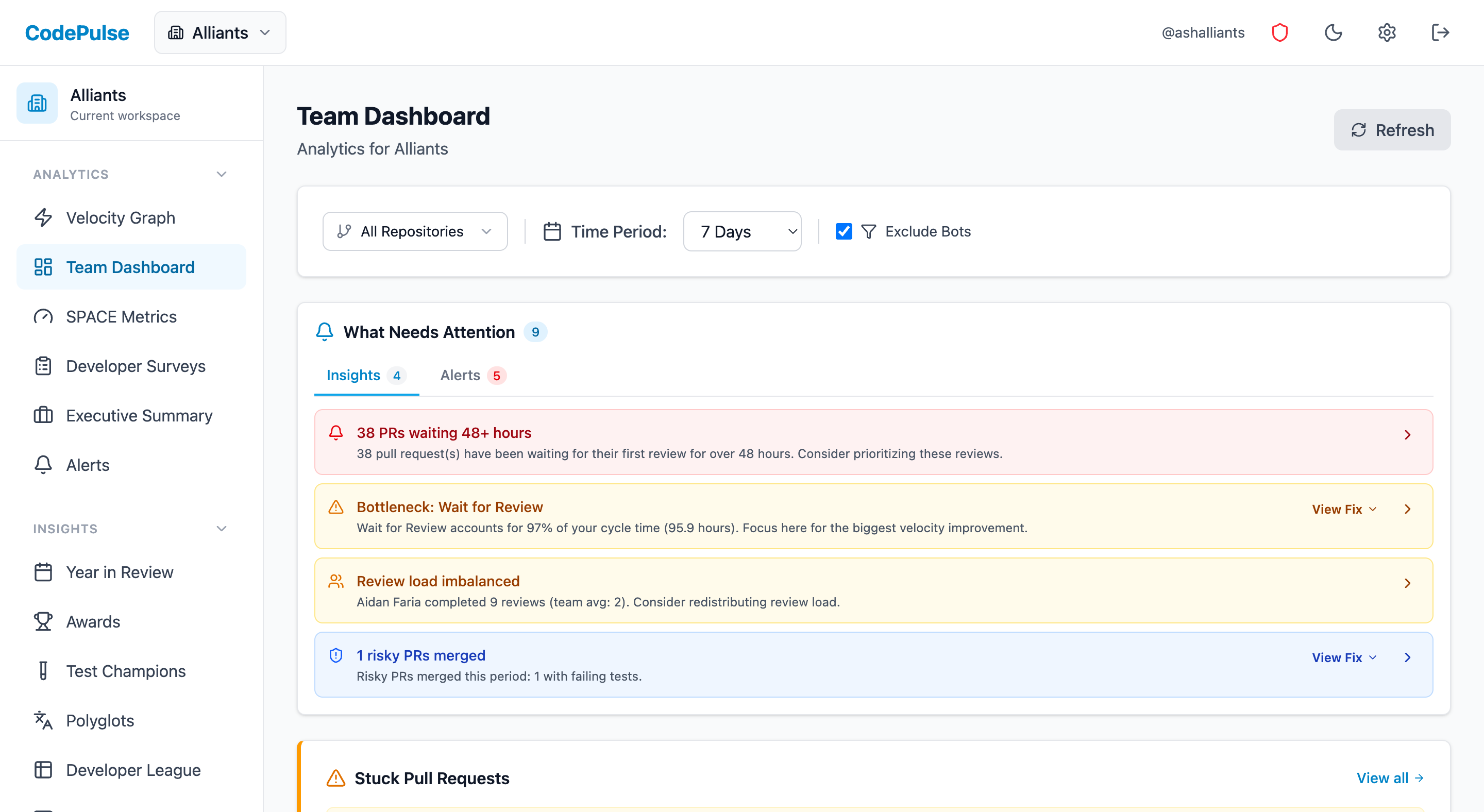
Evaluate CodePulse against your own delivery history
A comparison table only goes so far. Connect read-only GitHub in about five minutes and judge the output on your repositories, at one flat price, with no per-seat math.
Read-only GitHub · Your code stays yours · Team-level by default · No credit card
See These Features in Action
Board-ready engineering performance in a single page.
Break down cycle time into coding, waiting, review, and merge phases.
Related Guides
Jellyfish vs LinearB vs Swarmia: Full 2026 Comparison
Compare Jellyfish, LinearB, Swarmia, Allstacks, Haystack and more engineering analytics tools. Features, pricing, cycle time benchmarks, and integrations.
Best Engineering Analytics Tools for 2026 (Ranked by Real Users)
We ranked the 10 best engineering analytics tools based on metric depth, setup speed, pricing transparency, and privacy posture. Honest pros and cons for each.
Engineering Analytics ROI: The Budget Approval Playbook
Calculate the ROI of engineering analytics tools with formulas for time savings, payback period, and a business case template tailored to CFOs, CTOs, and CEOs.
Your Engineering Metrics Are Lying to You
Learn how engineering analytics tools ensure data accuracy through bot filtering, file exclusions, and reliable sync mechanisms.