
See exactly where your delivery flow is waiting
Preview the phase-by-phase report for review pickup, active review, and merge time. Connect in about five minutes; the initial analysis runs after sync.
Read-only GitHub · Your code stays yours · Team-level by default · No credit card
GitHub reviews are the backbone of modern code quality practices, yet many teams barely scratch the surface of what's possible. While everyone uses basic PR comments and approvals, GitHub includes powerful features for enforcing quality gates, distributing review work, and streamlining collaboration that most teams never configure.
How do you optimize GitHub code reviews without adding new tools?
Three GitHub-native features cut review time for most teams: CODEOWNERS (auto-assigns the right reviewers based on file paths), suggested changes (lets reviewers propose one-click fixes instead of comment-only feedback), and branch protection rules (enforces review requirements without bottlenecks). Most teams underuse these features. Proper CODEOWNERS setup alone eliminates the 'who should review this?' delay that often accounts for 40%+ of review wait time. CodePulse tracks review metrics like time-to-first-review and reviewer load balance to show where these configurations have the most impact.
If your coding reviews feel slow or inconsistent, the issue is usually workflow design, not developer effort. The fixes are often simpler than adding a new tool.
This guide walks through GitHub's native code review features - from CODEOWNERS to branch protection rules - showing you how to optimize your review workflow without adding new tools to your stack.
GitHub Review Features Most Teams Underuse
Suggested Changes: One-Click Fixes
When reviewing pull requests, instead of writing "change X to Y" in a comment, use GitHub's suggested changes feature to propose the exact code modification. Reviewers write the fix, authors apply it with one click.
How to use suggested changes:
- In a PR review comment, click the "Add a suggestion" button (± icon)
- GitHub pre-fills a code block with the original line(s)
- Modify the code to show what you recommend
- The PR author sees a "Commit suggestion" button - one click applies your change
Best practices:
- Multi-line suggestions: Select multiple lines before clicking "Add a suggestion" to propose larger changes
- Batch commits: Authors can queue multiple suggestions and commit them all at once instead of creating separate commits
- Style fixes: Perfect for formatting, typos, or small refactorings that don't need explanation
- Add context: Include a comment above the suggestion explaining why you're recommending the change
Suggested changes reduce review round-trips. Instead of "fix the typo" followed by waiting for the author to make the change, the reviewer provides the fix directly.
Review Comments vs Review Requests
GitHub has three distinct review actions, but many teams only use "Comment" by default:
- Comment: General feedback without approving or blocking. Use for questions, suggestions, or non-blocking observations.
- Approve: Explicitly approves changes. Required if branch protection requires approvals - though requiring it and getting it are different things. Across 222 of the most-starred projects on GitHubin August 2026, the busiest ones merged 70% of their changes with no approving review from anyone else.
- Request Changes: Blocks merging (if branch protection enforces it). Use for issues that must be fixed before merge.
Many reviewers leave multiple comments but never actually approve or request changes, leaving the PR author uncertain whether they can merge. Establish team norms: every review should end with an explicit approve or request changes decision.
Re-Request Review After Updates
When an author addresses review feedback, GitHub provides a "Re-request review" button (circular arrow icon next to the reviewer's name). This notifies the reviewer that their feedback has been addressed and the PR is ready for another look.
Without re-requesting, reviewers don't get notifications about updates, leading to PRs that sit "done" but unmerged because reviewers don't realize the author addressed their comments.
Team process tip: Make it a norm that authors always re-request review after making changes, rather than just commenting "Done."
Draft Pull Requests
Mark PRs as "Draft" when they're not ready for full review. Draft PRs:
- Can't be merged (even by accident)
- Signal to reviewers "not ready yet, don't spend time on this"
- Allow early feedback on direction without formal review
- Keep CI running to catch issues early
Use drafts when you want CI feedback or architectural input before the code is complete. When ready, click "Ready for review" to signal reviewers should look at it.
Setting Up CODEOWNERS Effectively
What CODEOWNERS Does
The CODEOWNERS file automatically requests reviews from specific people or teams when a PR touches certain files or directories. This ensures the right experts see changes to their areas of responsibility.
Basic CODEOWNERS Syntax
Create a file at .github/CODEOWNERS in your repository:
# Default owner for everything in the repo
* @your-org/engineering-team

# Frontend code requires frontend team review
/src/components/ @your-org/frontend-team
/src/pages/ @your-org/frontend-team
*.tsx @alice @bob

# Backend code requires backend team review
/api/ @your-org/backend-team
/services/ @your-org/backend-team
*.py @charlie @diana

# Infrastructure requires DevOps review
/infrastructure/ @your-org/devops-team
/docker-compose.yml @your-org/devops-team
/Dockerfile @evan

# Database migrations require DBA review
/migrations/ @your-org/database-team @frank
Pattern Matching Rules
CODEOWNERS uses gitignore-style patterns:
*matches any files in the directory**matches zero or more directories/path/matches the directory and all subdirectories- Last matching pattern wins (more specific rules override general ones)
Teams vs Individuals
Reference GitHub teams with @org-name/team-name or individuals with @username. Teams are better for most cases:
- Load distribution: GitHub rotates review requests among team members instead of pinging everyone
- Easy updates: Add/remove team members in GitHub settings without updating CODEOWNERS
- Clear ownership: Team names are more descriptive than individual usernames
Advanced CODEOWNERS Patterns
Multiple owners (all required):
# Security-sensitive files require both security team AND relevant domain team
/api/auth/ @your-org/security-team @your-org/backend-team
/src/payments/ @your-org/security-team @your-org/frontend-team
File extension matching:
# All TypeScript files
*.ts @your-org/typescript-experts
*.tsx @your-org/typescript-experts

# All Python files
*.py @your-org/python-team

# All YAML config files
*.yml @your-org/devops-team
*.yaml @your-org/devops-team
Specific files:
# Critical config files require architect review
/package.json @your-org/architects
/pyproject.toml @your-org/architects
/.github/workflows/ @your-org/devops-team
CODEOWNERS Anti-Patterns to Avoid
1. Too granular: Don't assign different owners to every single file. This creates fragmented reviews and slows PRs.
2. Single points of failure: Avoid assigning individuals as sole owners. Use teams or list multiple people.
3. Too many required owners: If every PR requires 5+ different teams to review, PRs will stall.
4. Stale ownership: When team members leave, update CODEOWNERS immediately.
📊 How CodePulse Helps
CodePulse's Review Network visualization shows who actually reviews whose code, revealing whether your CODEOWNERS setup creates bottlenecks. If you see single individuals handling the majority of reviews, it's time to expand your CODEOWNERS teams.
Suggested Changes and Batch Reviews
The Power of Batch Suggestions
GitHub allows PR authors to queue multiple suggested changes and commit them all at once, rather than creating separate commits for each suggestion. This is especially valuable when a reviewer provides 5-10 small fixes across different files.
How to batch suggestions as a PR author:
- A reviewer leaves multiple suggestions across your PR
- Instead of clicking "Commit suggestion" on each one, click "Add suggestion to batch"
- Review all queued suggestions at once
- Click "Commit suggestions" (plural) at the top to apply them all in a single commit
This keeps PR history cleaner (one "Address review feedback" commit instead of six "Fix typo" commits) and saves time for both author and reviewer.
Suggesting Code Blocks
Suggested changes aren't limited to single lines. Select multiple lines in the PR diff before clicking "Add a suggestion" to propose larger refactorings:
// Instead of commenting "Extract this to a function," show the refactoring:

// Suggestion: Extract validation logic
function validateUserInput(input) {
  if (!input.email) throw new Error('Email required');
  if (!input.name) throw new Error('Name required');
  return true;
}

// Then call it
if (validateUserInput(req.body)) {
  // ... rest of handler
}
When reviewers provide working code, authors can apply it directly rather than interpreting instructions.
Review Comments vs Suggestions: When to Use Each
Use suggestions for:
- Typos, formatting, naming
- Small logic fixes
- Import reordering
- Simple refactorings
Use comments for:
- Architectural questions
- Complex changes requiring explanation
- When you want discussion, not just a fix
- Security or design concerns
Review Assignment Strategies
Automatic Assignment with CODEOWNERS
When CODEOWNERS is configured, GitHub automatically requests reviews from the designated owners when a PR is opened. This removes the manual step of figuring out who should review.
To enable automatic assignment:
- Go to Settings → Branches → Branch protection rules
- Select your protected branch (usually
mainormaster) - Enable "Require a pull request before merging"
- Enable "Require review from Code Owners"
Now, when anyone opens a PR that touches files listed in CODEOWNERS, the specified reviewers are automatically added.
Team-Based Review Rotation
When you assign a GitHub team as a CODEOWNER, GitHub's default behavior is to notify all team members. To distribute load better, configure team review assignment:
- Go to your organization → Teams → Select the team
- Click "Settings"
- Under "Code review assignment," click "Enable auto assignment"
- Choose your assignment algorithm:
- Round robin: Rotate through team members in order
- Load balance: Assign to the person with fewest pending reviews
- Set how many team members to assign (1-2 is typical)
This prevents the "notify everyone, everyone ignores it" problem. One or two specific team members get assigned and are accountable for reviewing.
Review Fallback Options
Configure team settings to handle unavailability:
- Skip members on vacation: GitHub can automatically skip team members who have busy status set
- Notify team if reviewers don't respond: Escalate to the full team if assigned reviewers don't respond within a threshold
Manual Assignment Best Practices
For PRs that don't match CODEOWNERS or need specific expertise:
- Assign reviewers when opening the PR, not hours later when you remember
- Check reviewer workload: Before assigning, glance at how many other PRs they're reviewing
- Add context in the PR description: "Requesting review from @alice because she worked on this feature last quarter"
- Use the right number: 1-2 reviewers for most PRs, 3+ for critical changes only
For strategies on balancing review load across your team, see our Review Load Balancing Guide.
Branch Protection Rules That Work
Essential Protection Rules
Branch protection rules enforce quality gates before code reaches your main branch. Here's a progression from minimal to comprehensive protection:
Level 1: Basic Protection (minimum viable)
Settings > Branches > Add rule for "main"
- Require a pull request before merging
- Require approvals: 1
- Require status checks to pass before merging
- Require branches to be up to date before merging
- Add your CI checks (e.g., "build", "test")
This prevents direct commits to main and ensures PRs pass CI and get at least one approval.
Level 2: Standard Protection (recommended for most teams)
Pull Request Requirements
- Require a pull request before merging
- Require approvals: 1-2
- Dismiss stale pull request approvals when new commits are pushed
- Require review from Code Owners
Status Checks
- Require status checks to pass before merging
- Require branches to be up to date before merging
- Add your CI checks
Additional Rules
- Require conversation resolution before merging
- Do not allow bypassing the above settings
This adds requirement for CODEOWNERS approval, dismisses outdated approvals when code changes, and requires all review threads to be resolved.
Level 3: Strict Protection (for production-critical repos)
Pull Request Requirements
- Require a pull request before merging
- Require approvals: 2+
- Dismiss stale pull request approvals when new commits are pushed
- Require review from Code Owners
- Restrict who can dismiss pull request reviews
Status Checks
- Require status checks to pass before merging
- Require branches to be up to date before merging
- Add all CI checks (tests, security scans, linting)
Commit Requirements
- Require conversation resolution before merging
- Require signed commits
- Require linear history (no merge commits)
Access Control
- Do not allow bypassing the above settings
- Restrict who can push to matching branches
Status Checks: What to Require
Recommended status checks to require before merging:
- Automated tests: Unit, integration, and end-to-end tests must pass
- Code quality: Linters, formatters, type checkers
- Security scans: Dependency vulnerability checks, SAST tools
- Build verification: Ensure code actually compiles/builds
Don't require slow, flaky, or non-critical checks. Every required check adds delay and frustration when it fails intermittently.
Handling Dismissal of Stale Reviews
"Dismiss stale pull request approvals when new commits are pushed" is one of the most important settings. Here's why:
Without this setting:
- Reviewer approves PR at 2pm
- Author makes significant changes at 3pm (new commits)
- PR still shows as "approved" even though reviewer hasn't seen the new code
- PR can be merged without re-review
With this setting:
- Reviewer approves PR at 2pm
- Author makes changes at 3pm
- Approval is automatically dismissed
- Author must re-request review of the new changes
This prevents the common problem of PRs being approved, then substantively changed, then merged without re-review.
Require Conversation Resolution
Enabling "Require conversation resolution before merging" ensures authors explicitly address all review comments. Reviewers mark threads as "Resolved" when satisfied.
This prevents PRs from being merged with open questions or unaddressed feedback.
🔒 How CodePulse Helps
CodePulse tracks whether PRs are merged without proper approvals. The Dashboard shows "Merge Without Approval Rate" to reveal gaps in your protection rules. If this metric is above 0%, your branch protection isn't configured correctly.
Measuring Review Effectiveness
Key Metrics to Track
GitHub gives you the tools, but are they working? Track these metrics to measure the effectiveness of your review process:
1. Review Coverage Rate
What percentage of merged PRs received at least one substantive review? Target: 95%+.
Low coverage indicates branch protection rules aren't enforced or team culture tolerates merging without review.
2. Time to First Review
How long do PRs wait before someone starts reviewing? Target: under 4 business hours.
Long waits suggest reviewer overload, unclear ownership (CODEOWNERS not configured), or lack of review accountability.
3. Review Round Trips
How many request-changes → update → re-review cycles does a typical PR go through? Target: 1-2 rounds.
High round-trip counts suggest PRs are too large, lacking context, or code quality issues that should've been caught by CI/linting.
4. Review Load Distribution
Is review work spread evenly, or do 2-3 people handle most reviews? Target: no single reviewer handles more than 25% of team reviews.
Concentrated reviews create bottlenecks and burnout. See our Review Load Balancing Guide for strategies.
5. PR Cycle Time
Total time from PR opened to PR merged. Target: under 24 hours for small PRs, 2-3 days for larger ones.
Long cycle times compound delays across your entire team. See our guide to reducing PR cycle time.
Where to Find These Metrics
GitHub's built-in insights (limited):
- Repository → Insights → Contributors shows review counts
- Pull Requests tab shows open/closed counts but no timing metrics
- No historical trends or team-level aggregation
GitHub API + custom scripts:
You can query GitHub's API for detailed PR data, but this requires scripting:
# Example GraphQL query for PR review timing
query {
  repository(owner: "your-org", name: "your-repo") {
    pullRequests(first: 100, states: MERGED) {
      nodes {
        createdAt
        mergedAt
        reviews(first: 10) {
          nodes {
            createdAt
            author { login }
            state
          }
        }
      }
    }
  }
}
Analytics platforms:
Tools like CodePulse automatically collect and visualize these metrics without custom scripting. CodePulse tracks review coverage, time to first review, reviewer load distribution, and cycle time trends over time.
For a comprehensive comparison of code review analytics tools, see our Code Review Platforms Comparison Guide.
Setting Review SLAs
Service Level Agreements for reviews turn "get to it when you can" into team commitments:
- First response SLA: 4 business hours (same-day for morning PRs, next morning for afternoon PRs)
- Follow-up SLA: 2 business hours after author addresses feedback
- Small PR SLA: PRs under 100 lines should merge same day if approved
Make SLAs visible. Dashboard alerts for "PRs approaching SLA breach" create healthy accountability without micromanagement.
Continuous Improvement Loop
Review effectiveness isn't static. Establish a regular cadence:
- Weekly: Quick check of review metrics in team standup. "Are any PRs stuck? Is anyone overloaded?"
- Monthly: Review trends. Are metrics improving? Where are remaining bottlenecks?
- Quarterly: Retrospective on review culture. Update CODEOWNERS, adjust protection rules, refine SLAs.
What gets measured and discussed gets improved. Teams that regularly review their review process see continuous cycle time improvements.
Frequently Asked Questions
Three high-impact changes: set up CODEOWNERS to auto-assign the right reviewers, use suggested changes for one-click fixes instead of comment-only feedback, and configure branch protection rules that enforce review without creating bottlenecks. Most teams see review time drop 30-50% after proper configuration.
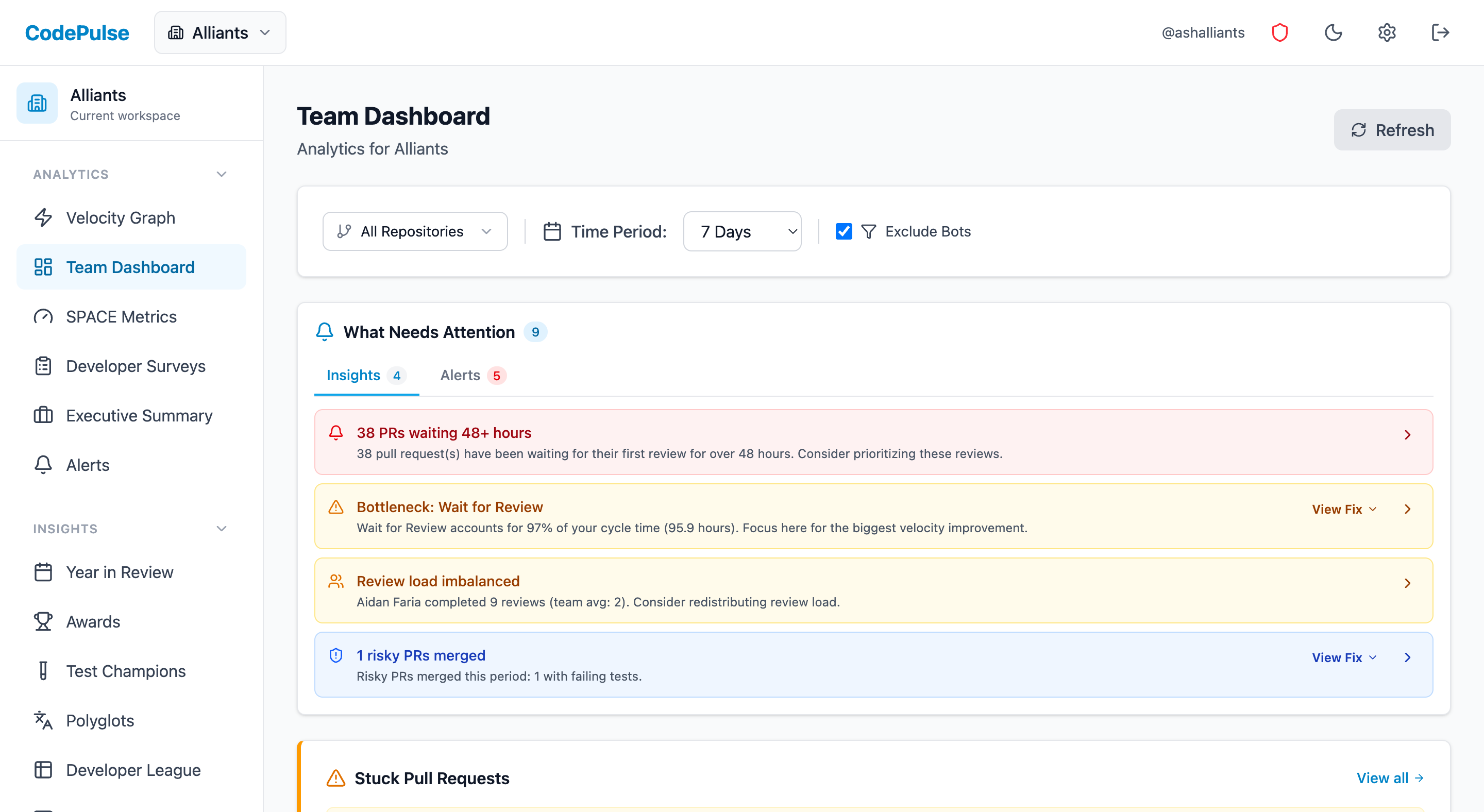
Find out which phase is holding your delivery up
CodePulse splits your cycle time into coding, waiting for review, active review, and merge, so you fix the queue that is actually costing you days. Read-only GitHub, no credit card.
Read-only GitHub · Your code stays yours · Team-level by default · No credit card
See These Features in Action
Interactive graph of review relationships and workload distribution.
Measure review thoroughness and feedback quality across the team.
Related Guides
7 Code Review Rules That Actually Get PRs Approved Faster
Learn code review best practices backed by metrics. Covers reviewer guidelines, author guidelines, team practices, and how to measure review effectiveness.
We Cut PR Cycle Time by 47%. Here's the Exact Playbook
A practical playbook for engineering managers to identify bottlenecks, improve review processes, and ship code faster - without sacrificing review quality.
100% Review Coverage Is a Lie (What Actually Matters)
Why 100% review coverage matters, how to track it, and practical steps to build a consistent code review culture across your team.
Your Best Engineer Is About to Quit (Check Review Load)
Learn how to identify overloaded reviewers, distribute review work equitably, and maintain review quality without burning out your senior engineers.
MLOps vs DevOps: Key Differences, Tools, and When You Need Both
MLOps extends DevOps for machine learning with unique challenges like model drift, data versioning, and continuous training. This guide compares pipelines, roles, tools, and metrics across both practices, plus migration strategies for hybrid organizations.
Engineering Flow Metrics Dashboard: Measuring Developer Flow State
Build a flow metrics dashboard to optimize developer experience. Track flow efficiency, WIP limits, and the metrics that correlate with deep work.
Remote Code Reviews Are Broken. Here's the 3-Timezone Fix
How to run effective code reviews across time zones without sacrificing quality or velocity.
Ancient PRs Are Murdering Your Velocity. Here's the Triage
Tactical strategies for managing your review queue, prioritizing PRs effectively, and preventing aging PRs from blocking your team.