
Compare the finished analysis before you choose a platform
See the report CodePulse produces from read-only GitHub workflow data, or connect your own repositories and evaluate the fit with real evidence.
Read-only GitHub · Your code stays yours · Team-level by default · No credit card
Python teams face a specific problem with code review that Java and Go teams do not: bugs hide until runtime. AI code review tools promise to catch those bugs earlier, but their Python support varies wildly. We compared the major AI reviewers - evaluating their Python detection capabilities, testing them against Django, FastAPI, and data pipeline patterns, and cross-referencing published benchmarks covering 200,000+ real pull requests to see which ones deliver real results.
What is AI code review for Python?
AI code review for Python uses machine learning models to analyze pull requests for bugs, security issues, and code quality problems specific to Python codebases. A UCL study of 3 million commits across 600 GitHub projects found that dynamically typed languages like Python have a statistically higher association with defect-fixing commits - meaning Python code needs more bug fixes per commit, which makes automated review especially valuable. In the Martian Code Review Benchmark (200,000+ real PRs, March 2026), the top AI reviewer achieved an F1 score of 51.2%. CodePulse tracks the impact of these tools on your team's review cycle time and defect rates automatically.
Why Does Python Need Specialized AI Code Review?
Python's dynamic typing makes you fast and makes your bugs invisible. A variable that is a string in one branch and an integer in another will not throw an error until that specific code path executes. In Go or Java, the compiler catches this before the code runs.
A UCL study of 70 million lines of code across 600 GitHub projects (published in IEEE Transactions on Software Engineering) found that dynamically typed languages have a statistically higher association with defect-fixing commits. Python codebases required more bug fixes relative to their overall commit volume - not because Python is a worse language, but because its flexibility shifts error detection from compile time to runtime.
This is not a knock on Python. It is a statement about where automated tooling adds the most value. The bugs AI reviewers catch in Python - type mismatches, None handling errors, incorrect dictionary key access - are exactly the class of bugs that a type system would catch at compile time.
"Python's dynamic typing is both its greatest strength and the reason AI reviewers catch more bugs in Python than in any statically-typed language."
Python also has unique review challenges beyond typing:
- Duck typing and metaprogramming - Code that uses
__getattr__, metaclasses, or dynamic class creation is nearly impossible for static analysis tools. AI reviewers with LLM backends handle this better than rule-based linters, but still miss edge cases. - Framework-specific patterns - Django ORM queries, FastAPI dependency injection, and SQLAlchemy session management each have their own anti-patterns that generic reviewers miss entirely.
- Data pipeline code - Pandas, NumPy, and scikit-learn code follows different patterns than web application code. A reviewer trained on web apps will produce irrelevant suggestions for data engineering work.
🔥 Our Take
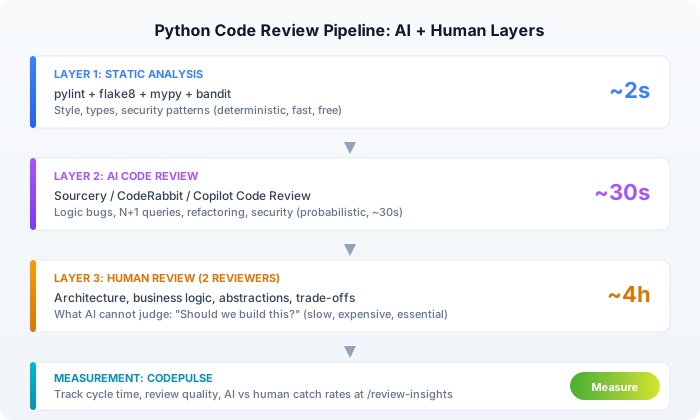
AI code reviewers are the best thing to happen to Python teams since type hints. But they are a zeroth reviewer, not a replacement.
Use them to catch the mechanical stuff - type inconsistencies, missing error handling, security patterns - so your human reviewers can focus on whether the abstraction actually makes sense. Two human reviewers remains the right number. AI just makes both of them more effective. A team that replaces a human reviewer with an AI tool has not improved their process. They have removed the person who catches the bugs AI cannot see.
Which AI Code Review Tools Support Python Best?
Not all AI code review tools treat Python equally. Some were built for Python first. Others bolt on Python support as an afterthought. The difference shows up in the quality of their suggestions.
| Tool | Python Support | What It Catches | Pricing | Best For |
|---|---|---|---|---|
| Sourcery | Native (Python-first) | Refactoring patterns, complexity, Pythonic idioms | $12/user/mo | Python-heavy teams |
| CodeRabbit | Strong (multi-language) | Bugs, security, performance, style | $12-25/user/mo | Mixed-language teams |
| GitHub Copilot Code Review | Strong (multi-language) | Bug patterns, security, performance | $19-39/user/mo (with Copilot) | Teams already on Copilot |
| Qodo (formerly CodiumAI) | Strong (test focus) | Test gaps, edge cases, logic errors | $19-30/user/mo | Test-first Python teams |
| Amazon CodeGuru (deprecated Nov 2025) | Was supported (Java/Python) | Performance, AWS anti-patterns, security | Was $0.50/100 lines | Migrate to Amazon Q Developer |
| Codacy | Supported (rule-based + AI) | Style, duplication, complexity | $15/user/mo | Compliance-focused teams |
Sourcery stands out for Python because it was built for it. Their 100+ built-in Python rules cover two layers: a deterministic static analysis engine for Python idioms (list comprehensions, context managers, dataclasses, generator expressions) plus an LLM-powered layer for contextual reasoning. It will suggest replacing a loop-and-append pattern with a list comprehension, flag unnecessary else after return, and catch Python-specific gotchas like mutable default arguments. Multi-language tools miss most of these.
For teams already paying for GitHub Copilot, the built-in Code Review feature is the lowest-friction option. Copilot Code Review crossed 60 million reviews as of March 2026 and now handles more than 1 in 5 code reviews on GitHub. In 71% of reviews, Copilot surfaces actionable feedback; in 29%, it stays silent by design.
A note on CodeGuru: Amazon deprecated CodeGuru in November 2025. If you were using it for Python review, migrate to Amazon Q Developer.
What the benchmarks actually show
Three independent benchmarks have tested AI code review tools at scale, though none are Python-specific:
- Martian Code Review Bench (March 2026, 200,000+ real PRs, 17 tools) - CodeRabbit ranked #1 with 51.2% F1 score and 52.5% recall. Methodology: "Did the developer modify code after the AI comment?"
- Greptile Benchmark (July 2025, 50 real bugs) - CodeRabbit scored 44% bug catch rate with only 2 false positives. Copilot scored in the mid-50s.
- Qodo Benchmark (February 2026, 100 PRs with 580 injected issues, 7 languages including Python) - Qodo scored 60.1% F1.
The honest caveat: every vendor that publishes a benchmark wins their own. The Greptile and Martian benchmarks used different evaluation methodologies and got different rankings for the same tools. There is no vendor-neutral benchmark for AI code review equivalent to SWE-bench for coding agents. Take all numbers as directional, not definitive.
For more on AI review tools, see our complete AI code review tools comparison and the second-wave AI review bots guide.
How Do AI Reviewers Perform on Django and FastAPI Code?
Framework-specific bugs are where AI code review pays for itself on Python teams. Generic linters do not understand Django's ORM or FastAPI's dependency injection. AI reviewers with LLM backends reason about these patterns because they were trained on millions of Django and FastAPI repositories.
Patterns AI catches well
N+1 queries in Django:
# AI reviewers flag this pattern reliably
def get_authors_with_books(request):
    authors = Author.objects.all()
    for author in authors:
        # N+1: each iteration hits the database
        books = author.book_set.all()
    return render(request, 'authors.html', {'authors': authors})

# AI suggestion: use prefetch_related
authors = Author.objects.prefetch_related('book_set').all()
Missing authentication in FastAPI:
# AI reviewers catch unprotected endpoints
@app.get("/api/users/{user_id}")
async def get_user(user_id: int, db: Session = Depends(get_db)):
    return db.query(User).filter(User.id == user_id).first()

# AI suggestion: add authentication dependency
@app.get("/api/users/{user_id}")
async def get_user(
    user_id: int,
    db: Session = Depends(get_db),
    current_user: User = Depends(get_current_user)  # Added
):
    return db.query(User).filter(User.id == user_id).first()
Other framework patterns AI catches:
- Missing database migrations after model changes in Django
- Synchronous database calls in async FastAPI endpoints
- Unvalidated Pydantic model fields in API responses
- Missing CSRF middleware in Django settings
- SQLAlchemy session management leaks (sessions not closed in error paths)
Patterns AI misses
AI reviewers miss problems that require business context:
- Business logic correctness - An AI cannot tell you that a discount calculation is wrong if it does not know your pricing rules
- Architecture decisions - Whether to use a Django signal vs. a Celery task is a design choice, not a bug
- Performance at scale - A queryset that works fine for 1,000 records but fails at 1 million requires production context AI does not have
- Cross-service interactions - How a FastAPI service communicates with your Django monolith involves context that spans multiple repositories
"The best AI code reviewer is the one your team actually configures. An unconfigured AI reviewer is worse than no reviewer - it creates a false sense of coverage."
What About ML and Data Pipeline Code Review?
Data science and ML code has a different bug profile than web application code. The mistakes that matter are not missing null checks - they are data leakage, feature engineering errors, and pipeline ordering bugs that produce silently wrong results.
What AI reviewers catch in data code
- Data leakage in ML pipelines - Fitting a scaler on the full dataset before train/test split. AI reviewers trained on scikit-learn patterns flag this reliably.
- Pandas anti-patterns - Chained indexing that triggers SettingWithCopyWarning, iterating over DataFrames row-by-row instead of vectorized operations, and
.apply()calls that could be replaced with built-in methods. - Type coercion bugs - Pandas silently converts types in ways that produce wrong results. A column of integers with one NaN becomes float64. AI reviewers that understand Pandas catch this.
What AI reviewers miss in data code
- Feature engineering mistakes - Using future data to predict past events requires domain knowledge no AI reviewer has.
- Pipeline ordering - Whether normalization should happen before or after feature selection depends on your specific modeling goals.
- Notebook-to-production issues - Code that works in a Jupyter notebook often fails in production due to missing imports, hardcoded paths, and implicit global state. AI reviewers check the code they see, not the runtime environment it will execute in.
For data teams, use Qodo. Its test generation catches a class of bugs that pure code review - human or AI - misses entirely. Testing that your pipeline produces expected output shapes and value ranges is worth more than any code review suggestion.
How Do You Measure AI Code Review Impact?
Installing an AI code review tool without measuring its impact is guessing. You need a baseline and a tracking system.
The three metrics that matter
- Review cycle time - Time from PR creation to first human review. This should decrease if the AI is handling the mechanical checks that previously caused back-and-forth. Track this at the team level, not individual.
- Defect escape rate - Bugs that reach production per week. If AI review catches bugs earlier, fewer should escape to production. This takes 4-8 weeks to measure reliably.
- AI comment dismiss rate - What percentage of AI suggestions are dismissed without action. Above 40% means the tool is too noisy. Below 10% means it might not be catching enough. The sweet spot is 15-30%.
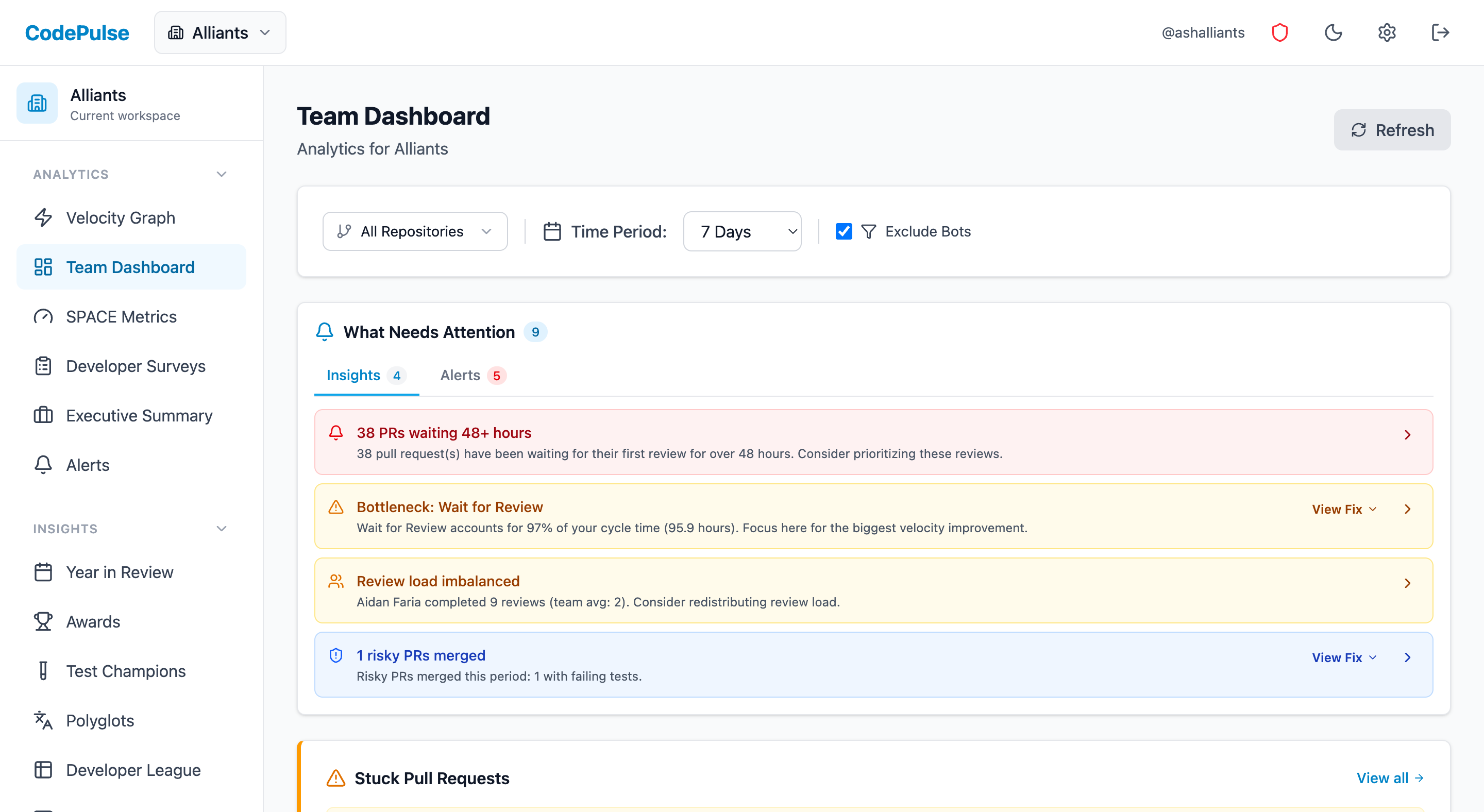
📊 How to Measure This in CodePulse
Track AI code review impact automatically across your Python repositories:
- Review Insights shows bot vs. human review quality, sentiment analysis, and review thoroughness - so you can see if AI reviews are substantive or noise
- Dashboard tracks cycle time trends over time - compare the 30 days before AI tool adoption to 30 days after
- Review coverage percentage shows whether AI tools are supplementing human reviews or replacing them (replacement is a red flag)
How you measure matters more than which tool you pick. A team that tracks impact and tunes configuration will get more from a mediocre tool than a team that installs the best tool and never checks the results.
For more on building a healthy review culture alongside AI tools, see our code reviewer best practices guide and code review culture and sentiment guide.
Frequently Asked Questions
Sourcery is the best Python-specific AI code reviewer at $12/user/month, with deep understanding of Python idioms and refactoring patterns. For broader coverage across multiple languages, CodeRabbit ($12-25/user/month) provides thorough line-by-line analysis that works well with Python, Django, and FastAPI codebases.
Evaluate CodePulse against your own delivery history
A comparison table only goes so far. Connect read-only GitHub in about five minutes and judge the output on your repositories, at one flat price, with no per-seat math.
Read-only GitHub · Your code stays yours · Team-level by default · No credit card
See These Features in Action
Measure the real productivity impact of AI coding assistants.
Measure review thoroughness and feedback quality across the team.
Related Guides
AI Code Review Tools: Which Actually Save Time (2026 Tests)
We tested 8 AI code review tools to see which caught real bugs, which added noise, and the metrics that prove whether they work for your team.
AI Code Review Bots: BugBot, Codex, Claude Compared
The second wave of AI code review bots works differently. BugBot, Codex, Claude Code Review, and Greptile compared head-to-head with real pricing - plus our rebuilt scoring of the benchmark everybody quotes, against all 183 real defects rather than one per pull request.
7 Code Review Rules That Actually Get PRs Approved Faster
Learn code review best practices backed by metrics. Covers reviewer guidelines, author guidelines, team practices, and how to measure review effectiveness.
5 Signs Your Code Review Culture Is Toxic (Fix #3 First)
Assess and improve your code review culture. Identify toxic patterns and build psychological safety in your engineering team.