
Compare the finished analysis before you choose a platform
See the report CodePulse produces from read-only GitHub workflow data, or connect your own repositories and evaluate the fit with real evidence.
Read-only GitHub · Your code stays yours · Team-level by default · No credit card
AI code review tools promise to catch bugs faster, reduce review bottlenecks, and improve code quality. We tested 8 of them to see which delivered on those promises and which just added noise to already-cluttered pull requests.
What are the best AI code review tools?
GitHub Copilot Code Review leads for teams already using Copilot, with native GitHub PR integration. CodeRabbit provides the most thorough automated reviews with line-by-line analysis. Sourcery excels for Python codebases. Qodo (CodiumAI) focuses on test generation alongside review. For measuring the actual impact of these tools on your team, connect CodePulse to track review cycle time and defect rates before and after adoption.
The AI Code Review Market
AI-assisted code review went from novelty to mainstream in under two years. GitHub shipped Copilot Code Review in late 2024. CodeRabbit passed 10,000 repositories in 2025. Every major IDE and Git platform now offers some form of AI review integration.
The problem is not availability. It is signal-to-noise ratio. A bad AI reviewer that comments on every PR with obvious suggestions ("consider adding a docstring") trains your team to ignore all automated feedback, including the useful kind.
🔥 Our Take
Most AI code review tools have a noise problem, not a capability problem.
The tools that work best are the ones with aggressive filtering. A tool that catches 1 real bug per 10 PRs with zero false positives is more valuable than one that flags 5 issues per PR where 4 are irrelevant. Your team's willingness to engage with AI feedback degrades with every false positive.
The 8 Tools We Tested
| Tool | Best For | Price | Key Strength |
|---|---|---|---|
| GitHub Copilot Code Review | GitHub-native teams | $19/dev/mo (with Copilot) | Seamless PR integration |
| CodeRabbit | Thorough automated reviews | Free OSS, $15/dev/mo | Most detailed line-by-line analysis |
| Qodo (CodiumAI) | Test-first teams | Free tier + paid | Test generation alongside review |
| Sourcery | Python codebases | Free OSS, $20/dev/mo | Python-specific refactoring suggestions |
| Amazon CodeGuru | Existing AWS-integrated teams only | Per lines scanned | Security + performance focus. Closed to new repository associations since November 2025; AWS now points new users to Amazon Q Developer. |
| Graphite Reviewer | Stacked PR workflows | Included with Graphite | Stack-aware context |
| Codeium Windsurf Review | Multi-language teams | Free tier + paid | Broad language support |
| Bito AI | Enterprise compliance | $15-25/dev/mo | On-prem deployment option |
What AI Reviews Actually Catch
After testing across multiple codebases, here is what AI review tools reliably find and what they miss:
AI is good at catching:
- Style and formatting issues - Consistent naming, import ordering, unused variables
- Common bug patterns - Null pointer risks, off-by-one errors, resource leaks
- Security anti-patterns - Hardcoded secrets, SQL injection, insecure deserialization
- Performance obvious-wins - N+1 queries, unnecessary allocations, missing indexes
- Documentation gaps - Missing function descriptions, unclear parameter names
AI consistently misses:
- Architectural problems - Wrong abstraction level, poor service boundaries
- Business logic errors - Incorrect calculations, wrong edge case handling
- Design trade-offs - "This works but will not scale to 100x"
- Context-dependent issues - Code that is correct in isolation but wrong in this codebase
- Subtle race conditions - Timing issues that require understanding the full system
"AI code review catches the things humans are bad at remembering. Humans catch the things AI is bad at understanding. That is the right division of labor."
The Noise Problem
The biggest risk with AI code review is alert fatigue. When a tool comments on every PR with low-value suggestions, developers learn to click "resolve all" without reading. Then the one real security issue gets buried under 15 style nitpicks.
The tools with the best signal-to-noise ratio in our testing:
- CodeRabbit - Configurable severity thresholds. Can suppress style-only comments.
- GitHub Copilot Code Review - Conservative by default. Fewer comments, higher relevance.
- Sourcery - Python-focused means less noise from generic suggestions.
The noisiest tools were the ones trying to cover every language and every issue type. Specialization correlates with quality in AI review tools.
The same principle applies when you write your own rules. A Claude Code review skill earns attention by naming what is out of scope, so the linter's territory stays the linter's.
Measuring AI Review Impact
Adopting an AI review tool without measuring its impact is guessing. Here is the measurement framework we recommend. Python-first teams should also read our dedicated AI code review for Python guide - the metrics are the same, but the failure modes (type-hint regressions, dependency drift) differ enough to warrant language-specific baselines. Still deciding which bot to run these numbers against? Our BugBot, Codex, and Claude comparison re-scores the published benchmarks against every real defect, not just one per PR.
| Metric | Measure Before | Measure After | Target |
|---|---|---|---|
| Review turnaround time | 2 weeks baseline | 4 weeks after adoption | 15-30% reduction |
| Defect escape rate | Track production bugs/week | Same measurement | 10-20% reduction |
| AI comment dismiss rate | N/A | % of AI comments resolved without action | <30% |
| Developer satisfaction | Quick survey | Same survey at 30 days | Neutral or positive |
📊 How to See This in CodePulse
Track AI review tool impact automatically:
Our Recommendations by Team Type
One behavioural difference is worth knowing before you pick: these tools vary enormously in how willing they are to take a position. Our measurement of AI reviewers on public GitHub found approval rates ranging from 0% to 12% and change-request rates from 0% to 9.2% across the major agents. Some review and never take a view; one blocks more often than humans do.
- GitHub-native teams already using Copilot: Start with Copilot Code Review. Zero additional setup. Conservative feedback reduces noise risk.
- Teams wanting thorough automated reviews: CodeRabbit. The most detailed analysis with configurable thresholds to control noise.
- Python-heavy teams: Sourcery. Language-specific tools outperform generalists for refactoring suggestions.
- Teams prioritizing test coverage: Qodo. Generates test suggestions alongside code review, addressing two problems at once.
- Enterprise with compliance requirements: Bito, or Amazon CodeGuru if you already have it associated with your repositories (AWS closed CodeGuru Reviewer to new repository associations in November 2025 and now directs new users to Amazon Q Developer). Both offer deployment options that keep code within your infrastructure.
This list is scoped to review-specific tooling. If the decision in front of you is broader - which AI coding assistant to standardize on in the first place, not just which one reviews the diff - see our GitHub Copilot alternatives comparison, including a dedicated Claude Code vs Copilot breakdown.
Getting Started
- Pick one tool. Do not install three AI review tools simultaneously. Start with the one that matches your primary language and Git platform.
- Baseline your metrics first. Connect CodePulse to measure current review turnaround time and cycle time before the AI tool affects the numbers.
- Enable on one team first. Run a 2-week pilot on a single team before rolling out organization-wide. Measure the metrics above.
- Tune the sensitivity. After the first week, review which AI comments were useful and which were noise. Adjust thresholds accordingly.
- Measure at 30 days. Compare review turnaround time and defect escape rate to your baseline. If both improved, expand the rollout.
For more on code review best practices, see our code review rules guide, code review platforms comparison, and AI coding tools impact measurement.
Which AI Code Review Tools Fit Large, Multi-Language Teams?
The tools above work fine for a single team on a single stack. Once you scale past that, the questions change: can admins configure review behavior once and have it apply across hundreds of repos, does the tool actually understand your non-primary languages, and does it review the infrastructure code sitting alongside your application code? Here is what we found researching each tool's own documentation.
Which AI code review tools work best for large engineering teams?
GitHub Copilot Code Review scales best for large Copilot-licensed orgs: organization custom instructions went generally available in April 2026 so admins set review guidance once for every repo, and a June 2026 update added org-level runner locking and content exclusion enforcement. CodeRabbit's Enterprise plan adds custom RBAC, SSO, audit logging, and multi-org support for holding-company structures. Neither tool requires per-repo setup to roll out at headcount.
Which AI code review tools handle multi-language and multi-repo codebases?
CodeRabbit's own FAQ is upfront that it works across all languages but that model proficiency varies with how much public training data exists for each one - a fair caveat for niche languages. Sourcery advertises multi-language support, but its deepest, rules-based refactoring is Python-first; treat it as a Python specialist that also reviews other languages, not a true polyglot tool. For genuinely mixed stacks, pair a general reviewer with language-specific tooling rather than expecting one tool to be equally strong everywhere.
Which AI code review tools fit cloud-native applications?
CodeRabbit is the strongest option we tested for infrastructure code: its built-in Trivy integration scans Terraform, Dockerfiles, Kubernetes manifests, Helm charts, and CloudFormation templates alongside your application PRs. Worth flagging for anyone still weighing Amazon CodeGuru for this: AWS closed CodeGuru Reviewer to new repository associations in November 2025 and pointed customers toward Amazon Q Developer instead - check current availability before building a cloud-native review workflow around it.
Which AI code review tools have the best CI and workflow integrations?
CodeRabbit ships native, no-setup integrations for GitHub Issues and GitLab Issues, plus Jira via the Atlassian Forge app and Linear via OAuth for linking review feedback to tickets. Graphite Reviewer is the strongest fit for stacked-PR workflows, with a stack-aware merge queue that batches CI across dependent PRs instead of re-running checks per commit. Qodo Merge (PR-Agent) is the most git-platform-agnostic: it runs on GitHub, GitLab, Bitbucket, and Azure DevOps via the same CLI, Docker image, or CI job pattern, useful if your teams are split across platforms. None of these tools measure whether the integration is actually reducing review time once it is live - that is what an engineering analytics layer like CodePulse is for, tracking review coverage and cycle time across every repo the AI reviewer touches.
Frequently Asked Questions
The leading AI code review tools are GitHub Copilot Code Review (native GitHub integration), CodeRabbit (most detailed automated reviews), Qodo/CodiumAI (test generation focus), Sourcery (Python specialist), and Amazon CodeGuru (AWS-integrated, though closed to new repository associations since November 2025, with AWS directing new users to Amazon Q Developer). The best choice depends on your language stack, existing toolchain, and whether you need inline suggestions or full-PR analysis.
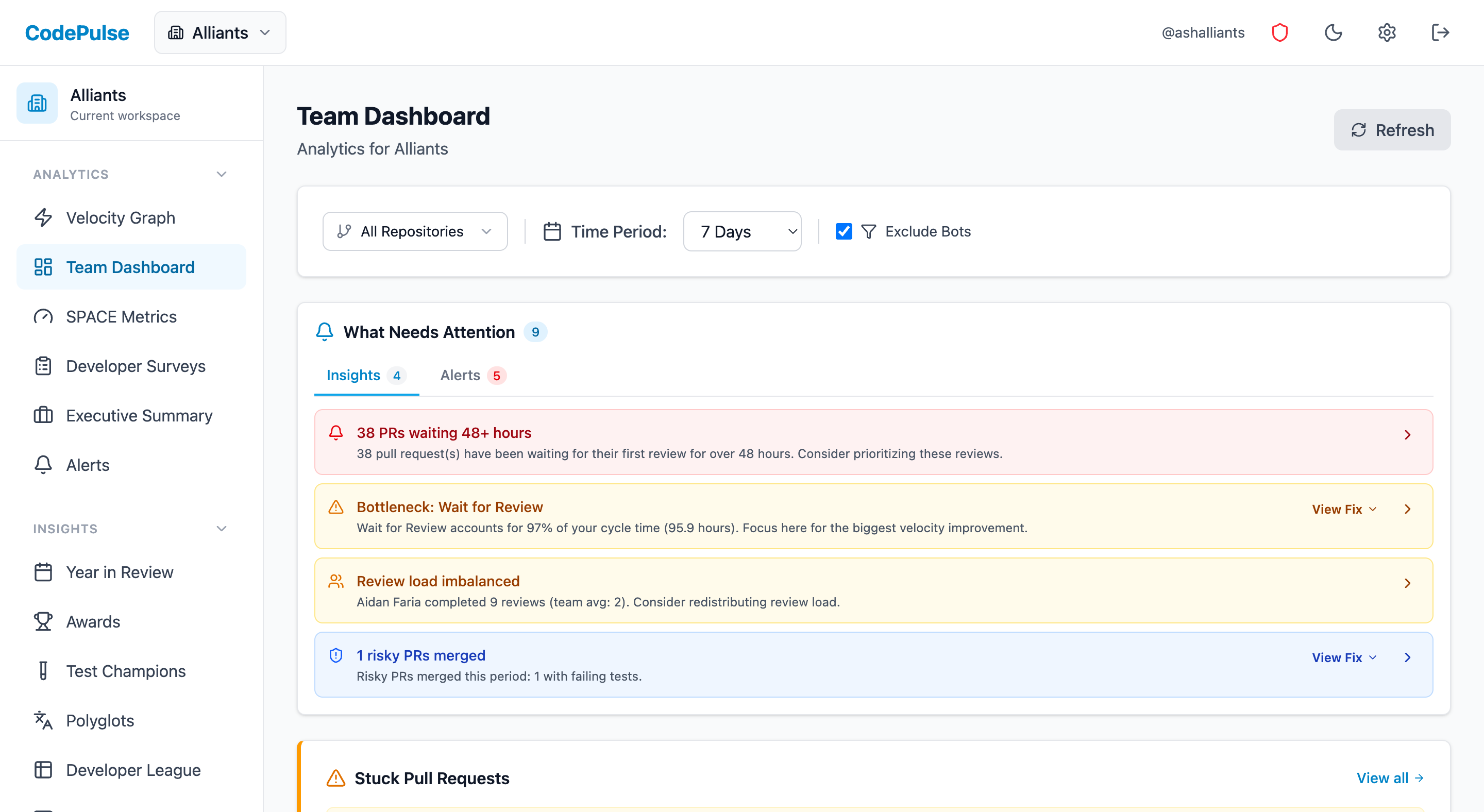
Evaluate CodePulse against your own delivery history
A comparison table only goes so far. Connect read-only GitHub in about five minutes and judge the output on your repositories, at one flat price, with no per-seat math.
Read-only GitHub · Your code stays yours · Team-level by default · No credit card
See These Features in Action
Measure the real productivity impact of AI coding assistants.
Measure review thoroughness and feedback quality across the team.
Related Guides
Best Code Review Tools 2026: GitHub, Graphite +4
Compare code review platforms and approaches, from GitHub native features to specialized tools and analytics solutions. Includes stacked PR tools, review benchmarks from 803K PRs, and a 6-tool feature matrix.
7 Code Review Rules That Actually Get PRs Approved Faster
Learn code review best practices backed by metrics. Covers reviewer guidelines, author guidelines, team practices, and how to measure review effectiveness.
AI Coding Tools: What Actually Changed After 6 Months
Measure the real impact of AI coding tools like Copilot and Cursor on your engineering team. Data-driven framework using cycle time, code churn, and review metrics.
5 Signs Your Code Review Culture Is Toxic (Fix #3 First)
Assess and improve your code review culture. Identify toxic patterns and build psychological safety in your engineering team.