
Turn this metric into a baseline for your team
Preview a system-level engineering health report, then connect GitHub when you are ready to compare this metric with your own delivery history.
Read-only GitHub · Your code stays yours · Team-level by default · No credit card
"We need more engineers" is easy to say. "Here's the data showing why we need 3.5 more FTEs to hit our Q3 roadmap" is what gets budget approved. This guide shows you how to build a data-driven case for engineering headcount using metrics executives actually understand.
This guide gives you the framework to translate engineering throughput into business terms - for justifying new hires, defending against cuts, or planning for growth.
The Challenge of Justifying Engineering Headcount
Why Engineering Headcount is Hard to Justify
Engineering headcount requests often fail because of a communication gap:
- Engineers think in: Complexity, technical debt, code quality, velocity points
- Executives think in: Revenue, costs, time-to-market, competitive advantage
- The gap: "We're too busy" doesn't translate to "Here's the business impact and solution"
Common Failure Modes
Headcount Request Patterns
- "The team is stressed and overworked" - Morale problem, not a staffing problem
- "We have too much technical debt" - Engineers want to do fun work, not ship features
- "Velocity is declining" - What does that actually mean for the business?
- "We can't deliver the roadmap" - Scope the roadmap down
- Lead with specific throughput data (X features/quarter)
- Quantify the gap (roadmap requires 2X current capacity)
- Show timeline impact (18 weeks behind, reduced to 6 weeks)
- Connect to revenue ($Y unblocked by adding 3 engineers)
Key Throughput Metrics for Capacity Planning
PRs Merged Over Time
The simplest throughput metric: how many PRs is your team shipping per week?
- Trend direction: Increasing, stable, or declining?
- Per-engineer rate: Total PRs / number of engineers
- Consistency: Is output predictable or highly variable?
PR throughput calculation:

Current state:
  Team size: 8 engineers
  PRs merged last month: 64
  Per-engineer rate: 8 PRs/month

Roadmap requirement:
  Features planned: 24 (next quarter)
  Avg PRs per feature: 6
  Total PRs needed: 144
  Current quarterly capacity: 192 (64 × 3)

Analysis:
  Capacity: 192 PRs
  Need: 144 PRs + buffer for bugs/support
  Status: Looks manageable, but...

Reality check:
  20% of time goes to bugs/support = 154 available
  10% buffer for unknowns = 139 available
  Status: Tight. Any surprises = missed deadlines.
Deployment Frequency
How often does code reach production? This connects engineering work to business value delivery.
- High deployment frequency: Team is shipping continuously, value delivered regularly
- Low deployment frequency: Batching work, longer time to value
- Declining frequency: May indicate capacity constraints
Lines of Code Per Day
LOC isn't a quality metric, but it's a capacity indicator:
- Useful for: Rough capacity estimation, trend analysis
- Not useful for: Comparing individual productivity, quality assessment
- Watch for: Declining LOC/day can indicate context switching, meetings overload, or technical debt
📊 Key Metrics in CodePulse
CodePulse's Dashboard provides the core metrics for capacity planning:
prs_merged- Total PRs merged over selected time perioddeployment_frequency_per_day- How often code ships to productionloc_per_day- Lines of code added/modified daily- Total contributors - Active engineers in period
Use the time period selector to view 7d, 30d, 90d trends.
Using Benchmarks to Show Team is Understaffed
Why Benchmarks Matter
Internal metrics show trends, but benchmarks show how you compare to peers. This is powerful for headcount conversations:
- "Our cycle time is 72 hours" - Exec doesn't know if that's good or bad
- "Our cycle time is 72 hours vs industry median of 24 hours"- Now it's clear there's a gap
Key Benchmarks for Comparison
Cycle Time
Interpretation:
Deployment Frequency
Interpretation:
PR Size
Interpretation:
Review Coverage
Interpretation:
CodePulse's Benchmarks page compares your metrics against industry standards, giving you ready-made talking points for headcount discussions.
Trend Analysis: Declining Velocity as a Hiring Signal
Recognizing Capacity Strain
Declining throughput over multiple periods is a strong signal of capacity constraints:
Example trend analysis:

PRs Merged Per Month (8-engineer team):
  January:   72 PRs (9.0 per engineer)
  February:  68 PRs (8.5 per engineer)
  March:     61 PRs (7.6 per engineer)
  April:     54 PRs (6.8 per engineer)
  May:       48 PRs (6.0 per engineer)

Decline: 33% over 5 months

Contributing factors to investigate:
- Increased operational load (support, incidents)
- Technical debt slowing development
- More complex features taking longer
- Team members stretched across more projects
- Onboarding new hires reducing senior bandwidth
Correlating with Business Impact
Connect declining velocity to business outcomes:
- Roadmap delay: "At current velocity, Feature X ships in Q4 instead of Q3"
- Revenue impact: "Each month of delay costs $Y in deferred revenue"
- Competitive risk: "Competitor shipped similar feature last month"
- Technical debt compounding: "Each month of shortcuts adds Z hours of future work"
Historical Trend Charts
CodePulse provides 8-week trend charts for all key metrics. Use these to:
- Show velocity trends over time (PRs merged, deployment frequency)
- Identify inflection points where performance changed
- Correlate with events (team changes, project starts, incidents)
Building the Business Case with CodePulse Data
The Executive Summary Format
Structure your headcount request to lead with business impact:
Headcount Request: Engineering Team
Q3 Capacity PlanningData to Include
Pull these metrics from CodePulse for your business case:
- Current throughput: PRs merged, deployment frequency, features shipped (from Dashboard)
- Trend direction: 8-week trends showing velocity changes (from MetricTrend)
- Benchmark comparison: How you compare to industry (from Benchmarks page)
- Contributor count: Active engineers in period (from Dashboard)
- Supporting quality metrics: Cycle time, review coverage, risk indicators
Presenting Headcount Requests to Leadership
Know Your Audience
Different stakeholders care about different things:
Tailoring Your Message
"Show me total cost (fully-loaded), ROI calculation, comparison to alternatives (contractors, outsourcing), and payback period."
"I care about strategic roadmap alignment, competitive positioning, time-to-market impact, and risk to key initiatives."
"Tell me about roadmap delivery, feature prioritization implications, trade-offs (what ships vs what doesn't), and customer commitments at risk."
"We focus on growth trajectory, efficiency ratios (revenue per engineer), industry comparisons, and how our hiring plan compares to competitors."
Anticipate Objections
Prepare responses to common pushback:
- "Can you do more with the current team?"
→ Show efficiency metrics, explain what's already been optimized - "What if we just cut scope?"
→ Present trade-offs with business impact of each cut - "Can we use contractors instead?"
→ Compare ramp-up time, institutional knowledge, long-term cost - "What about automation/tools?"
→ Explain what's already automated and what has diminishing returns
The Alternatives Framework
Present headcount as one option among several, with trade-offs:
Options analysis:

Option A: Add 3 engineers
- Cost: $XXX/year
- Result: Ship 7 features/quarter
- Risk: Hiring takes time, onboarding required

Option B: Add 2 engineers + contractors
- Cost: $XXX/year
- Result: Ship 6 features/quarter
- Risk: Contractor ramp-up, knowledge retention

Option C: Maintain current team
- Cost: $0 additional
- Result: Ship 4 features/quarter
- Risk: Roadmap slip, competitor gap, burnout

Option D: Cut 30% of roadmap
- Cost: $0 additional
- Result: Ship 4 features on reduced scope
- Risk: Feature Y cut → $X revenue impact

Recommendation: Option A provides best
ROI given strategic importance of Q3 roadmap.
Ongoing Tracking and Adjustment
After getting headcount approved, continue tracking to show ROI:
- Onboarding progress: New hire ramp-up time to full productivity
- Throughput recovery: PRs merged, deployment frequency improving
- Roadmap progress: Features delivered vs plan
- Team health: Overtime hours, burnout indicators decreasing
For more on metrics-driven conversations with leadership, see our guides on Engineering Analytics ROI and Board-Ready Engineering Metrics.
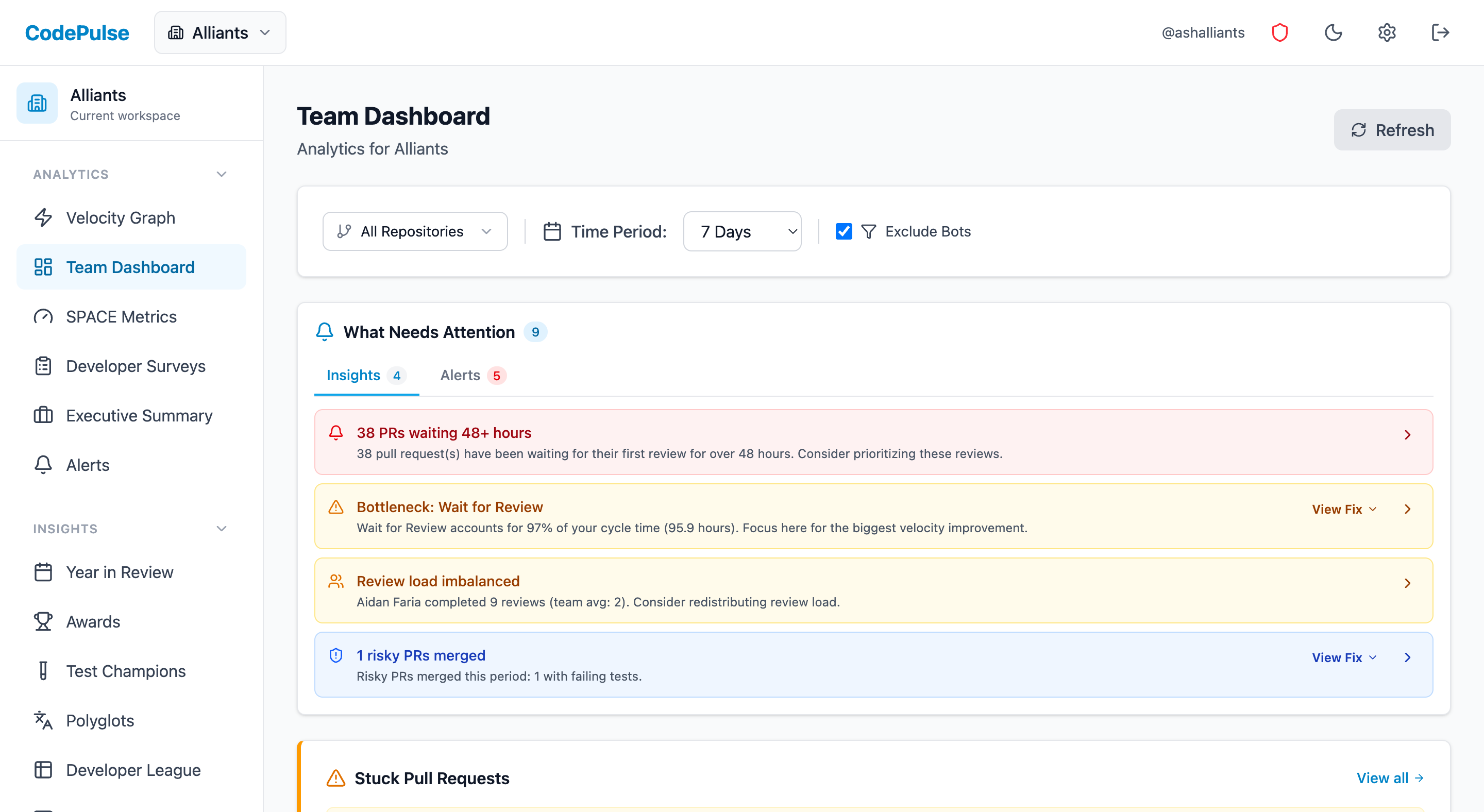
Now measure this metric on your own repositories
Connect read-only GitHub in about five minutes and get your baseline, your trend, and the constraint behind it. Your fourteen usable trial days start when the first repository finishes syncing.
Read-only GitHub · Your code stays yours · Team-level by default · No credit card
See These Features in Action
Board-ready engineering performance in a single page.
Predict delivery timelines based on historical velocity trends.
Related Guides
Engineering Analytics ROI: The Budget Approval Playbook
Calculate the ROI of engineering analytics tools with formulas for time savings, payback period, and a business case template tailored to CFOs, CTOs, and CEOs.
I Got $2M in Budget With These 5 Engineering Metrics
Learn how to create engineering metrics presentations that resonate with board members, investors, and C-suite executives.
Your PR Cycle Time Is Fine (Here's the Benchmark)
What is a good PR cycle time? Benchmarks and targets based on team size, industry, and engineering maturity.
Stop Guessing Capacity. Your PRs Already Know
Use PR metrics to build data-driven capacity models, plan sprints realistically, and communicate engineering capacity to stakeholders.
Engineering Metrics Dashboard: The 7 Metrics You Need
Skip vanity metrics. Here are the 7 engineering metrics VPs actually need to track team performance, delivery, and quality.
DORA Metrics Explained: The 4 Keys Without the Hype
A complete breakdown of the four DORA metrics - deployment frequency, lead time, change failure rate, and MTTR - with honest benchmarks and gaming traps to avoid.