
Understand the system around the team, not a developer leaderboard
Preview team-level workload, collaboration, and delivery signals designed for process improvement rather than performance grading.
Read-only GitHub · Your code stays yours · Team-level by default · No credit card
Engineering onboarding is often a mix of intuition and tribal knowledge. New hires get paired with whoever's available, pointed at a wiki that's three years out of date, and left to figure things out. But your Git history contains a wealth of data that can make onboarding faster, more targeted, and more effective.
How do you use Git data to accelerate engineering onboarding?
Your Git history is a real-time map of your codebase that reveals who owns what, what changes most, and who reviews each area. Use commit and review data to match new hires with the right mentors, focus learning on high-churn files where they will actually work, and track ramp-up with concrete metrics like commit frequency and PR cycle time. Teams using data-driven onboarding typically cut ramp-up time by 2-4 weeks. CodePulse surfaces domain experts, file hotspots, and knowledge silos automatically.
This guide shows you how to use Git activity data to identify the right mentors, focus onboarding on high-impact areas, and track how quickly new hires are ramping up.
Why Does Data-Driven Onboarding Work?
The Problem with Traditional Onboarding
Most engineering onboarding suffers from common problems:
- Random mentor assignment: New hires get paired with whoever's free, not necessarily who knows the code they'll work on
- Generic curriculum: Everyone reads the same docs, regardless of their role or first project
- Outdated documentation: Wikis and READMEs don't reflect how the code actually works today
- No progress visibility: Managers can't tell if onboarding is working until the new hire either succeeds or struggles
🔥 Our Take
The "high performer" on your team is often just the most visible person, not the best mentor.
Stop assigning mentors based on seniority or who volunteers first. The best mentor for a new hire working on payments code is the person who has reviewed the most payments PRs recently, not the principal engineer who touched it two years ago. Git data replaces gut feelings with evidence. Use it.
What Git Data Tells You
Your Git history is a real-time map of your codebase:
- Who owns what: Commit history shows who has worked on each file and module most recently
- What changes most: High-churn files are where new hires will likely need to work
- Who reviews what: Review patterns show who's best positioned to mentor in each area
- Ramp-up patterns: Past new hire activity shows normal progression curves
"Your Git history is a better onboarding guide than any wiki. The wiki tells you how things should work. Git tells you how they actually work."
Benefits of Data-Driven Onboarding
- Faster ramp-up: New hires learn from the right people about the right code
- Better mentor matches: Pairing based on actual expertise, not availability
- Targeted learning: Focus on high-impact areas, not the entire codebase
- Measurable progress: Track ramp-up with concrete metrics
How Do You Identify Domain Experts for Pairing?
Finding the Right Mentor
The ideal mentor for a new hire isn't just someone senior - it's someone who:
- Has deep knowledge of the code the new hire will work on
- Is actively working in that area (not someone who touched it 2 years ago)
- Has bandwidth to mentor (isn't already overloaded)
- Has good communication skills (subjective, but important)
Using Git Data to Find Experts
Analyze recent commit and review activity to identify domain experts:
Domain Expert Analysis: src/payments/
Commits in last 6 monthsBut commits only show authorship. Review activity shows who understands the code well enough to review it:
Commit Author vs. Code Reviewer: Who Makes a Better Mentor?
"Authored 45 commits in payments/ - deep expertise in code she wrote, but may be focused on specific features"
"Reviewed 60 PRs touching payments/ - seen many approaches to problems, broader perspective makes her a better mentor choice"
📊 How to See This in CodePulse
CodePulse automatically surfaces domain experts based on both commit and review activity:
- File Hotspots shows which engineers are the primary contributors to each file and module
- Review Network shows who reviews code in each area, identifying reviewers who can serve as mentors
- Developer Leaderboard shows activity levels to ensure potential mentors have bandwidth
Use these to match new hires with the right mentors based on actual expertise, not just seniority.
"The best onboarding programs match new hires with recent experts, not historical ones. Code ownership is a moving target."
Avoiding Single Points of Failure
Sometimes your "domain expert" is actually a knowledge silo - one person who's the only one who knows an area. This is a warning sign:
- For onboarding: If only one person knows an area, they might not have bandwidth to mentor
- For the team: Knowledge silos are bus factor risks
- Opportunity: Onboarding a new hire into a silo area helps spread knowledge
What Are the High-Impact Areas to Focus Onboarding On?
Not All Code Is Equal
New hires can't learn the entire codebase at once. Focus onboarding on:
- High-churn files: Code that changes frequently is where they'll work most
- Their team's domain: The specific modules their team owns
- Critical paths: Core business logic they'll need to understand
Identifying High-Churn Areas
Code hotspots - files that change frequently - are where new hires will spend most of their time:
High-Churn Files: Last 3 Months
Onboarding priorities🔥 How CodePulse Helps
The File Hotspots page shows your highest-churn files with:
- Change frequency (commits touching each file)
- Number of contributors (who works on it)
- Risk level (high churn + few contributors = risk)
Use this to build a prioritized list of code areas for new hires to learn first.
Building a Learning Path
Combine high-churn data with domain ownership to create a targeted learning path:
Example: New backend engineer joining Payments team
Week 1: Core Concepts
- Read: Architecture overview (wiki)
- Deep dive: src/services/payment-processor.ts (87 changes)
- Mentor: Alice (primary contributor)
Week 2: API Layer
- Deep dive: src/api/orders/handler.ts (142 changes)
- Task: Fix small bug in this file
- Mentor: Bob (secondary contributor)
Week 3: Integration Points
- Deep dive: src/integrations/stripe/
- Task: Add logging to payment flow
- Mentor: Carol (reviewed most Stripe PRs)
Week 4: First Feature
- Assigned real ticket in payments domain
- Reviewers: Alice, Bob (spread knowledge)
How Do You Track Onboarding Ramp-Up Progress?
What Ramp-Up Looks Like in Data
A healthy onboarding progression shows up in Git activity:
- Week 1-2: Few commits, mostly documentation reads and environment setup
- Week 3-4: First small commits, high review feedback
- Month 2: Regular commits, feedback decreasing as code quality improves
- Month 3: Contributing like a team member, starting to review others' code
Metrics to Track
Monitor these metrics to gauge onboarding progress:
1. Commit Frequency
Track commits over time. Healthy pattern: starts slow, ramps up, stabilizes around team average by month 2-3.
Healthy New Hire Commit Pattern
Expected ramp-up trajectory2. PR Cycle Time
New hires typically have longer cycle times initially due to more review rounds. This should decrease:
Healthy New Hire PR Cycle Time
Expected improvement over time3. Review Participation
A key milestone: when new hires start reviewing others' code. This signals they understand the codebase well enough to evaluate others' work.
4. First-Time Review Approval Rate
Track how often the new hire's PRs are approved on first review vs. needing changes. Early: low. Over time: should approach team average.
Setting Expectations
Share ramp-up expectations with both the new hire and their manager:
Onboarding Milestones
End of Week 1
- Dev environment working
- First commit (even if trivial)
- Met with mentor 2+ times
End of Week 2
- First PR merged
- Understands team's main workflows
- Can navigate codebase
End of Month 1
- Completed 3+ PRs
- Fixed at least one bug independently
- Understands team's domain
End of Month 2
- Working on features independently
- PR cycle time approaching team norm
- Starting to review others' PRs
End of Month 3
- Contributing like a full team member
- Can mentor on specific areas they've learned
- Identified first improvement/initiative
How Do You Build an Effective Onboarding Checklist?
Before Day 1
- Identify domain expert mentor using Git/review data
- Pull list of high-churn files in new hire's team domain
- Prepare first small task (bug fix in a hotspot file)
- Schedule mentor 1:1s for first two weeks
Week 1: Environment and Context
- Dev environment setup (documented, mentor assists)
- Codebase walkthrough focusing on high-churn areas
- First trivial commit (typo fix, small improvement)
- Daily check-ins with mentor
Week 2: First Contribution
- Assigned first real task (small bug or minor feature)
- First PR opened and reviewed
- Learn team's PR conventions and review culture
- Attend team ceremonies (standup, planning, retro)
Month 1: Building Momentum
- Complete 3-5 PRs of increasing complexity
- Deep dive into one module (with domain expert)
- Identify one area for documentation improvement
- Weekly mentor 1:1s continue
Month 2-3: Full Participation
- Take on feature-level work
- Start reviewing others' PRs
- Contribute to technical discussions
- Mentor check-ins become bi-weekly
Tracking Success
Create a simple dashboard to track each new hire's progress:
New Hire: Jane (Backend, Payments team)
Start Date: Jan 15 | As of Feb 15Manager Notes
"Strong ramp-up, ahead of typical timeline"
"Particularly quick on payments code (mentor match worked)"
"Needs more exposure to observability tooling"
Data-driven onboarding takes the guesswork out of bringing new engineers up to speed. By using Git activity to match mentors, focus learning, and track progress, you can cut ramp-up time and set new hires up for success from day one.
Frequently Asked Questions
Run git shortlog to find who has the most recent commits in the code area the new hire will work on. But also check review activity: someone who has reviewed 60 PRs touching a module often makes a better mentor than someone who authored 45 commits, because they have seen more diverse approaches and have a broader perspective on the codebase.
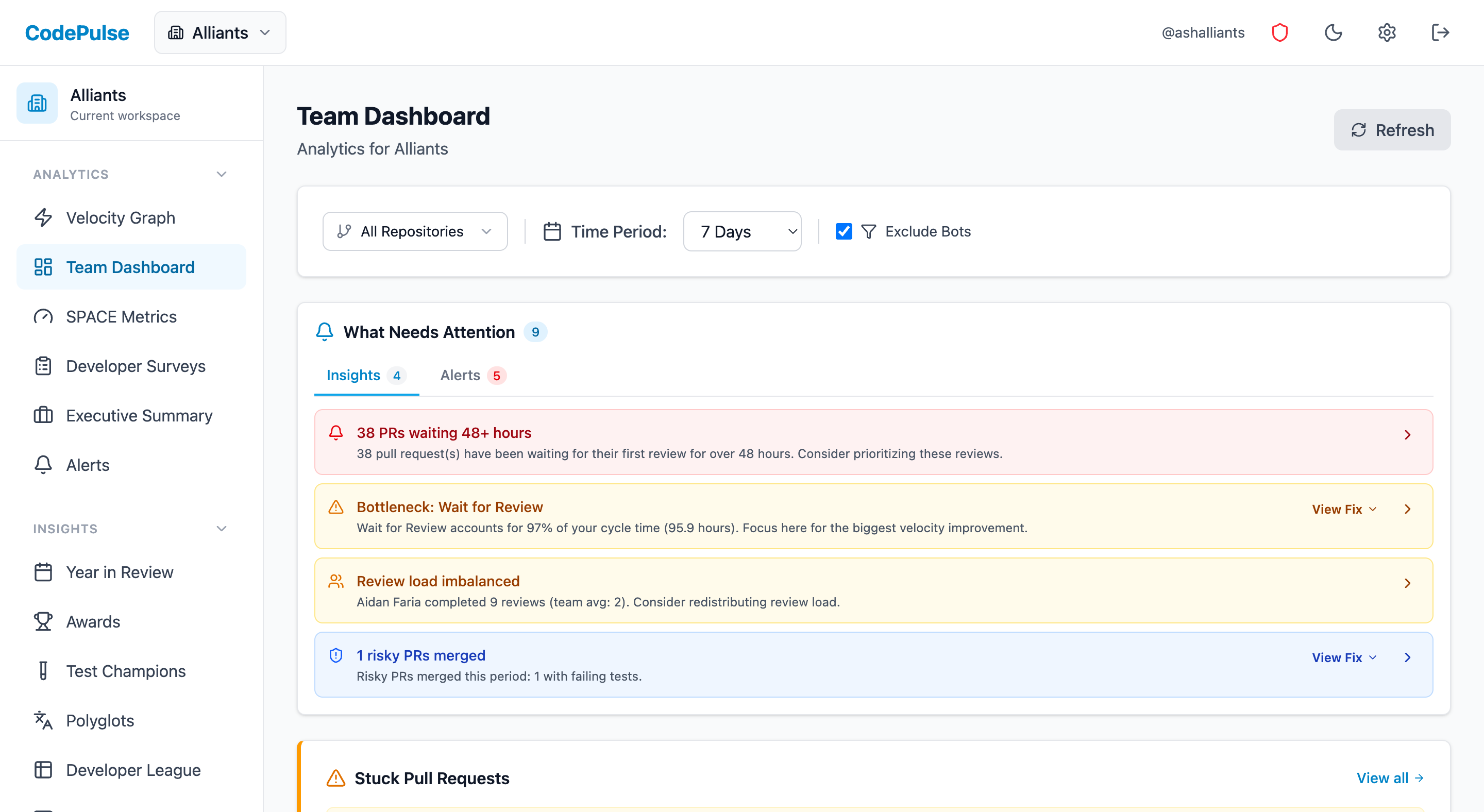
Get this view for your own teams
Connect GitHub for team-level workload, review distribution, and delivery signals. Individual views stay off unless your organisation explicitly turns them on.
Read-only GitHub · Your code stays yours · Team-level by default · No credit card
See These Features in Action
Compare contribution patterns for coaching, not surveillance.
Detect bus-factor-1 code before it becomes an operational risk.
Related Guides
The 'Bus Factor' File That Could Kill Your Project
Use the Bus Factor Risk Matrix to identify where knowledge concentration creates hidden vulnerabilities before someone leaves.
Engineering Metrics That Won't Get You Reported to HR
An opinionated guide to implementing engineering metrics that build trust. Includes the Visibility Bias Framework, practical do/don't guidance, and a 30-day action plan.
Engineering Awards That Won't Destroy Your Culture
Build a data-driven recognition program that celebrates engineering achievements without creating toxic competition. 15 award categories, program design checklist, and measurement framework.
5 Signs Your Code Review Culture Is Toxic (Fix #3 First)
Assess and improve your code review culture. Identify toxic patterns and build psychological safety in your engineering team.
Daily Standups: The 15-Minute Meeting Most Teams Get Wrong
Daily standups are the most common - and most commonly misused - meeting in software. This guide shows better formats (async, walk-the-board, exception-based), rules that work, and anti-patterns to avoid.
Engineering Metrics Rollout: The Trust-First Playbook
A change management playbook for rolling out engineering metrics without triggering developer resistance. Covers communication plans, staff engineer buy-in, trial structure, and anti-gaming safeguards.
The PR Comment Sweet Spot (Hint: It's Not Zero)
Learn what healthy code review comment volumes look like, industry benchmarks by team type, and how to balance thorough reviews with velocity.
Brooks's Law: Why Adding Engineers Slows Delivery
What Fred Brooks actually wrote in 1975, the three mechanisms behind the law, what 580k+ commits of modern data show, whether AI changes it, and how to see it in your own Git history.