

Understand the system around the team, not a developer leaderboard
Preview team-level workload, collaboration, and delivery signals designed for process improvement rather than performance grading.
Read-only GitHub · Your code stays yours · Team-level by default · No credit card
Working agreements are the explicit rules your engineering team agrees to follow. They cover everything from code review turnaround times to meeting etiquette to how you handle disagreements. When done well, they reduce friction and create predictability. When done poorly, they're ignored documents that collect dust. This guide shows you how to create working agreements that actually work.
Want the fast path? Our free Working Agreement Generator builds a ready-to-edit markdown agreement from the clauses in this guide - nothing leaves your browser.
What should an engineering team working agreement include?
Effective working agreements cover five areas: code review turnaround times (e.g., first review within 4 hours), PR size limits (under 400 lines), meeting norms (no-meeting blocks for focus time), communication channels (when to use Slack vs email vs meetings), and on-call expectations. The key is making them measurable. 'Review PRs quickly' fails. 'First review within 4 business hours for PRs under 400 lines' works because the team can track compliance.
"The best working agreements are the ones you don't have to think about - they're just how the team operates. The worst are the ones posted on the wall that nobody follows."
What Are Working Agreements?
A working agreement is a set of guidelines that a team creates together to define how they'll work. Unlike policies imposed from above, working agreements are team-owned - created by the people who follow them, for the people who follow them.
Working agreements typically cover:
- Communication: Response times, meeting norms, async vs. sync
- Code practices: Review turnaround, PR size limits, testing requirements
- Collaboration: Pairing expectations, knowledge sharing, documentation
- Availability: Core hours, on-call expectations, time-off communication
- Decision-making: How to resolve disagreements, escalation paths
Why Working Agreements Matter
Without explicit agreements, teams operate on implicit assumptions - and assumptions diverge. One engineer thinks "I'll review PRs when I have time." Another thinks "PRs should be reviewed within 4 hours." Both are frustrated, neither is wrong, and nothing improves until someone makes it explicit.
Benefits of Good Working Agreements
| Benefit | How It Helps |
|---|---|
| Reduced friction | Clear expectations prevent conflicts before they start |
| Faster onboarding | New team members know "how we do things" immediately |
| Better async work | Distributed teams need explicit norms to avoid delays |
| Accountability | Shared agreements can be referenced when patterns break |
| Continuous improvement | Explicit agreements can be explicitly changed when they don't work |
/// Our Take
Working agreements without measurement are wishes. If you agree to "review PRs within 4 hours," you need to track whether that's happening.
This is where tools like CodePulse fit in - not to enforce agreements, but to make them visible. When everyone can see that review pickup time is 8 hours instead of 4, the conversation shifts from blame to problem-solving.
Working Agreement Examples
Here are concrete examples organized by category. Don't copy these directly - use them as starting points for your team's discussion.
Code Review Agreements
## Code Review Working Agreements

### Turnaround Time
- PRs should receive initial review within 4 business hours
- Authors should respond to review comments within 24 hours
- If you can't review in time, communicate in Slack

### PR Standards
- PRs should be <400 lines of code (excluding tests, generated files)
- Every PR needs at least 2 reviewers for production code
- Self-merging is allowed for typos/docs with no code changes

### Review Quality
- Approve means "I would ship this" - not "I looked at it"
- Blocking comments should explain why AND suggest alternatives
- Use "nit:" prefix for style suggestions that shouldn't block

### When to Pair Instead
- If a PR will take >30 minutes to review, consider pairing
- Complex architectural changes should be discussed before coding
Communication Agreements
## Communication Working Agreements

### Async vs. Sync
- Default to async (Slack, docs, PRs)
- Meetings are for discussion, not information sharing
- Urgent issues: Slack with @mention, then escalate to call if no response in 30min

### Response Expectations
- Slack DMs: Respond within 4 hours during work hours
- @channel mentions: Read within 2 hours
- Email: Respond within 24 hours (or set auto-reply if OOO)

### Meeting Norms
- Meetings start on time (no waiting for latecomers)
- Camera on for team meetings, optional for large meetings
- End meetings 5 minutes early to allow breaks
- Decline meetings without agendas

### Documentation
- Decisions should be documented in writing (Confluence/Notion)
- "If it's not written down, it didn't happen"
- PRs should link to relevant docs/tickets
Availability Agreements
## Availability Working Agreements

### Core Hours
- Core collaboration hours: 10am-4pm [timezone]
- Meetings should be scheduled within core hours
- No expectation to respond outside core hours

### Focus Time
- Everyone blocks 2+ hours of focus time daily
- Respect focus time - don't interrupt unless urgent
- Use Slack status to signal availability

### Time Off
- Announce PTO in team channel at least 1 week ahead
- Ensure coverage for on-call and critical reviews
- Out of office = actually offline (no "just checking in")

### After Hours
- Production incidents may require after-hours response
- Non-urgent issues wait until next business day
- No shame in not responding to weekend Slack
Creating Effective Working Agreements
"The process of creating working agreements is as valuable as the agreements themselves. It forces the team to surface assumptions and find common ground."
Step 1: Identify Pain Points
Start with what's broken. Ask the team:
- What causes friction or frustration in how we work?
- What assumptions have caused misunderstandings?
- What do you wish was more predictable?
Step 2: Draft Together
Working agreements should be created by the team, not imposed by managers. This means:
- Schedule a dedicated session (60-90 minutes)
- Everyone contributes - not just the loudest voices
- Focus on behaviors, not personalities
- Write down exactly what you agree to
Step 3: Make Agreements Specific
Vague agreements are useless. Compare:
| ❌ Vague | ✅ Specific |
|---|---|
| "Review PRs quickly" | "First review within 4 hours" |
| "Keep PRs small" | "PRs under 400 lines of code" |
| "Be responsive on Slack" | "Respond to DMs within 4 hours during work hours" |
| "Respect focus time" | "Don't interrupt people with 'Focus' Slack status" |
Step 4: Make Agreements Measurable
If you can't measure it, you can't improve it. For each agreement, identify:
- How will we know if we're following this?
- What data can we look at?
- How often will we check?
📊 How to See This in CodePulse
CodePulse can track several working agreement metrics automatically:
- Review turnaround: Dashboard shows "Wait for Review" time - your pickup SLA
- PR size: Track average PR size to see if "<400 lines" is being followed
- Review coverage: Review Insights shows if PRs have the required number of reviewers
- Load balance: Review Network reveals if review load is evenly distributed
Enforcing (or Not) Working Agreements
Here's the uncomfortable truth: working agreements that require enforcement have already failed. The goal is agreements that the team wants to follow because they make work better.
What Works
- Visibility: Show metrics in team retros, not to blame but to discuss
- Accountability partners: Pair people to remind each other
- Automation: PR size limits in CI, Slack reminders for stale PRs
- Regular review: Check agreements quarterly - update what isn't working
What Doesn't Work
- Punishment: Fining people for violations creates resentment
- Public shaming: Calling out individuals damages trust
- Manager enforcement: Turns team agreements into top-down rules
- Rigid adherence: Agreements should have escape valves for exceptions
"If an agreement is consistently broken, the problem isn't the people - it's the agreement. Either it's unrealistic, unclear, or addressing the wrong problem."
Working Agreements for Agile Teams
Agile teams often have additional agreements around ceremonies and processes:
Sprint Agreements
## Sprint Working Agreements

### Planning
- Sprint planning is 1 hour max
- Only items with clear acceptance criteria enter the sprint
- Capacity is calculated after accounting for PTO and meetings

### Daily Standup
- Standup at [time], max 15 minutes
- Focus on blockers, not status updates
- Deep dives happen after standup, not during

### Sprint Review
- Demo working software, not slides
- Stakeholders can attend but questions are held until the end
- Celebrate wins before discussing improvements

### Retrospective
- What we discuss in retro stays in retro
- Focus on systems, not people
- Every retro produces at least one actionable improvement
Working Agreements for Distributed Teams
Remote and distributed teams need more explicit agreements because they can't rely on office-proximity cues:
## Distributed Team Working Agreements

### Timezone Considerations
- Core overlap hours: 2pm-6pm UTC
- Async updates in Slack replace synchronous standups
- Record all meetings for people in other timezones

### Communication
- Slack status reflects true availability
- Over-communicate when blocked - don't wait for someone to ask
- Use video for complex discussions, async for simple updates

### Handoffs
- End-of-day updates in #team-updates channel
- PRs should be self-explanatory (don't assume reviewer can ask questions)
- Document decisions in writing - "we talked about it" doesn't scale

### Trust and Autonomy
- No tracking software or "productivity" monitoring
- Judge by outcomes, not hours online
- Assume good intent when messages seem terse
Keeping Agreements Alive
Working agreements decay. Team composition changes, tools change, and what worked six months ago might not work now. Build in regular reviews:
Quarterly Review Checklist
- Are we following our agreements? Look at actual data (review time, PR size, etc.)
- Which agreements are consistently broken? Discuss why - maybe they need updating
- What new friction has emerged? Add agreements for new pain points
- What's no longer relevant? Remove agreements that don't matter anymore
- Do new team members know about these? Update onboarding docs
Related Guides
- Async Code Review for Distributed Teams - How to make code review work across time zones
- Reduce PR Cycle Time - Tactics to speed up your review process
- Review Load Balancing - Distribute review work fairly across the team
- Engineering Metrics Without Surveillance - Using data without creating a surveillance culture
Conclusion
Working agreements are the operating system for how your team collaborates. They turn implicit assumptions into explicit commitments, reduce friction, and create accountability. But they only work if:
- The team creates them together - not imposed from above
- They're specific and measurable - not vague aspirations
- They're visible and tracked - not forgotten in a doc somewhere
- They evolve over time - updated when they stop working
"Your team already has working agreements - they're just implicit. Make them explicit, and you can actually improve them."
Start small. Pick one or two areas of friction and create agreements for those. Use tools like CodePulse to track whether you're following your own rules. And remember: the goal isn't compliance - it's a team that works better together.
Frequently Asked Questions
Working agreements are explicit, team-created rules that define how the team operates. They cover code review expectations, communication norms, availability, and decision-making processes. Unlike top-down policies, working agreements are owned and maintained by the team itself.
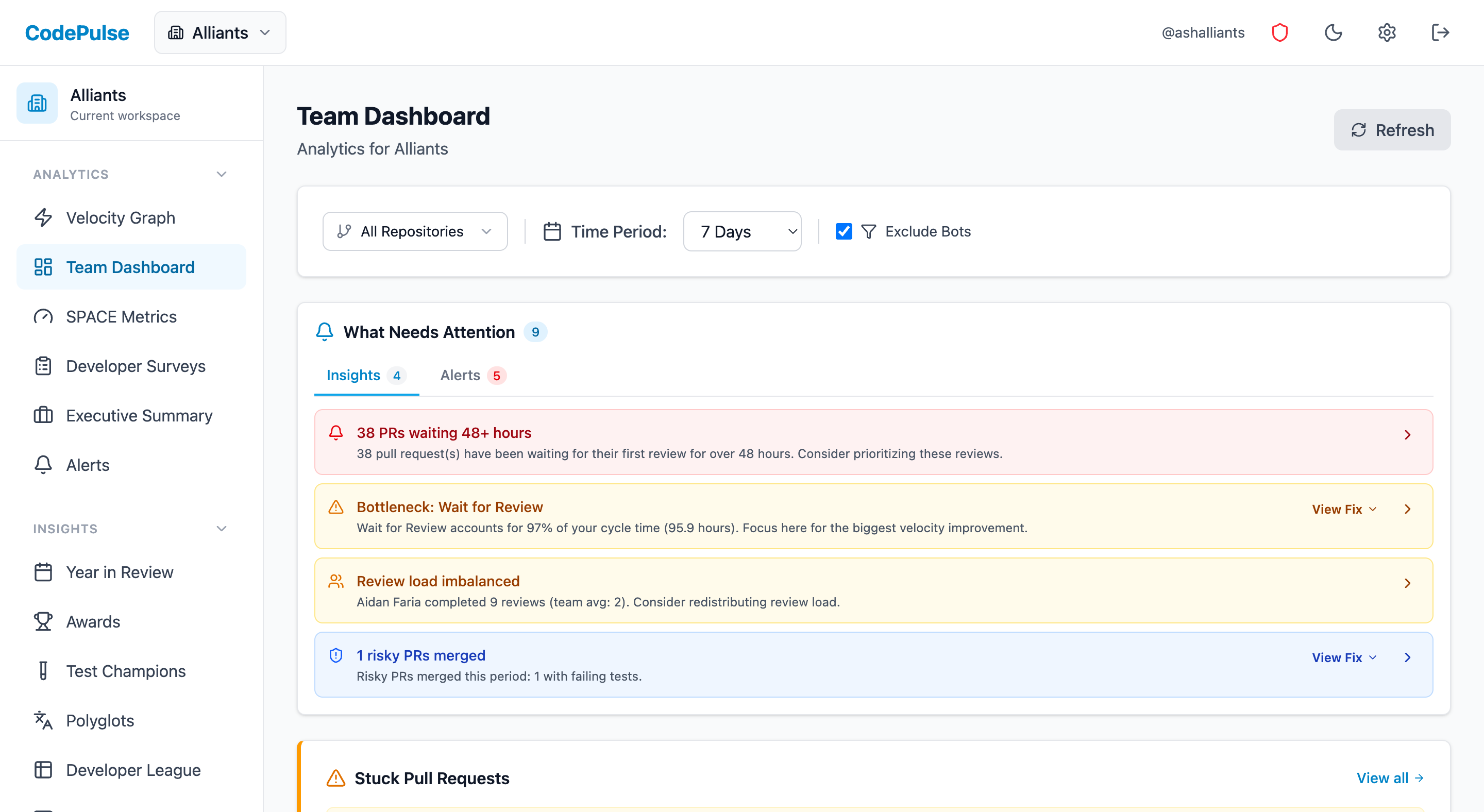
Get this view for your own teams
Connect GitHub for team-level workload, review distribution, and delivery signals. Individual views stay off unless your organisation explicitly turns them on.
Read-only GitHub · Your code stays yours · Team-level by default · No credit card
See These Features in Action
Interactive graph of review relationships and workload distribution.
Break down cycle time into coding, waiting, review, and merge phases.
Related Guides
Remote Code Reviews Are Broken. Here's the 3-Timezone Fix
How to run effective code reviews across time zones without sacrificing quality or velocity.
We Cut PR Cycle Time by 47%. Here's the Exact Playbook
A practical playbook for engineering managers to identify bottlenecks, improve review processes, and ship code faster - without sacrificing review quality.
Your Best Engineer Is About to Quit (Check Review Load)
Learn how to identify overloaded reviewers, distribute review work equitably, and maintain review quality without burning out your senior engineers.
How to Measure Developers Without Becoming the Villain
Learn how to implement engineering metrics that developers actually trust, focusing on insight over surveillance and team-level patterns.