
Turn this metric into a baseline for your team
Preview a system-level engineering health report, then connect GitHub when you are ready to compare this metric with your own delivery history.
Read-only GitHub · Your code stays yours · Team-level by default · No credit card
GitHub provides activity data for individual users and repositories, but engineering leaders need team-level visibility. How is your team performing? Where are the bottlenecks? How does work flow across team members? This guide shows you how to get meaningful team analytics from your GitHub data.
Whether you manage one team or multiple, team-level metrics give you the visibility to make informed decisions about process, resources, and priorities. For a quick before-you-connect-anything look at any public GitHub org's activity profile, our free GitHub org analyzer gives team-size, contributor, and activity estimates in seconds.
Why Individual GitHub Insights Aren't Enough
The Visibility Gap
GitHub's built-in insights show repository activity and individual contribution graphs. But these don't answer the questions leaders actually need to answer:
- Is my team hitting our delivery commitments?
- Are we getting faster or slower over time?
- Who is overloaded? Who has capacity?
- How well is the team collaborating?
- Where are the bottlenecks in our process?
The Context Problem
Individual metrics without team context are misleading. A developer with fewer commits might be:
- Mentoring junior team members
- Doing architecture and design work
- Handling code reviews for the team
- Working on a complex problem that requires research
- Or genuinely struggling and needing support
Team-level metrics provide context that individual metrics lack.
The Aggregation Challenge
Rolling up individual data to team level isn't straightforward:
- Team membership changes over time
- People work across multiple repositories
- Collaboration happens across team boundaries
- Work types vary (features, bugs, maintenance)
You need analytics that understand team structure, not just repository structure.
Team-Level Metrics That Matter
Delivery Metrics
| Metric | What It Tells You |
|---|---|
| Team cycle time | How fast the team ships from commit to merge |
| PR throughput | Volume of completed work over time |
| Deployment frequency | How often the team releases to production |
| Review wait time | Bottlenecks in the review process |
These metrics, tracked as team aggregates with trends over time, reveal whether your delivery capability is improving. See our DORA metrics guide for deeper context.
Quality Metrics
| Metric | What It Tells You |
|---|---|
| Review coverage | Percentage of code that gets reviewed |
| Code churn rate | Rework and instability in the codebase |
| Average PR size | Whether PRs are sized for effective review |
| Test failure rate | CI reliability and code quality |
Learn more in our code quality metrics guide.
Collaboration Metrics
| Metric | What It Tells You |
|---|---|
| Review network density | How connected the team is through reviews |
| Reviewer distribution | Whether review load is balanced |
| Knowledge distribution | Bus factor and knowledge silos |
| Cross-team interactions | Dependencies and collaboration outside team |
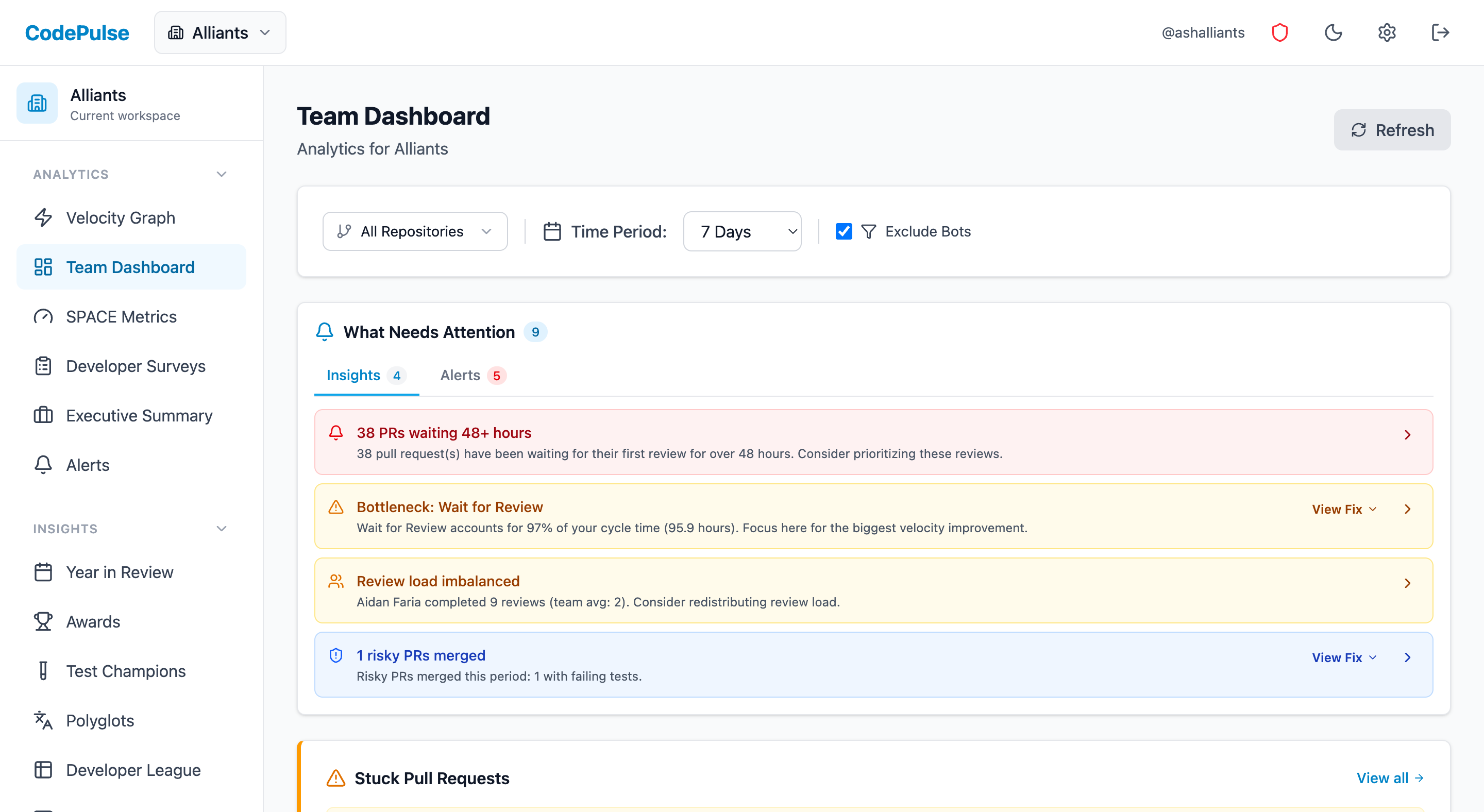
📊 How to See This in CodePulse
Navigate to Review Network to visualize team collaboration:
- See who reviews whose code with line thickness showing frequency
- Identify isolated team members and collaboration gaps
- Spot reviewer bottlenecks and load imbalances
Cross-Team Collaboration Patterns
Healthy vs Unhealthy Patterns
Review network visualization reveals collaboration health:
- Healthy: Dense connections within team, some connections to other teams, no isolated members
- Unhealthy: One person reviews everything (bottleneck), isolated members with no review connections, no cross-team interaction
Cross-Team Dependencies
When your team frequently needs reviews from other teams, it creates dependencies that can slow delivery. Watch for:
- PRs that wait for reviewers outside your team
- High percentage of reviews coming from other teams
- Recurring requests to specific individuals outside the team
High cross-team dependency might indicate unclear boundaries or missing expertise within the team.
Knowledge Silos
When only one person touches certain code, you have a knowledge silo. At team level, look for:
- Modules where only one team member commits
- Reviews always going to the same person for certain areas
- Long wait times when specific individuals are unavailable
Address silos through pairing, documentation, and intentional knowledge spreading. See our knowledge silos guide.
Comparing Team Performance Fairly
Why Raw Comparisons Fail
Comparing Team A's cycle time to Team B's seems straightforward but ignores:
- Different codebases: Legacy vs greenfield, regulated vs experimental
- Different work types: Feature development vs maintenance vs platform
- Different team sizes: A 3-person team and 12-person team aren't comparable
- Different domains: Complexity varies dramatically by problem space
Fair Comparison Approaches
Compare teams to themselves: Is Team A improving relative to last quarter? That's more meaningful than comparing to Team B.
Compare similar work types: If you must compare teams, compare teams doing similar work (feature teams to feature teams, platform to platform).
Focus on trends, not absolutes: A team that reduces cycle time by 30% is improving regardless of where they started.
What to Look For Across Teams
Cross-team analysis is useful for identifying:
- Teams that might need support (declining metrics)
- Teams with practices worth sharing (strong improvement)
- Organization-wide bottlenecks (all teams slow at same point)
- Resource allocation opportunities (some teams overloaded, others underutilized)
Setting Up Team Dashboards
Essential Views
An effective team dashboard includes:
- Health summary: Key metrics at a glance with trend indicators
- Cycle time breakdown: Where time is spent in your delivery process
- Review metrics: Coverage, wait time, and load distribution
- Collaboration view: Review network visualization
- Trend charts: Key metrics over time to show improvement
Who Should See What
| Audience | Key Metrics |
|---|---|
| Team members | Team metrics, individual self-view, collaboration patterns |
| Engineering managers | Team metrics, trend analysis, bottleneck identification |
| Directors/VPs | Cross-team comparison, organization health, capacity |
| Executives | High-level health scores, delivery capability trends |
See our engineering metrics dashboard guide for comprehensive dashboard design.
Common Team Analytics Mistakes
Mistake 1: Using Team Metrics for Individual Evaluation
Team metrics should drive team improvement, not individual performance reviews. Using team data to evaluate individuals destroys the collaborative benefits.
Mistake 2: Comparing Teams Without Context
Ranking teams by metrics without accounting for their different circumstances creates unfair comparisons and toxic competition.
Mistake 3: Tracking Too Many Metrics
More metrics doesn't mean more insight. Focus on 3-5 metrics that matter most for your current priorities. You can always add more later.
Mistake 4: Ignoring Trends
A single snapshot tells you where you are. Trends tell you where you're heading. Always look at metrics over time, not just current values.
Mistake 5: Not Acting on Insights
Analytics without action is waste. Each insight should lead to a conversation, experiment, or change. If you're not acting on the data, you don't need to collect it.
💡 Getting Started
Start with cycle time and review coverage for your team. These two metrics alone reveal most delivery bottlenecks and quality risks. Expand to collaboration metrics and cross-team analysis once you're acting effectively on the basics.
Now measure this metric on your own repositories
Connect read-only GitHub in about five minutes and get your baseline, your trend, and the constraint behind it. Your fourteen usable trial days start when the first repository finishes syncing.
Read-only GitHub · Your code stays yours · Team-level by default · No credit card
See These Features in Action
Board-ready engineering performance in a single page.
Compare contribution patterns for coaching, not surveillance.
Related Guides
Engineering Metrics Dashboard: The 7 Metrics You Need
Skip vanity metrics. Here are the 7 engineering metrics VPs actually need to track team performance, delivery, and quality.
The Monorepo Metrics Trap (And How to Escape It)
How to aggregate, compare, and analyze engineering metrics across multiple repositories or within a monorepo structure.
The 'Bus Factor' File That Could Kill Your Project
Use the Bus Factor Risk Matrix to identify where knowledge concentration creates hidden vulnerabilities before someone leaves.
Why the 70/30 Rule Is Killing Your Engineering Team
Find the right balance between shipping new features and maintaining existing code using engineering metrics and data-driven strategies.
GitHub Metrics That Matter: A No-Vanity Shortlist
GitHub is a goldmine of engineering data. This guide shows which GitHub metrics actually matter (PR cycle time, review load, knowledge distribution), how to build a useful dashboard, and which vanity metrics to avoid.
DevOps Automation: How to Measure What Actually Matters
DevOps automation promises faster delivery and fewer errors. This guide covers the metrics that prove automation ROI, what to automate first, and how to calculate the business impact.