
Turn this metric into a baseline for your team
Preview a system-level engineering health report, then connect GitHub when you are ready to compare this metric with your own delivery history.
Read-only GitHub · Your code stays yours · Team-level by default · No credit card
When you were 5 engineers, you knew what everyone was doing by looking over their shoulder. At 50 engineers, you're flying blind. The CEO asks "What are we building?" and you freeze. This is the Black Box Problem - and according to a 2024 Jellyfish survey, 43% of engineers feel leadership is "out of the loop" on engineering challenges. Here's how to turn on the lights without installing surveillance cameras.
"Visibility without surveillance isn't just possible - it's the only approach that actually works. Engineers who feel watched produce metrics. Engineers who feel supported produce software."
The irony of the Black Box Problem is that most attempts to solve it make things worse. Timesheets destroy trust. Activity monitoring creates busywork. Status update meetings become theater. The real solution isn't more oversight - it's better signals.
🔥 Our Take
The desire for "visibility" is often surveillance in disguise. If your first instinct is to track what individuals are doing, you have a trust problem - not a data problem.
Real visibility comes from understanding how work flows through the system, not from watching individual developers. An executive who understands cycle time breakdown, investment allocation, and delivery trends knows more than one with access to every engineer's calendar. The goal isn't to see everything - it's to see what matters.
Why CEOs Fear the Black Box
To a non-technical executive, Engineering is a machine: money goes in, code comes out. When they can't see inside the machine, fear fills the gap:
- "Are they working?" - The productivity anxiety
- "Are they building the wrong things?" - The alignment anxiety
- "Are we overstaffed?" - The efficiency anxiety
- "Why does everything take so long?" - The velocity anxiety
- "What are we actually getting for $X million in eng salary?" - The ROI anxiety
These fears are understandable. Engineering is often the largest line item on the P&L, and executives who can read a balance sheet like a novel are genuinely confused when they look at a sprint board. The language is foreign. The timelines seem arbitrary. The estimates are wrong half the time.
"Executive fear of the Black Box isn't irrational - it's uninformed. Your job isn't to make them stop worrying. It's to give them something better to worry about."
The Perception Gap That Makes It Worse
The same Jellyfish 2024 survey revealed a troubling perception gap on team health:
| Perception | Engineers Say | Executives Say | Gap |
|---|---|---|---|
| "Our team is experiencing burnout" | 46% | 34% | 12 points |
| "Leadership understands our challenges" | 57% | ~75% | ~18 points |
| "We have embraced AI tools" | 52% | 76% | 24 points |
That 12-point gap on burnout represents real engineers burning out while leadership thinks everything is fine. That 24-point gap on AI adoption means executives are making strategic decisions based on reality they've invented. The Black Box isn't just preventing visibility - it's creating false confidence.
Visibility vs. Surveillance: A Critical Distinction
Before solving the Black Box Problem, you need to be honest about what you're actually trying to achieve. There's a difference between visibility and surveillance, and your engineers can tell which one you want.
- How is work flowing through our system?
- Where are our bottlenecks?
- Is the team healthy and sustainable?
- Are we investing in the right areas?
- What's blocking us from going faster?
- What is each person doing right now?
- Who is the slowest?
- Who worked the most hours?
- Are people doing "real work"?
- Who's blocking us from going faster?
The left column generates actionable insight. The right column generates defensive behavior. If your engineering team thinks they're being watched, they'll optimize for looking busy instead of being effective.
"You can measure what developers do, or you can get great software. Pick one. Surveillance optimizes for activity. Visibility optimizes for outcomes."
What Executives Actually Need to Know (vs. What They Think They Need)
Most executives think they need more detail. They're wrong. They need better abstraction. The CEO doesn't need to know that Sarah is working on the authentication refactor - they need to know that security improvements are on track.
The Executive Information Hierarchy
| They Think They Need | They Actually Need | Why |
|---|---|---|
| Status of every project | RAG status on strategic initiatives only | Details obscure patterns |
| Individual productivity metrics | Team velocity trends | Individual metrics are gameable and misleading |
| Lines of code or commits | Cycle time and throughput | Output matters, not activity |
| Daily updates | Weekly trends with monthly deep-dives | Daily variance is noise |
| What everyone is doing | What's blocked and what's at risk | Exceptions need attention, steady-state doesn't |
| Engineering team capacity | Investment allocation (features vs. debt vs. ops) | Capacity is meaningless without context |
The Three Questions Framework
Any executive dashboard should answer exactly three questions:
- Are we building the right things? (Alignment)
- Are we building them fast enough? (Velocity)
- Can we sustain this pace? (Health)
If your reporting doesn't map to these questions, you're generating noise, not insight.
The 3 Layers of Visibility
You need three distinct lenses to see the whole picture. Each layer serves a different audience and answers different questions.
Layer 1: The Investment Profile (Strategic)
Audience: CEO, CFO, Board
Question: "Where is our engineering money going?"
Metric: Investment Allocation (Innovation vs. KTLO vs. Platform)
This is the CEO's real fear. They're not actually worried about whether individual developers are working. They're worried about whether $5 million in engineering salary is producing $5 million in value. The Investment Profile answers this directly.
Investment Allocation Framework
Where engineering money goesThis transforms "We're coding" into "We're investing 60% in new features and 20% in scalability." See our Investment Profile Guide for implementation details.
Layer 2: The Delivery Pipeline (Operational)
Audience: VP Engineering, Product Leadership
Question: "When will it be done?"
Metric: Cycle Time & Throughput
This reveals the flow. Is work stuck in Review? In QA? In "waiting for approval"? This transforms "It's complicated" into "It's averaging 3 days in review - here's why."
📊Seeing Pipeline Flow in CodePulse
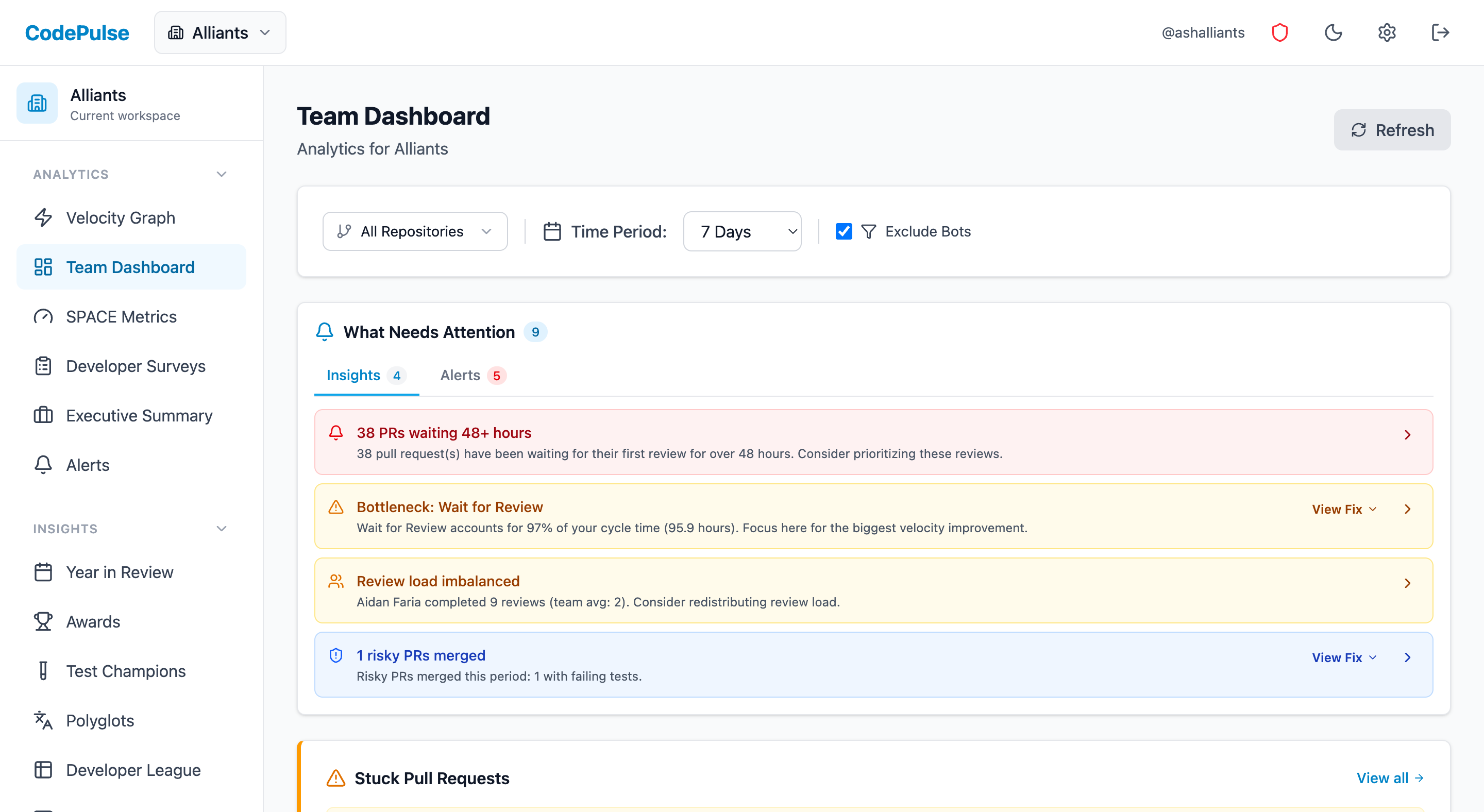
Navigate to the Dashboard to see cycle time breakdown:
- Dashboard shows cycle time broken into coding, review, and merge time
- Filter by repository to identify which projects are flowing vs. stuck
- Compare time periods to spot degradation early
- See our Cycle Time Breakdown Guide for optimization strategies
Layer 3: Team Health (Tactical)
Audience: Engineering Managers, Team Leads
Question: "Is the team burning out?"
Metric: Review Load, After-Hours Work, Knowledge Distribution
Remember that 12-point perception gap on burnout? This is how you close it. Team health signals show problems before they become resignations.
🏥Monitoring Team Health in CodePulse
Don't wait for resignations:
- Review Network - Is one person doing 80% of reviews? (Hero Syndrome)
- Developer Analytics - Is after-hours activity increasing? (Burnout signal)
- File Hotspots - Does one person own all changes to critical code? (Bus factor risk)
- See our STRAIN Score Framework for systematic burnout detection
Dashboard Design Principles for Executives
Most engineering dashboards fail because they're designed by engineers for engineers. Executive dashboards need different principles.
The 5-Second Rule
If an executive can't understand the dashboard's main message in 5 seconds, it's too complex. They should glance at it and know: "Are we okay or not?"
Executive Dashboard Hierarchy
Level 1: The Glance (5 seconds)
- Overall Health: Green / Yellow / Red
- One sentence: "Shipping 15% faster than last quarter, watching review load on Platform team"
Level 2: The Summary (30 seconds)
- Velocity: On track
- Quality: Improving
- Investment: Tech debt higher than target
- Team Health: One team at elevated burnout risk
Level 3: The Deep Dive (5 minutes)
- Per-team metrics, trend charts, exceptions list
- Only shown when they click in
Principle
- Every detail should be one click away, but zero clicks should show everything.
Show Trends, Not Snapshots
A cycle time of 2.3 days is meaningless without context. Is that good? Bad? Improving? Executives need directional information:
- "Cycle time is 2.3 days" - Useless
- "Cycle time improved from 3.1 to 2.3 days this quarter" - Useful
- "Cycle time improved 25%, exceeding our 15% target" - Actionable
Exceptions Over Averages
Executives don't need to know that 47 PRs were merged last week. They need to know that 3 PRs have been stuck in review for 5+ days, and one of them is blocking a customer commitment.
"Good news is boring. An executive dashboard should make no news the default, and surface only what requires attention. If everything is green, the whole thing should fit in one glance."
Communication Templates for Executive Updates
The best dashboard in the world is useless if you can't narrate what it means. Here are templates for common executive communication scenarios.
Weekly Engineering Digest (Email/Slack)
Subject: Engineering Weekly - [Date] - [Overall Status Emoji]

TL;DR: [One sentence summary]

Example: "Shipping 12% faster than last month. One yellow flag
on Platform team review load - intervening this week."

KEY METRICS THIS WEEK:
• Velocity:    [Up/Down X%] from last week
• Throughput:  [N PRs merged] ([comparison to average])
• Health:      [Status] - [Brief note if not green]

WHAT SHIPPED:
• [Major feature/fix 1]
• [Major feature/fix 2]
• [Major feature/fix 3]

WHAT'S NEXT:
• [Top priority 1]
• [Top priority 2]

WATCH ITEMS:
• [Thing leadership should know about, if any]

Full dashboard: [Link to CodePulse]
Questions? Reply here or grab me at standup.
Monthly Board Update Slide
ENGINEERING UPDATE - [MONTH YEAR]

HEADLINE: [One sentence that tells the story]
Example: "Velocity improved 18% as tech debt investment
pays off. On track for Q3 product commitments."

┌─────────────────────────────────────────────────┐
│ INVESTMENT ALLOCATION                           │
│                                                 │
│ New Features    ████████████░░░░   60% (↑5%)   │
│ Platform        █████░░░░░░░░░░░   20% (→)     │
│ Tech Debt       ███░░░░░░░░░░░░░   12% (↓3%)   │
│ Operations      ██░░░░░░░░░░░░░░    8% (→)     │
└─────────────────────────────────────────────────┘

VELOCITY TREND:
[Simple line chart showing 6-month trend]
"Cycle time decreased from 4.2 to 2.9 days (31% improvement)"

TEAM HEALTH:
• Overall:     🟢 Sustainable pace
• Burnout:     No elevated risk individuals
• Attrition:   0 departures, 2 offers out

RISKS & MITIGATIONS:
1. [Risk]: [What we're doing about it]

LOOKING AHEAD:
• [Q next] Focus: [One line]
• Key deliverables: [List of 2-3]
Incident/Delay Communication
Subject: [Project/Feature] - Timeline Update

CURRENT STATUS: [On Track / Delayed / At Risk]

WHAT CHANGED:
[One paragraph explaining the situation in business terms,
not technical details]

Example: "The payment integration is taking longer than
estimated because Stripe's API changed in ways our initial
analysis didn't anticipate. This is a scope increase, not
a productivity issue."

IMPACT:
• Original date: [Date]
• New estimate:  [Date]
• What this affects: [Customer commitment / Revenue / etc.]

WHAT WE'RE DOING:
• [Action 1]
• [Action 2]

WHAT WE NEED:
• [Any executive decision or resource needed]

LESSONS FOR NEXT TIME:
• [What we'll do differently]

Full details: [Link to internal doc]
Questions: [Your availability]
Automating the "Lights On" Dashboard
The cure for the Black Box is Radical Transparency - but transparency that's automated, not demanding. Manual reporting becomes theater. Automated reporting becomes culture.
Make It Passive, Not Active
Don't ask engineers to fill out status reports. Pull status from the work itself:
- PR merge = work completed - No status update needed
- PR stuck in review = blocked - Automatically flagged
- Deployment to production = feature shipped - Automatic announcement
Put It on a TV (Literally)
Put the CodePulse Dashboard on a TV in the office (or pin it in your #engineering Slack channel). Radical transparency means anyone can see what Engineering is doing at any time - without asking.
📺Setting Up Public Visibility in CodePulse
Make your engineering pulse visible to the organization:
- Executive Summary provides a health-grade view suitable for public display
- Dashboard shows real-time velocity and quality metrics
- Set up Alert Rules to post exceptions to Slack automatically
- Year in Review generates exportable metrics for quarterly reviews
Narrate the Changes
Transparency isn't just showing the data - it's explaining what it means:
- When velocity is down: "Velocity is down 10% because we're paying down debt in the Auth service. This is planned - we'll recover next sprint."
- When velocity is up: "We shipped 15% more value this sprint thanks to the new CI pipeline investment paying off."
- When something breaks: "The outage yesterday cost us 4 hours. Here's what failed and what we're doing to prevent recurrence."
"Trust is built when the Black Box becomes a Glass Box - but only if you're willing to explain what people are seeing. Data without narrative is just noise."
Building Trust Through Transparency
The ultimate goal isn't visibility for visibility's sake - it's building enough trust that visibility becomes natural. When done right, transparency creates a virtuous cycle:
- Share data openly - Everyone sees the same metrics leadership sees
- Narrate what it means - Help people interpret what they're seeing
- Act on what you learn - Data that doesn't drive action breeds cynicism
- Give credit publicly - Celebrate when metrics improve
- Own problems honestly - Admit when metrics show problems
The Trust Test
Ask your engineers: "Do you believe leadership understands what we're actually dealing with?"
If 43% say no (the current industry average), you have a visibility problem. Fix it not by demanding more reports, but by building better signals - and proving you'll use them to help, not to micromanage.
Action Plan: Dissolving Your Black Box
This Week
- Audit current visibility: What does leadership actually see? What do they think it means? Survey 3-4 executives on what they understand about engineering.
- Identify the gap: What questions do executives have that data can't currently answer?
- Set up your CodePulse dashboard and review what signals are already available
This Month
- Create your Investment Profile: Categorize recent work into Features / Platform / Debt / Operations. Share with leadership.
- Start weekly digests: Send a 5-sentence summary to executives using the template above.
- Check team health signals: Review Review Network and Developer Analytics for early warning signs.
This Quarter
- Establish monthly board narrative: Use the template above for your first board-ready engineering update.
- Measure the perception gap: Re-survey engineers on whether leadership understands their challenges. Target: reduce "out of the loop" perception by 20%.
- Automate what you can: Set up alerts for exceptions so proactive communication replaces reactive firefighting.
The Black Box Problem isn't about installing more cameras - it's about building better windows. When executives can see what matters, they stop asking about what doesn't. When engineers see that visibility helps rather than hurts, they stop hiding.
That's not visibility. That's partnership.
For more on communicating engineering value to leadership, see our guides on Board-Ready Engineering Metrics, Engineering Metrics Dashboard, and Measuring Team Performance Without Micromanaging.
Now measure this metric on your own repositories
Connect read-only GitHub in about five minutes and get your baseline, your trend, and the constraint behind it. Your fourteen usable trial days start when the first repository finishes syncing.
Read-only GitHub · Your code stays yours · Team-level by default · No credit card
See These Features in Action
Explore all featuresRelated Guides
The Slide That Changed How Our Board Sees Engineering
Stop talking about "maintenance" and start talking about "investment." How to measure and present your engineering investment profile to the board.
I Got $2M in Budget With These 5 Engineering Metrics
Learn how to create engineering metrics presentations that resonate with board members, investors, and C-suite executives.
Engineering Metrics That Won't Get You Reported to HR
An opinionated guide to implementing engineering metrics that build trust. Includes the Visibility Bias Framework, practical do/don't guidance, and a 30-day action plan.
How I Got Engineering Metrics Budget Approved in 1 Meeting
Learn how to justify engineering analytics investment to CFOs, CEOs, and boards by translating technical value into business outcomes.
GitHub Pull Request Analytics: From Raw Data to Team Insights
GitHub gives you PR data. It does not give you analytics. How to turn merge times, review patterns, and cycle time into decisions that improve your team.
Engineering Metrics Look Wrong? Fix These 7 Data Quality Problems
Your engineering metrics look off. Cycle time is impossibly high. GitHub Insights shows different numbers. This guide covers the 7 most common data quality problems and how to fix each one.