
Inspect the output before you grant repository access
Preview the report first. When you are ready, start with selected repositories through a read-only GitHub connection, and your code stays yours.
Read-only GitHub · Your code stays yours · Team-level by default · No credit card
DevSecOps promises security without slowing delivery. But security teams measure vulnerabilities while engineering measures velocity - and the metrics rarely align. This guide covers the metrics that bridge both worlds: how to measure security effectiveness, prove shift-left ROI, and keep security from becoming a bottleneck.
"73% of organizations say manual security and compliance processes slow down code releases. The fix isn't less security - it's automated security that doesn't wait for the end."
The State of DevSecOps
DevSecOps adoption has accelerated rapidly. According to recent research:
- 70% of security teams say security has shifted left (StrongDM, 2025)
- 75% of rapid development teams will have fully integrated DevSecOps by 2025
- 60%+ of organizations will integrate automated security into CI/CD pipelines by 2026, up from <20% in 2022 (Gartner)
- Over 70% of organizations using DevSecOps report improved security outcomes and faster vulnerability remediation
The shift is happening. The question is: how do you measure whether it's working?
Core DevSecOps Metrics
Effective DevSecOps measurement spans three categories: detection, remediation, and prevention.
Detection Metrics
| Metric | Definition | Target |
|---|---|---|
| Mean Time to Detect (MTTD) | Time from vulnerability introduction to discovery | <24 hours (ideally: caught in CI) |
| Pre-Production Detection Rate | % of vulnerabilities found before production | >90% |
| Security Scan Coverage | % of codebases with automated security scanning | 100% |
| False Positive Rate | % of security alerts that are noise | <10% (high FP = ignored alerts) |
Remediation Metrics
| Metric | Definition | Target |
|---|---|---|
| Mean Time to Remediate (MTTR) | Time from detection to fix deployed | Critical: <24h, High: <7 days |
| Vulnerability Backlog | Open vulnerabilities awaiting fix | Trending down over time |
| Reopen Rate | % of vulnerabilities that recur after fix | <5% |
| Patch Deployment Time | Time to deploy security patches | <72 hours for critical |
Prevention Metrics
| Metric | Definition | Why It Matters |
|---|---|---|
| Security Training Completion | % of devs trained in secure coding | Prevention beats detection |
| Dependency Currency | % of dependencies on latest secure versions | Outdated deps = known vulns |
| Secret Exposure Rate | Hardcoded secrets found in code | Should be zero |
| Security Gate Pass Rate | % of builds passing security checks | >95% (low = too strict or bad hygiene) |
Measuring Shift-Left ROI
Shift-left security moves vulnerability detection earlier in the pipeline. The ROI is straightforward: earlier detection means cheaper fixes.
Cost of Fixing Vulnerabilities by Stage
═══════════════════════════════════════════════════

Stage                    Relative Cost    Example
──────────────────────────────────────────────────
Development (IDE)        1x              $25
Build (CI)               5x              $125
Testing (QA)             10x             $250
Staging                  15x             $375
Production               30x             $750
Post-Breach              100x+           $2,500+

Source: IBM Systems Sciences Institute, adjusted for 2025

SHIFT-LEFT ROI CALCULATION
─────────────────────────

Before Shift-Left:
• 80% of vulns found in production/staging
• Average fix cost: $500/vuln
• 50 vulns/quarter = $25,000

After Shift-Left:
• 90% of vulns found in CI/development
• Average fix cost: $75/vuln
• 50 vulns/quarter = $3,750

Quarterly Savings: $21,250
Annual Savings: $85,000
"A vulnerability found in CI costs 5x less to fix than one found in production. Found post-breach? 100x. The math is simple: shift left or pay later."
/// Our Take
Security metrics that don't connect to delivery metrics are useless to engineering.
If your security dashboard shows "500 vulnerabilities" without context, engineers will ignore it. Show: "15 critical vulnerabilities blocking production in this repo, average remediation time 3 days." Security metrics must tie to delivery impact to drive action.
Integrating Security Into the Pipeline
Here's where to add security gates and what to measure at each stage:
DevSecOps Pipeline Integration Points
═══════════════════════════════════════════════════

┌─────────────┐   ┌─────────────┐   ┌─────────────┐   ┌─────────────┐
│   COMMIT    │──▶│    BUILD    │──▶│    TEST     │──▶│   DEPLOY    │
└─────────────┘   └─────────────┘   └─────────────┘   └─────────────┘
      │                 │                 │                 │
      ▼                 ▼                 ▼                 ▼
┌─────────────┐   ┌─────────────┐   ┌─────────────┐   ┌─────────────┐
│Pre-commit   │   │SAST Scan    │   │DAST Scan    │   │Image Scan   │
│hooks        │   │Dependency   │   │Pen testing  │   │Runtime      │
│Secret scan  │   │check        │   │Security     │   │monitoring   │
│Linting      │   │License scan │   │review       │   │WAF/IDS      │
└─────────────┘   └─────────────┘   └─────────────┘   └─────────────┘

METRICS AT EACH STAGE
─────────────────────

Commit:
• Secrets blocked: ___ per week
• Pre-commit hook pass rate: ___%

Build:
• SAST findings by severity: ___
• Dependency vulnerabilities: ___
• Build failure rate (security): ___%

Test:
• DAST findings: ___
• Security test coverage: ___%

Deploy:
• Container vulnerabilities: ___
• Runtime alerts: ___
Security Tools Stack
Different tools serve different purposes in the DevSecOps pipeline:
| Tool Type | Purpose | Examples |
|---|---|---|
| SAST | Static analysis (code review) | SonarQube, Semgrep, CodeQL |
| DAST | Dynamic analysis (runtime testing) | OWASP ZAP, Burp Suite |
| SCA | Dependency/supply chain scanning | Snyk, Dependabot, Renovate |
| Secret Scanning | Find hardcoded credentials | GitLeaks, TruffleHog, GitHub Secret Scanning |
| Container Security | Image vulnerability scanning | Trivy, Prisma Cloud, Wiz |
| IAC Security | Infrastructure misconfigurations | Checkov, tfsec, Terrascan |
DevSecOps vs. DevOps Metrics
DevSecOps doesn't replace DevOps metrics - it extends them:
| DevOps Metric | DevSecOps Extension |
|---|---|
| Deployment Frequency | + Deployment frequency with security gates passed |
| Lead Time for Changes | + Time added by security review/scanning |
| Change Failure Rate | + Change failure rate due to security issues |
| Time to Restore Service | + Time to remediate security vulnerabilities |
"If security scans add 30 minutes to every build, that's a delivery tax. Measure the tax - then reduce it."
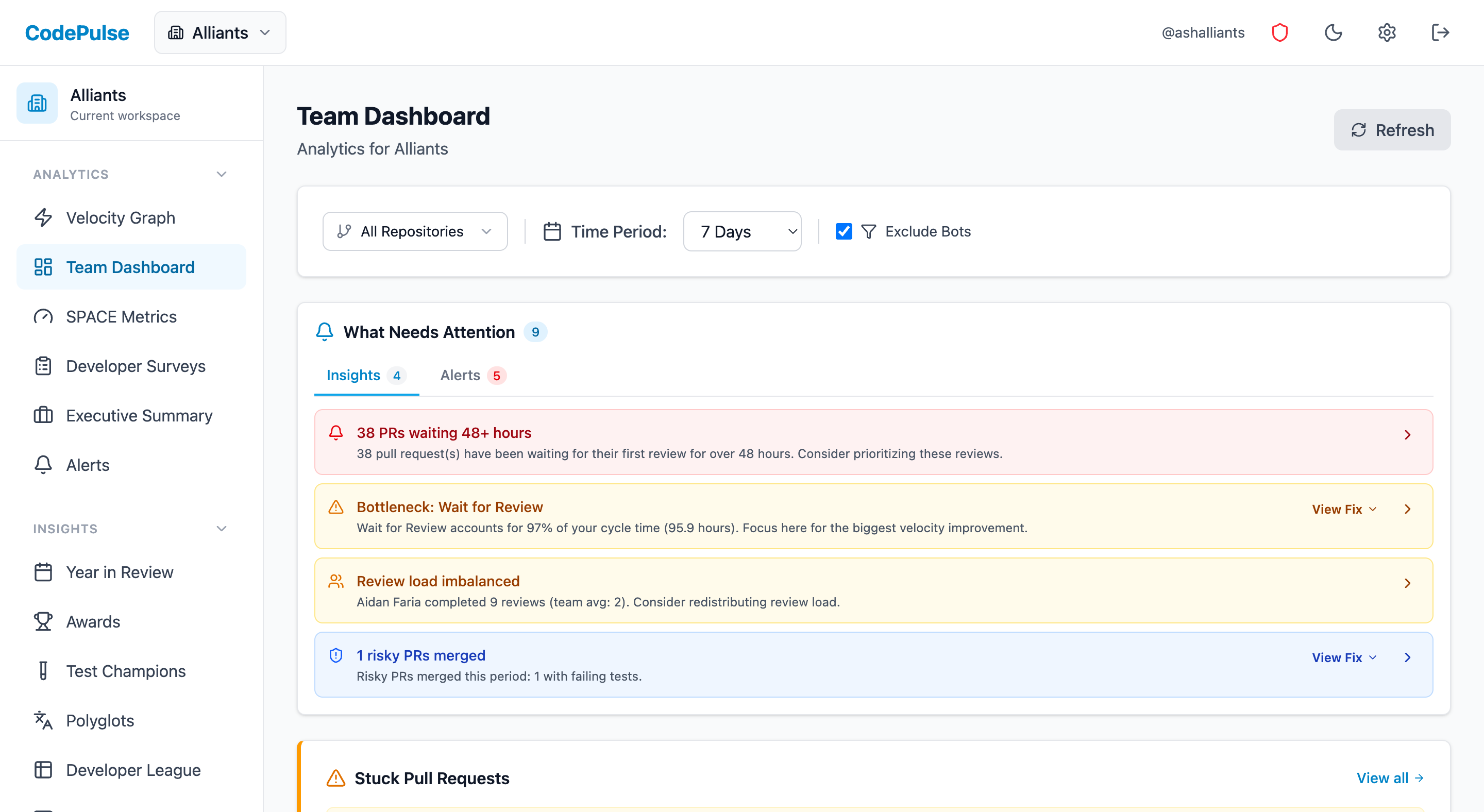
📊 How to Track This in CodePulse
CodePulse tracks the delivery metrics that show security integration impact:
- Cycle Time Breakdown: See if security reviews are creating bottlenecks
- Lead Time Trends: Monitor whether security automation is speeding up or slowing delivery
- Change Failure Rate: Track whether security improvements reduce production incidents
Use Dashboard to correlate security initiatives with delivery metrics.
Implementation Guide
Phase 1: Foundation (Weeks 1-4)
- Enable dependency scanning (Dependabot/Snyk) on all repositories
- Add secret scanning to pre-commit hooks
- Establish baseline metrics: current vulnerability count, MTTR, detection rates
- Define severity-based SLAs (critical: 24h, high: 7 days, etc.)
Phase 2: Pipeline Integration (Weeks 5-8)
- Integrate SAST scanning into CI pipeline
- Add container image scanning for deployed services
- Create security dashboards with metrics above
- Establish security gates (block deploys for critical vulns)
Phase 3: Optimization (Weeks 9-12)
- Tune scanners to reduce false positives (<10%)
- Add DAST for critical services
- Implement infrastructure-as-code scanning
- Review and optimize scan performance (keep CI fast)
Common DevSecOps Pitfalls
Pitfall 1: Security Theater
Having 10 security tools that nobody looks at is worse than having one tool with actionable alerts. Focus on signal, not tool count.
Pitfall 2: Blocking Without Context
Failing builds for every medium-severity finding trains developers to ignore security. Be strict on critical/high, track medium/low as tech debt.
Pitfall 3: Not Measuring the Tax
If security scans add 20 minutes to every build, engineering will (rightfully) complain. Measure and optimize scan performance just like you optimize build time.
Pitfall 4: Ignoring Developer Experience
Security tools that produce confusing output or require context-switching get ignored. Integrate findings into existing workflows (PR comments, IDE plugins).
Related Guides
- DORA Metrics Guide - The delivery metrics that DevSecOps extends
- DevOps Automation Metrics Guide - Measuring automation effectiveness
- Security & Compliance for GitHub Analytics - Data security for engineering metrics tools
- Test Failure Rate Guide - Quality metrics that complement security
Conclusion
DevSecOps metrics bridge the gap between security requirements and engineering velocity. The goal isn't maximum security - it's appropriate security that doesn't become a delivery bottleneck.
Start by measuring where vulnerabilities are found (pre-production vs. post), how long they take to fix (MTTR), and how much time security processes add to delivery (the security tax). Then optimize: shift detection earlier, automate remediation, and reduce false positives.
"Modern DevSecOps isn't just shifting left - it's shifting everywhere. Security in production is no longer a reactive afterthought."
Track your delivery metrics with CodePulse to see how security integration affects your overall engineering velocity.
Start with one repository and a read-only connection
You choose the repositories. CodePulse cannot push, merge, or modify anything, and never clones your code. Expand the scope only once the output has earned it.
Read-only GitHub · Your code stays yours · Team-level by default · No credit card
See These Features in Action
Track deployment frequency, lead time, and release patterns.
Flag large PRs, single-owner changes, and untested modifications.
Related Guides
The SOC 2 Question That Eliminates 80% of Analytics Vendors
Everything you need to know about data security, SOC 2 compliance, and privacy when evaluating engineering analytics platforms.
The DORA Metric Everyone Ignores (Until Production Breaks)
Learn how to measure Change Failure Rate and Mean Time to Restore using GitHub data, even without full incident tracking integration.
Your CI Is Crying for Help. Here's What It's Telling You
Understand what test failure rate measures, identify patterns causing CI failures, and implement strategies to improve your pipeline reliability.
The GitHub Permission Mistake That Gets Security Rejected
Understand GitHub OAuth scopes and app permissions required for engineering analytics tools, with security best practices.
HIPAA-Compliant Metrics: The Checklist That Saved Our Audit
How healthcare and life sciences engineering teams use metrics to meet FDA requirements, maintain HIPAA compliance, and ensure software quality.