
GitHub-native depth, with your issue tracker connected
CodePulse reads your code activity directly from GitHub, then links it to the issues in Jira, Linear, and Azure DevOps. You get code-level detail and the planning context around it, without standing up a data warehouse or moving off the tools your team already uses.
A GitHub-only tool will not fit our stack
Your team plans in Jira or Linear and ships in GitHub or Azure DevOps. Most code-analytics tools see only one half. Either they read pull requests with no idea what work they belong to, or they sit on top of the issue tracker and never look at the code. So you end up exporting CSVs and stitching the two together by hand. The question every VP of Engineering asks before buying is the same - will this actually work with what we run today?
Code and issue context in one place
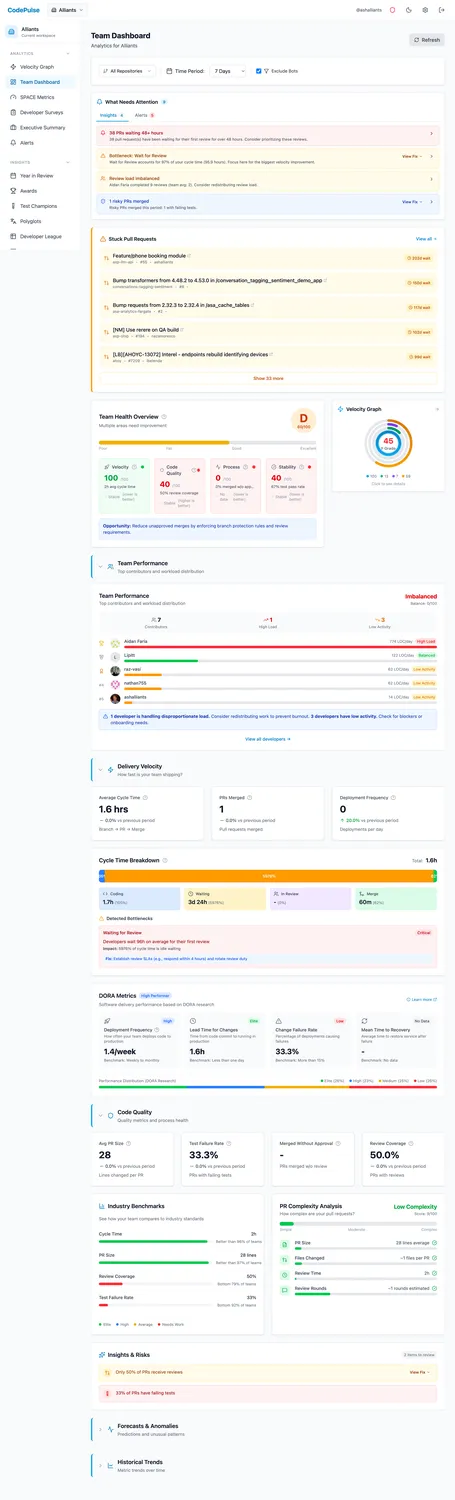
CodePulse stays GitHub-native at its core and treats Jira, Linear, and Azure DevOps as first-class connections. Connect over OAuth in minutes, and issue keys in your branch names and PR titles are matched automatically. The result is one view where a pull request carries the issue it delivered, its work type, and its lead time - no warehouse, no per-seat math, flat pricing.
Connect over OAuth
Authorize Jira (Atlassian Cloud) or Linear with OAuth - no API tokens to copy or service accounts to provision. Azure DevOps connects as a code and pull-request source alongside GitHub. Setup takes minutes, not a procurement cycle.
Issues sync automatically
CodePulse pulls issues on a schedule, with an initial lookback of about 400 days so historical work is covered from day one. Jira sync uses JQL with per-project watermarks, so each project stays current without re-reading everything.
PRs link to issues
Issue keys like ENG-123 are detected in branch names and PR titles, then matched to the synced issue. The link is automatic - your engineers keep working the way they already do.
Context enriches your metrics
Linked issues feed work classification (feature, bug fix, tech debt, and more) and issue lead time. Classification follows a clear priority - GitHub labels first, then issue-tracker labels, then AI, then issue type - and you can override the mappings per project.
Key Metrics You Will Track
OAuth Setup in Minutes
Authorize Jira or Linear with OAuth and start syncing the same day. No tokens, no warehouse, no separate analyst to maintain the join
Automatic PR-to-Issue Links
Issue keys in branch names and PR titles are matched to synced issues, so every pull request carries the work it delivered
Work Classification
Linked issue labels and types drive investment categories - feature, bug fix, tech debt, maintenance, infrastructure - with per-project overrides
Issue Lead Time and Status History
Status changelogs are synced from Jira and Linear, so you can see how long work sat in each state, not just when it closed
Related Features
See where engineering effort goes across features, maintenance, and debt.
Measure end-to-end issue lead time from creation to merge and find where work stalls across Jira or Linear statuses.
Data-backed retros with concrete metrics for each sprint.
See Jira, Linear & Azure DevOps Integrations in Action
Connect your GitHub account and get insights in under 5 minutes. Free forever for small teams.