
Turn this metric into a baseline for your team
Preview a system-level engineering health report, then connect GitHub when you are ready to compare this metric with your own delivery history.
Read-only GitHub · Your code stays yours · Team-level by default · No credit card
You need to report on engineering progress, but you don't have access to Jira. Maybe it's owned by another team, maybe you're in a different org, or maybe your team just uses GitHub for everything. Good news: your Git data tells a compelling progress story on its own.
This guide shows you how to track and report engineering progress using pull request data, deployment frequency, and repository metrics - no project management tool required. If you do get Jira access later, the natural next step is linking your pull requests to Jira issues, which adds the planning phase these GitHub-only metrics cannot see. If the tracker itself is still an open question, our Azure DevOps vs Jira comparison weighs the two most common answers.
When You Don't Have Access to the PM Tool
Common Scenarios
Many engineering managers find themselves without access to traditional progress tracking:
- Embedded in client organization: Contractors and consultants often can't access the client's PM tools
- Cross-functional projects: Engineering may use different tools than product/PM
- Startup without PM tooling: Small teams that haven't set up formal project management
- Open source projects: No centralized PM tool, just GitHub issues
- Agency work: Each client has different tools, need consistent reporting
Why Git Data Works
Git data has advantages over PM tool data for progress tracking:
- Can't be gamed: Unlike story points, merged PRs represent actual work done
- Automatic: No need to update tickets - data captured as part of normal workflow
- Granular: See exactly what code shipped, not just ticket status changes
- Universal: Every engineering team uses Git, regardless of PM tools
PRs Merged as a Progress Proxy
Why PRs Are a Good Progress Indicator
Pull requests represent completed, reviewed, and shipped work:
- Completion signal: A merged PR means work is done, not "in progress"
- Quality gate: Merged PRs have passed code review
- Deployment proxy: Merged usually means deployed (or ready to deploy)
- Team effort: PRs show collaboration (author + reviewers)
Tracking PR Velocity
PR Velocity Tracking
Monthly OverviewPR Breakdown by Type
Not all PRs are equal. Break down by type if possible:
- Feature PRs: New functionality (progress on roadmap)
- Bug fix PRs: Stability work (maintaining quality)
- Refactoring PRs: Technical investment (enabling future speed)
- Documentation PRs: Knowledge capture (team efficiency)
You can approximate this by repository, file path patterns, or PR title conventions.
📊 PR Metrics in CodePulse
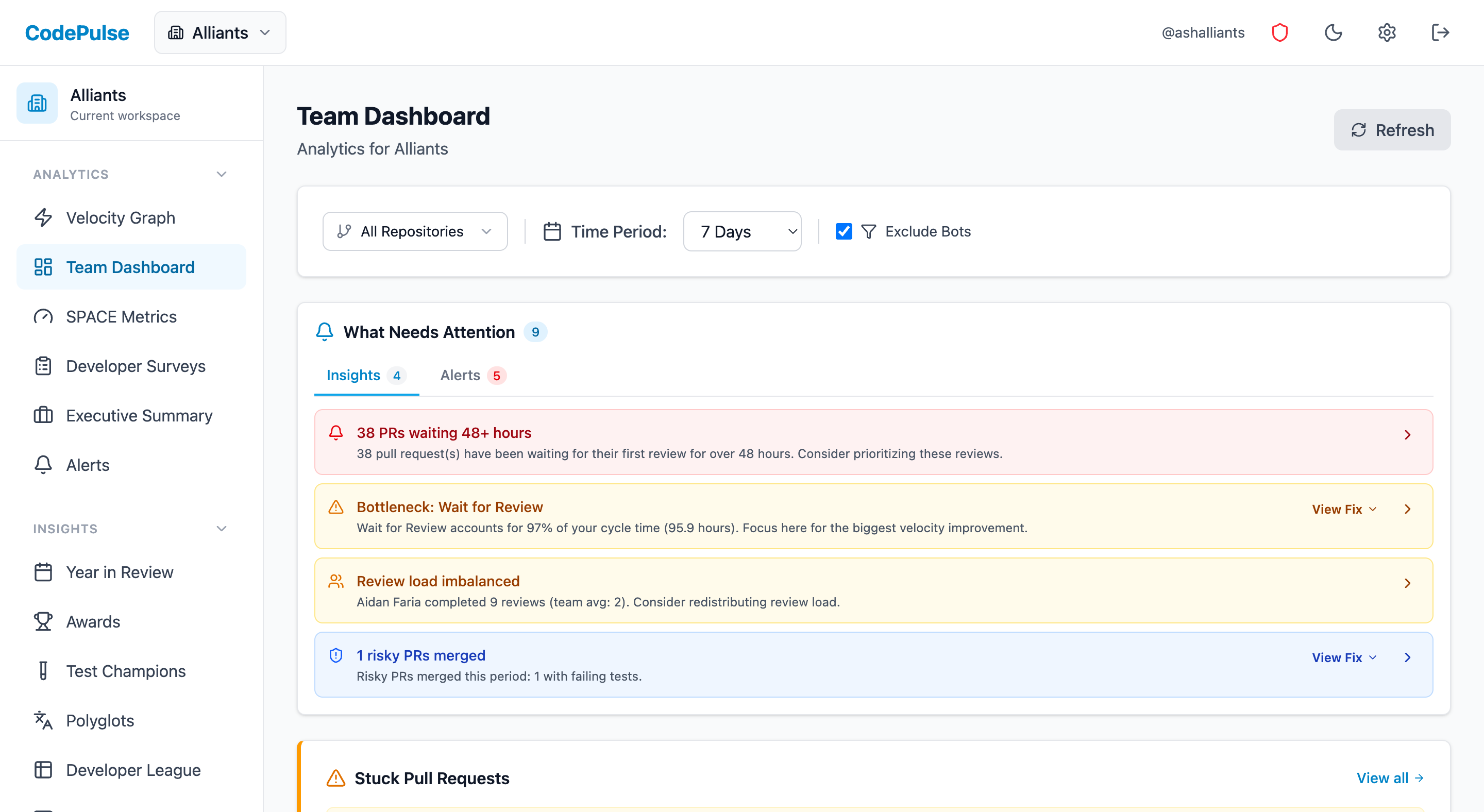
CodePulse's Dashboard provides PR velocity tracking:
prs_merged- Total PRs merged in selected period- 8-week trend chart shows velocity over time
- Filter by repository to track specific projects
- Time period selector: 7d, 30d, 90d, custom
Repository Breakdown for Project-Level Tracking
Mapping Repositories to Projects
If your repositories map to projects or features, you can track project-level progress through repository metrics:
Weekly Progress by Repository
Repository-to-Project MappingRepository Metrics to Track
For each project-repository, track:
- PRs merged: Volume of completed work
- Contributors: Team members actively working on it
- Cycle time: How quickly work moves through
- Churn: Is work being redone (possible scope issues)?
Deployment Frequency as Delivery Cadence
What Deployment Frequency Shows
Deployment frequency is one of the DORA metrics and indicates how often you're delivering value:
- High frequency (daily+): Continuous delivery, small batches, fast feedback
- Medium frequency (weekly): Regular releases, predictable cadence
- Low frequency (monthly+): Batched releases, longer feedback cycles
Using Deployment Frequency in Reports
Executive Summary Format
"The team deployed 47 times this month (2.4x per working day), up from 38 last month (1.9x per day). This 24% increase reflects our investment in CI/CD improvements."
Deployment Frequency Trend
Monthly TrackingBuilding Weekly Status Reports from Git Data
Report Structure
Weekly Engineering Status Report
Week of [Date]Progress by Project
Checkout Redesign (frontend-checkout) - 8 PRs
- Cart validation complete
- Payment form 80% done (2 PRs remaining)
Payment System (api-payments) - 4 PRs
- Stripe integration complete
- Testing phase this week
Mobile Launch (mobile-app) - 6 PRs
- iOS build passing
- Android: auth flow in review
- Waiting on design for checkout step 3
- Mobile Android auth needs backend API
- Checkout cart validation shipped
- Stripe integration complete
- iOS build pipeline green
Next Week
Planned Work
- Complete checkout payment form
- Begin checkout review step
- Mobile Android auth completion
Data Sources for Each Section
- Summary metrics: CodePulse Dashboard, weekly period
- Progress by project: Filter by repository, count PRs
- Highlights: Review merged PRs for significant completions
- Blockers: Open PRs with long cycle time, or external dependencies
Automating the Report
You can partially automate status report generation:
- Metrics section: Export from CodePulse Dashboard
- Project breakdown: Export per-repository metrics
- Highlights/blockers: Manual curation based on PR titles
- Next week: Based on open PRs and planned work
See our Weekly Engineering Status Report Template for more detailed formatting guidance.
Limitations and When You Need More
What Git Data Can't Tell You
Be honest about the limitations of Git-only tracking:
- Business value mapping: PRs don't directly map to user stories or business outcomes
- Roadmap progress: Without tickets, you can't show "Feature X is 60% complete"
- Priority alignment: Can't tell if work aligns with stated priorities
- Scope changes: No visibility into requirement changes or scope creep
- Estimation accuracy: Can't compare planned vs actual without estimates
Supplementing Git Data
To address gaps, consider lightweight additions:
Lightweight Tracking Supplements
Option 1: PR Labels
- Label PRs with project/feature names
- Label with type (feature, bug, refactor)
- Enables grouping in reports
Option 2: PR Title Conventions
- [PROJECT] Description format
- [TYPE] Description format
- Parseable for automated reports
Option 3: GitHub Projects (Basic)
- Map PRs to project boards
- Lightweight without full PM tool
- Visual progress tracking
Option 4: Milestone Tracking
- Create GitHub milestones for releases
- Associate PRs with milestones
- Track milestone completion %
When to Invest in PM Tooling
Consider adding a PM tool when:
- Stakeholder needs: Executives need business-level roadmap visibility
- Cross-team coordination: Multiple teams need to coordinate dependencies
- Estimation culture: Team wants to improve estimation and planning
- Compliance requirements: Need audit trail of requirement-to-code tracing
Making Git-Based Progress Tracking Work
Set Expectations
When reporting progress from Git data alone, be clear about what you're measuring:
- You can say: "The team shipped 23 PRs this week, 8% more than last week"
- You can't say: "Feature X is 75% complete" (without additional context)
- You can say: "The checkout repository received 8 PRs, the most of any project"
- You can't say: "Checkout is on track for the April deadline" (without knowing scope)
Build Narrative Around the Data
Data alone isn't enough - add context and narrative:
Building Narrative Around Data
"23 PRs merged, 12 deployments"
"23 PRs merged this week (up 8%), with 8 PRs going to checkout redesign. We completed cart validation and are on track to finish the payment form next week."
"Strong progress this week with 23 PRs merged, our highest in a month. The checkout redesign is our focus - we shipped cart validation and the payment form is 80% complete. Expect to begin the review step next week, putting us on track for beta by month end."
For more on communicating engineering progress, see our guides on Board-Ready Engineering Metrics and Engineering Metrics Dashboard.
Now measure this metric on your own repositories
Connect read-only GitHub in about five minutes and get your baseline, your trend, and the constraint behind it. Your fourteen usable trial days start when the first repository finishes syncing.
Read-only GitHub · Your code stays yours · Team-level by default · No credit card
See These Features in Action
Board-ready engineering performance in a single page.
Break down cycle time into coding, waiting, review, and merge phases.
Related Guides
The Status Report Template That Got Me Promoted
Stop writing status reports nobody reads. Here is a template for weekly engineering reports that executives actually find useful.
I Got $2M in Budget With These 5 Engineering Metrics
Learn how to create engineering metrics presentations that resonate with board members, investors, and C-suite executives.
Engineering Metrics Dashboard: The 7 Metrics You Need
Skip vanity metrics. Here are the 7 engineering metrics VPs actually need to track team performance, delivery, and quality.
Stop Guessing Capacity. Your PRs Already Know
Use PR metrics to build data-driven capacity models, plan sprints realistically, and communicate engineering capacity to stakeholders.
Goodhart's Law in Software: Why Your Metrics Get Gamed
When a measure becomes a target, it ceases to be a good measure. This guide explains Goodhart's Law with real engineering examples and strategies to measure without destroying what you're measuring.
GitHub Metrics That Matter: A No-Vanity Shortlist
GitHub is a goldmine of engineering data. This guide shows which GitHub metrics actually matter (PR cycle time, review load, knowledge distribution), how to build a useful dashboard, and which vanity metrics to avoid.