
See exactly where your delivery flow is waiting
Preview the phase-by-phase report for review pickup, active review, and merge time. Connect in about five minutes; the initial analysis runs after sync.
Read-only GitHub · Your code stays yours · Team-level by default · No credit card
Your team's pull request review queue is a critical bottleneck - one that most teams manage poorly. PRs pile up, some sit for days while others get immediate attention, and no one's quite sure which PRs to review first. The result? Blocked developers, stale branches, and mounting frustration.
How do you manage a PR review queue effectively?
Replace FIFO ordering with weighted priority: 2x for blocking/hotfix PRs, 1.5x for small PRs and PRs older than 1 day, 1.2x for high-risk changes. Set review SLAs (4-hour first response, same-day for small PRs) and configure aging PR alerts. Use a rotating 'review champion' role to keep the queue healthy. CodePulse tracks time-to-first-review, PR aging, and review load distribution to make these patterns visible.
This guide provides tactical strategies for managing your review queue effectively, implementing smart prioritization rules, and setting up alerts that prevent PRs from aging into costly merge conflicts. You'll learn how to build a system that keeps work flowing without sacrificing review quality.
What Is the Hidden Cost of Review Queue Bottlenecks?
When a pull request sits waiting for review, the clock isn't just ticking on that one PR - it's draining productivity across your entire team.
Context Switching Kills Productivity
When developers open a PR and then wait hours or days for feedback, they can't sit idle. They start new work, diving into different codebases, switching mental models, and building new context. When review feedback finally arrives, they must:
- Reload the original context: What was this PR doing? Why did I make these choices? Where was I in my thought process?
- Rebuild the mental model: Pull the branch, run the code, remember the edge cases and trade-offs
- Address feedback: Make changes while holding both the old context and the reviewer's perspective
- Switch back to current work: Return to whatever they were working on, reloading that context too
Research shows each context switch costs 15-30 minutes of productive time. If your average PR requires 2-3 rounds of review, that's potentially 90 minutes of pure waste per PR - just from context switching.
🔥 Our Take
Review load imbalance is the hidden bottleneck most teams never diagnose.
If one or two senior engineers handle 60% of your team's reviews, your review queue is only as fast as their availability. When they are in meetings, on vacation, or heads-down on their own work, the entire team's velocity drops. The fix is not asking them to review faster. It is cross-training more reviewers and distributing the load. Most teams have no idea how concentrated their review workload actually is until they measure it.
Stale PRs Breed Merge Conflicts
Every day a branch remains open, the probability of merge conflicts increases. Other PRs merge, the main branch evolves, and your carefully crafted changes become increasingly incompatible with the current codebase.
The math is unforgiving:
- Team merges 20 PRs per week (4 per workday)
- Your PR touches 5 files that are modified in 30% of other PRs
- After 1 day: ~20% chance of conflicts
- After 3 days: ~60% chance of conflicts
- After 5 days: ~85% chance of conflicts
Resolving merge conflicts isn't just annoying - it's risky. You're reconciling changes you made days ago with code you haven't seen, often in a rush. The likelihood of introducing bugs during conflict resolution is significantly higher than during original development.
"A PR waiting for review is inventory sitting on a shelf. It depreciates. Conflicts accumulate. Context fades. The longer it sits, the less valuable the merge."
Developer Frustration and Morale Impact
Waiting for code review is frustrating. Developers lose momentum, feel blocked, and start questioning whether their work matters. The psychological impact compounds:
- Loss of pride: "I was excited about this fix, but now I barely remember what it does"
- Decreased engagement: "Why bother if it's just going to sit in the queue?"
- Quality degradation: "I'll just batch more changes into this PR since review is so slow"
- Team friction: "Why did Sarah's PR get reviewed immediately while mine waited three days?"
The Cost in Numbers
Consider a team of 8 developers:
- Each opens 2 PRs per week = 16 PRs/week
- Average review queue time: 1.5 days
- Average time to address feedback: 2 hours
- Context switch overhead: 30 minutes per round
- Average rounds of review: 2
That's 16 hours per week lost to context switching alone. Over a year, that's 832 hours - more than 5 developer-months of wasted time, just from slow reviews causing context switches.
What Are the Best Prioritization Strategies for PR Review?
Not all pull requests are created equal. The key to managing review queues effectively is knowing which PRs to review first.
The FIFO Trap
Many teams default to First-In-First-Out: review PRs in the order they were opened. This seems fair, but it's dangerously inefficient:
- Small, low-risk PRs wait behind large refactors
- Blocking PRs sit while non-blocking work gets reviewed
- High-risk changes don't get the extra scrutiny they need
- Critical hotfixes wait their turn like routine updates
FIFO treats all work as equivalent. In reality, reviewing a 20-line bug fix that's blocking three other developers is far more valuable than reviewing a 500-line feature that no one's waiting on.
Priority-Based Review Framework
A smarter approach assigns priority scores to PRs based on multiple factors. Here's a practical framework:
| Factor | Weight | Why It Matters |
|---|---|---|
| Blocking other work | Critical (2x) | Unblocks multiple developers |
| PR size (smaller = higher) | High (1.5x) | Quick wins, easier review |
| Age (older = higher) | High (1.5x) | Prevents conflicts, context loss |
| Risk level (higher = higher) | Medium (1.2x) | Needs thorough review |
| Production fix | Critical (2x) | Resolves live issues |
"Two reviewers is optimal for most code changes. One catches the obvious bugs. Two catch the design problems. After that, you are mostly catching style preferences."
Practical Priority Calculation
Here's how to score PRs in practice:
Base priority: 100

Multiply by factors:
  2.0x if labeled "blocking" or "hotfix"
  1.5x if PR size < 100 lines
  1.2x if PR size < 50 lines
  1.5x if PR age > 1 day
  2.0x if PR age > 3 days
  1.2x if touches critical files (auth, payments)
  0.8x if PR size > 500 lines (needs careful review)
  0.7x if labeled "nice-to-have"

Example: Small urgent fix
  Base: 100
  x 2.0 (hotfix label)
  x 1.5 (< 100 lines)
  x 1.5 (> 1 day old)
  = 450 priority

Example: Large feature
  Base: 100
  x 0.8 (> 500 lines)
  x 0.7 (nice-to-have)
  = 56 priority

Review the highest priority PR first.
Team Agreements on Review Priority
Priority systems only work if the team agrees on them. Establish clear criteria:
- Define "blocking": What qualifies? Another PR depends on it? A feature launch is waiting? Deploy is blocked?
- Set size thresholds: Agree on what constitutes "small" (e.g., <100 lines) vs "large" (e.g., >500 lines)
- Clarify critical areas: Which files or directories warrant elevated priority? (authentication, payments, data migrations)
- Establish escalation rules: When can someone interrupt for urgent review? What's the process?
Document these agreements in your team wiki or CONTRIBUTING.md. Make them visible in your PR template as a reference for labeling.
Using Labels for Priority
GitHub labels are a simple way to make priority visible:
- priority: critical - Hotfixes, production issues, blocking work
- priority: high - Important features, time-sensitive work
- priority: normal - Regular development work
- priority: low - Nice-to-haves, refactoring, tech debt
For more strategies on reducing overall cycle time, see our guide on reducing PR cycle time.
How Do You Set Up Aging PR Alerts?
Even with good priority systems, PRs can slip through the cracks. Automated alerts ensure no PR ages invisibly.
Alert Thresholds for Different PR Types
Not all PRs should trigger alerts at the same age:
| PR Type | First Alert | Escalation |
|---|---|---|
| Hotfix / Critical | 2 hours | 4 hours |
| Small PR (<100 lines) | 4 hours | 1 day |
| Medium PR (100-300 lines) | 1 day | 2 days |
| Large PR (300-500 lines) | 1.5 days | 3 days |
| Very Large (>500 lines) | 2 days | 5 days |
CodePulse Alert Rules for Stuck PRs
CodePulse lets you configure custom alert rules that monitor your review queue and notify you when PRs exceed thresholds.
Example Alert Configurations
Alert 1: Small PRs aging without review
Rule: "Small PRs Waiting Too Long"
Metric: cycle_time_hours
Filter: PR size < 100 lines AND no reviews
Threshold: > 8 hours (1 business day)
Action: Send Slack alert to #engineering
Frequency: Check every hour
Alert 2: PRs approaching conflict risk
Rule: "PRs Aging into Conflict Risk"
Metric: days_since_created
Filter: Status = open
Threshold: > 3 days
Action: Email to PR author + reviewers
Frequency: Daily at 9 AM
Alert 3: Critical PRs stuck
Rule: "Critical/Hotfix PRs Blocked"
Metric: time_to_first_review
Filter: Label = "priority: critical" OR "hotfix"
Threshold: > 2 hours
Action: Slack alert to @eng-leads + PR reviewers
Frequency: Check every 30 minutes
Notification Channels
Choose notification channels based on urgency:
- Slack (team channel): Good for general awareness, non-urgent PRs. Post aging PR summaries daily.
- Slack (direct message): For PRs assigned to specific reviewers. Gentle nudge without public pressure.
- Email: For escalations or daily digests. Less interruptive than Slack.
- GitHub comments: Adds visibility directly on the PR. Useful for author notifications.
Avoid alert fatigue by starting conservative. It's easier to add alerts than to train your team to ignore them. For detailed guidance on setting up engineering metric alerts in Slack, see our Slack alerts guide.
What Are the Right Escalation Rules for Blocked Work?
Sometimes a PR gets stuck despite alerts. Clear escalation rules ensure blocked work doesn't stay blocked. When the same PRs keep stalling week after week, the problem is usually upstream of the queue - our unblocking engineering teams guide covers the systemic causes and how to diagnose which one is biting you.
When to Escalate Stalled Reviews
Escalate when:
- Time thresholds exceeded: PR has waited longer than agreed SLA without response
- Work is blocked: Other developers or features are waiting on this PR
- Deployment is delayed: Release timeline is at risk
- Production issue: Hotfix or critical bug fix needs immediate attention
Escalation Ladder: Progressive Steps
Use a progressive escalation approach:
Level 1: Direct Ping (4-8 hours for normal PRs)
- Author pings assigned reviewers directly in Slack
- No manager involvement, just friendly reminder
- Example: "Hey @reviewer, would you have time to look at PR #123 today? It's blocking my next task."
Level 2: Request Review Reassignment (24 hours)
- If original reviewer is unavailable, request new reviewer
- Post in team channel: "PR #123 needs review, @original-reviewer is busy. Can someone else take a look?"
- No shame in reassigning - this is normal workflow
Level 3: Team Lead Escalation (48 hours)
- Notify team lead that PR is blocked
- Team lead assesses priority and assigns reviewers
- Team lead has authority to expedite or deprioritize
Level 4: Manager Escalation (3+ days for urgent work)
- For critical work only
- Manager addresses resource allocation issues
- This should be rare - if it's frequent, you have a systemic problem
Handling Reviewer Unavailability
Reviewers get sick, go on vacation, or get pulled into other urgent work. Build systems that don't depend on any single person:
- Cross-train domain knowledge: Ensure at least 2-3 people can review each area of the codebase
- Set out-of-office indicators: Use GitHub status or team calendars to show availability
- Assign backup reviewers: For critical areas, have designated backups when primary reviewers are out
- CODEOWNERS flexibility: Configure CODEOWNERS to require "any one of" rather than specific individuals
Emergency Bypass Procedures
For true emergencies (production down, security issue, customer-impacting bug), have a clear bypass process:
Emergency Bypass Protocol:

1. Label PR with "emergency" or "hotfix"
2. Post in #engineering channel with:
   - What's broken
   - Impact on users/business
   - What this PR does to fix it
3. Any senior engineer can approve after:
   - Reviewing the fix
   - Confirming the emergency is legitimate
4. Merge immediately
5. Post-merge: Schedule follow-up review within 24 hours
6. Document: Add incident post-mortem note

Emergency bypass should be <1% of all merges.
Track and review if it's higher.
The key is making the emergency path clearly defined but deliberately inconvenient. This prevents abuse while ensuring legitimate emergencies can move quickly.
For strategies on balancing review workload to prevent these bottlenecks, see our Review Load Balancing Guide.
How Do You Use Risk Scoring to Prioritize Reviews?
High-risk PRs deserve faster review - not slower. The stakes are higher, so you want fresh eyes on them quickly before context fades.
Prioritizing High-Risk PRs for Faster Review
Counter-intuitively, risky PRs should often jump the queue. Here's why:
- Fresh context: The author's understanding is at its peak right after coding
- Prevent layering: If the risky PR is wrong, catching it before dependent work starts saves rework
- Quality time: Reviewers can give full attention rather than rushing through backlog
- Early incident prevention: Finding issues in review is infinitely cheaper than finding them in production
📊 How to See This in CodePulse
CodePulse makes review queue management data-driven:
- Dashboard tracks time-to-first-review and PR cycle time breakdown
- Review Network shows review load distribution across your team
- Alerts let you configure custom thresholds for aging PR notifications
- Awards recognizes developers who provide fast, thorough reviews
Use these views to identify review bottlenecks, balance workload, and track SLA adherence.
Balancing Risk vs Waiting Time
The optimal strategy balances risk level with age:
Priority algorithm that considers both:

priority_score = base_priority x risk_multiplier x age_multiplier

Where:
  risk_multiplier = 1.0 + (risk_score / 100)
  age_multiplier = 1.0 + (days_waiting / 3)

Example: High-risk, new PR
  base_priority: 100
  risk_score: 25 -> risk_multiplier: 1.25
  age: 0.5 days -> age_multiplier: 1.17
  = 100 x 1.25 x 1.17 = 146 priority

Example: Low-risk, old PR
  base_priority: 100
  risk_score: 5 -> risk_multiplier: 1.05
  age: 3 days -> age_multiplier: 2.0
  = 100 x 1.05 x 2.0 = 210 priority

Result: The old low-risk PR now has higher priority.
This ensures high-risk PRs get attention quickly, but also prevents low-risk PRs from aging indefinitely.
For a deep dive into identifying and responding to risky changes, see our guide on detecting risky deployments.
How Do You Build a Review SLA Culture?
Service Level Agreements for code review transform review from "whenever" to "expected." But SLAs only work when they're cultural norms, not top-down mandates.
Setting Reasonable SLA Expectations
Your review SLAs should be ambitious but achievable. Recommended starting points:
| Milestone | Target Time | What It Means |
|---|---|---|
| First response | 4 business hours | Someone acknowledges the PR, even just "will review this afternoon" |
| First review | 1 business day | Initial feedback provided |
| Follow-up review | 4 hours | Response after author addresses feedback |
| Small PR merge | Same day | PRs <100 lines should merge within work hours |
Important: These are team commitments, not individual requirements. The team as a whole aims to meet these SLAs - no one person is on the hook for every PR.
Making SLAs Visible and Trackable
What gets measured gets managed. Make SLA performance visible:
- Dashboard: Show "PRs within SLA" percentage. Celebrate when it's above 85%
- Color coding: In PR lists, show green (within SLA), yellow (approaching SLA), red (past SLA)
- Retrospectives: Review SLA performance in sprint retros. Identify what caused misses
- Trends: Track SLA adherence over time. Are you improving or backsliding?
Recognizing Fast Reviewers
People respond to recognition. Celebrate team members who consistently provide fast, thorough reviews:
- Unblock Hero Award: CodePulse's leaderboard recognizes developers who provide the most timely reviews
- Sprint shoutouts: At sprint planning or retros, call out people who unblocked others
- Metrics visibility: Show who has the best review response times - healthy competition can drive improvement
- Manager feedback: Include code review contribution in performance discussions
The goal isn't to shame slow reviewers - it's to normalize fast reviews as a team value and recognize those who embody it.
"When code review is valued, visible, and recognized, teams naturally gravitate toward faster cycles. The metrics just help track what the culture already values."
Review SLA Anti-Patterns to Avoid
- Individual blame: "Sarah keeps missing SLAs" focuses on people, not systems. Instead: "Why is Sarah overloaded?"
- Quality sacrifice: If SLAs lead to rubber-stamp approvals just to hit targets, you've optimized the wrong metric
- Rigid enforcement: Some PRs legitimately need more time. Allow flexibility for complex reviews
- Forgetting capacity: If your team is getting 30 PRs/week but only has capacity for 20, no SLA will fix that
SLAs are guides, not laws. When they're consistently missed, that's a signal of a deeper issue: review capacity, PR size, unclear ownership, or team training needs.
Sustaining SLA Culture
SLAs stick when they become cultural norms rather than imposed rules:
- Lead by example: Senior engineers should model fast review behavior
- Protect review time: Block calendar time for reviews. Treat it as first-class work
- Rotate responsibility: Have a "review champion" each day/week responsible for queue health
- Make it easy: Set up GitHub notifications, Slack integrations, and dashboard views that surface PRs needing review
Frequently Asked Questions
Use a weighted priority system instead of FIFO (first-in-first-out). Assign 2x priority to PRs that block other work or are production hotfixes. Give 1.5x to small PRs under 100 lines and PRs older than 1 day. Give 1.2x to PRs touching critical files like auth or payments. De-prioritize very large PRs (0.8x) and nice-to-have changes (0.7x). Review the highest-scored PR first.
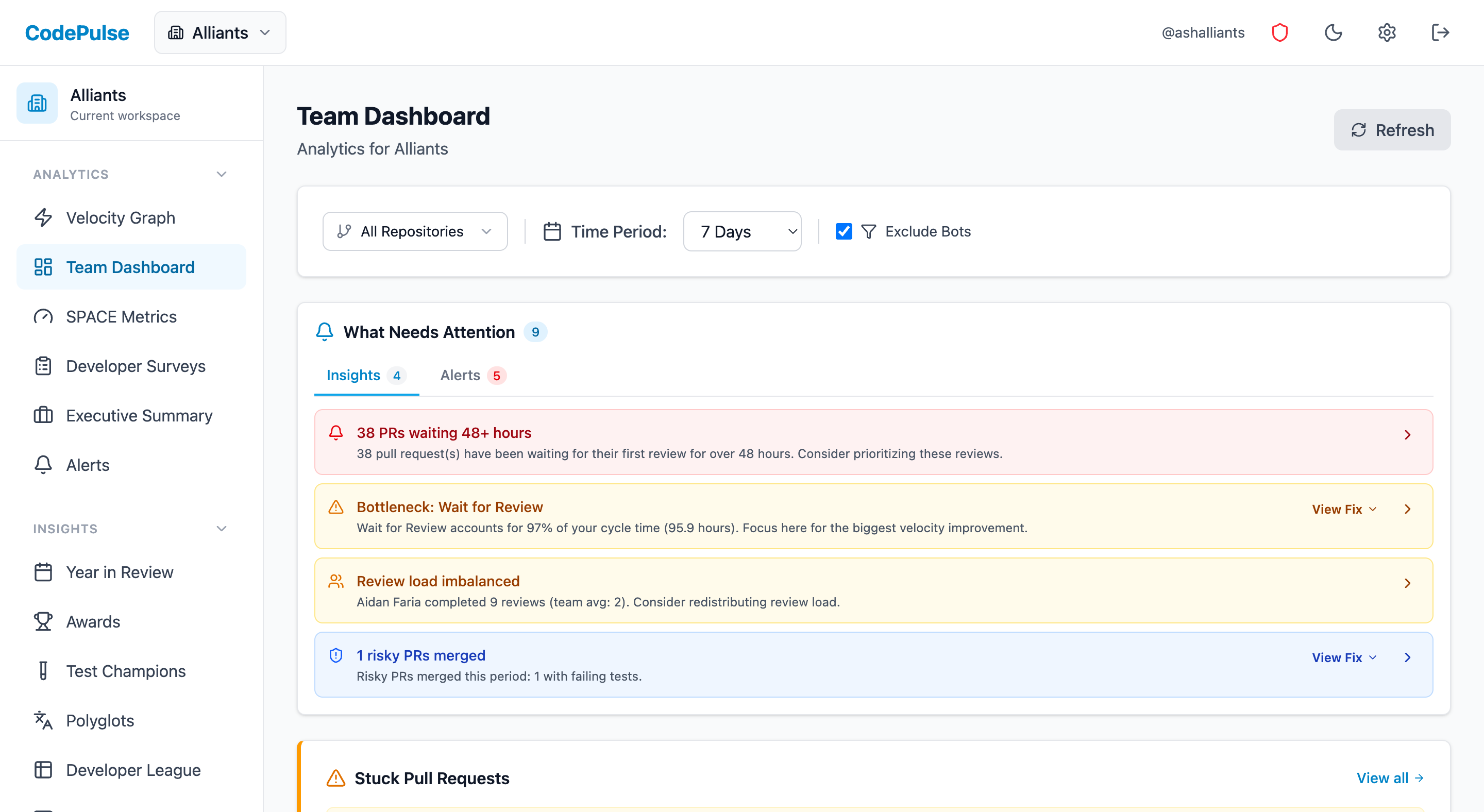
Find out which phase is holding your delivery up
CodePulse splits your cycle time into coding, waiting for review, active review, and merge, so you fix the queue that is actually costing you days. Read-only GitHub, no credit card.
Read-only GitHub · Your code stays yours · Team-level by default · No credit card
See These Features in Action
Break down cycle time into coding, waiting, review, and merge phases.
Get notified when cycle times spike or review patterns degrade.
Related Guides
We Cut PR Cycle Time by 47%. Here's the Exact Playbook
A practical playbook for engineering managers to identify bottlenecks, improve review processes, and ship code faster - without sacrificing review quality.
Your Best Engineer Is About to Quit (Check Review Load)
Learn how to identify overloaded reviewers, distribute review work equitably, and maintain review quality without burning out your senior engineers.
Your PR Cycle Time Is Fine (Here's the Benchmark)
What is a good PR cycle time? Benchmarks and targets based on team size, industry, and engineering maturity.
The Slack Alert That Catches Stuck PRs Before Standup
How to configure alerts for stuck PRs, review SLA breaches, and key metric changes to stay informed without constant dashboard checking.
DevOps Maturity Model: A Practical Assessment Framework
Assess your DevOps maturity across culture, CI/CD, testing, monitoring, and infrastructure. Includes self-assessment questionnaire and improvement roadmap by level.
DevOps Transformation: Why Most Fail (How to Win)
DevOps transformation is one of the most commonly failed initiatives in enterprise software. This guide shows how to avoid the pitfalls, measure success with real metrics, and achieve lasting cultural change.