
See exactly where your delivery flow is waiting
Preview the phase-by-phase report for review pickup, active review, and merge time. Connect in about five minutes; the initial analysis runs after sync.
Read-only GitHub · Your code stays yours · Team-level by default · No credit card
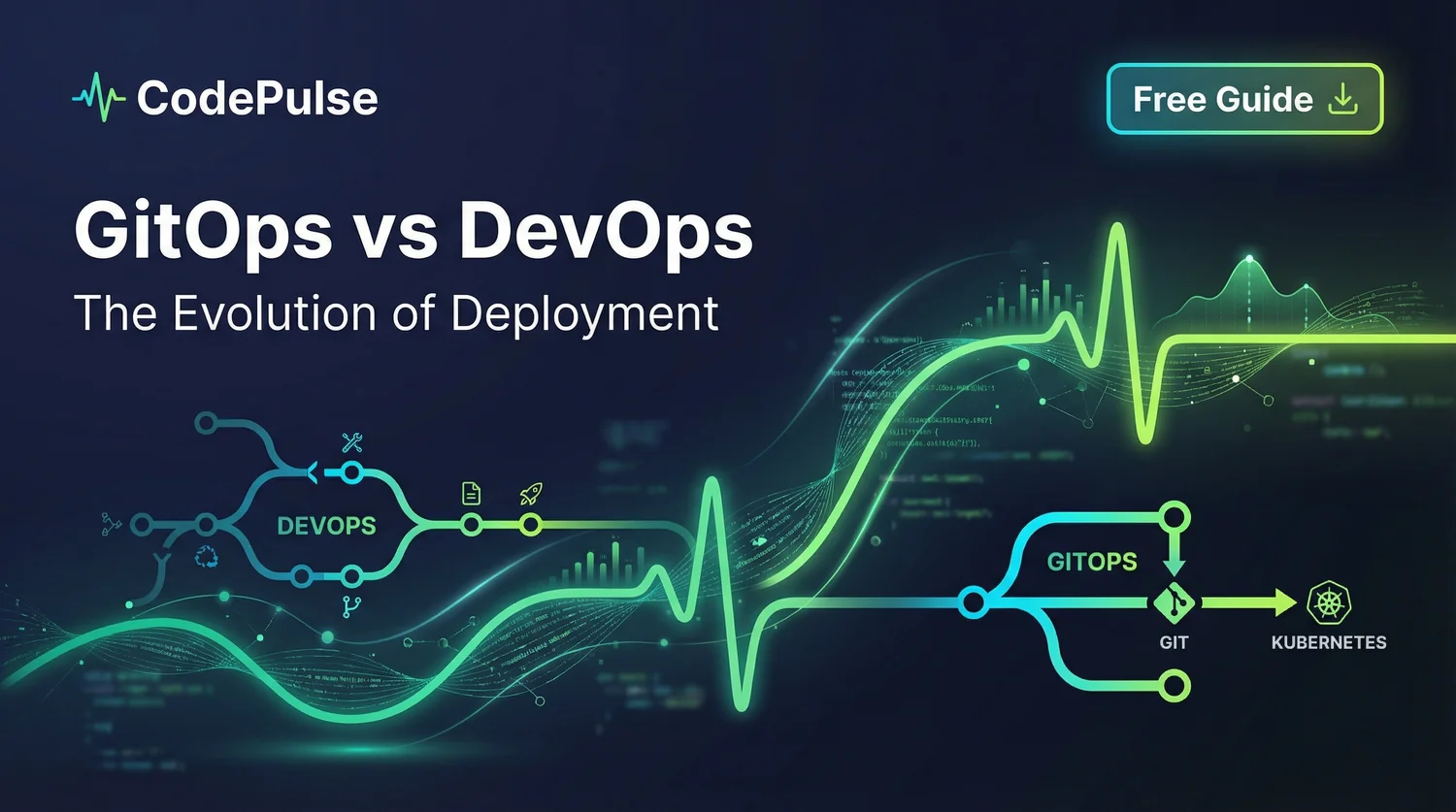
GitOps isn't a replacement for DevOps - it's an evolution of how we handle deployment and infrastructure management. This guide explains what GitOps actually is, how it relates to DevOps, and when adopting GitOps practices makes sense for your team.
"GitOps is DevOps where Git is the single source of truth for everything - not just code, but infrastructure, configuration, and desired system state."
What Is GitOps?
GitOps is an operational framework that applies Git-based workflows to infrastructure and application deployment. The core idea: if it's in Git, it's deployed. If it's not in Git, it shouldn't exist.
Core GitOps Principles
- Declarative: Desired state is described declaratively (YAML, JSON, HCL)
- Versioned and Immutable: Everything in Git with full history
- Pulled Automatically: Agents pull changes, not push-based CI/CD
- Continuously Reconciled: Drift detection and auto-correction
The term was coined by Weaveworks in 2017 and has become particularly popular in Kubernetes environments.
GitOps vs. DevOps: Key Differences
| Aspect | Traditional DevOps/CI-CD | GitOps |
|---|---|---|
| Deployment Model | Push-based (CI pushes to target) | Pull-based (agent pulls from Git) |
| Source of Truth | CI/CD pipeline + target system | Git repository only |
| Drift Detection | Manual or additional tooling | Built-in continuous reconciliation |
| Access Control | CI/CD needs prod credentials | Only agent needs prod access |
| Rollback | Re-run pipeline or scripts | Git revert = instant rollback |
| Audit Trail | Pipeline logs + deployment logs | Git history = complete audit |

/// Our Take
GitOps is fantastic for Kubernetes. For everything else, it's optional.
The GitOps model shines when you have declarative infrastructure (Kubernetes) and need continuous reconciliation. If you're deploying to VMs or serverless, traditional CI/CD is simpler and works fine. Don't adopt GitOps because it's trendy - adopt it when the pull model actually helps.
The Relationship: GitOps Extends DevOps
GitOps isn't a competitor to DevOps - it's a specific implementation of DevOps principles for infrastructure and deployment.
Hierarchy of Practices
═══════════════════════════════════════════════════

DevOps (Culture & Practices)
    │
    ├── CI/CD (Automation Pattern)
    │       │
    │       ├── Traditional CI/CD (Push-based)
    │       │
    │       └── GitOps (Pull-based + Git as truth)
    │
    ├── Infrastructure as Code
    │
    ├── Monitoring & Observability
    │
    └── Shared Ownership & Culture

GitOps is one way to implement DevOps automation,
not a replacement for DevOps culture.
You still need:
- DevOps culture (shared ownership, blameless postmortems)
- CI pipelines (building, testing code)
- Monitoring and alerting
- Security practices
GitOps changes how deployment happens, not the broader DevOps principles.
When to Use GitOps
GitOps Makes Sense When:
- Kubernetes-native: Your infrastructure is primarily Kubernetes
- Multi-cluster: You manage multiple environments/clusters
- Compliance requirements: You need complete audit trails
- Drift is a problem: Manual changes break your environments
- Security sensitive: You want to minimize who has prod credentials
Traditional CI/CD Is Fine When:
- VM-based: Infrastructure isn't declarative
- Serverless: Deployment is already handled by the platform
- Simple environments: Single cluster, single region
- Team is small: Overhead of GitOps tooling isn't worth it
GitOps Tools Compared
| Tool | Best For | Key Features |
|---|---|---|
| ArgoCD | Kubernetes-native GitOps | UI, multi-cluster, app-of-apps pattern |
| Flux | Lightweight GitOps | CNCF graduated, GitOps Toolkit |
| Jenkins X | Full CI/CD + GitOps | Opinionated, preview environments |
| Rancher Fleet | Multi-cluster at scale | Manages 1M+ clusters |
Measuring GitOps Effectiveness
GitOps-specific metrics to track:
| Metric | What It Measures | Target |
|---|---|---|
| Sync Time | Git commit to deployed in cluster | <5 minutes |
| Drift Detection Time | Time to notice manual changes | <1 minute |
| Auto-Heal Rate | % of drift automatically corrected | >99% |
| Rollback Time | Git revert to cluster recovery | <2 minutes |
| Sync Success Rate | % of syncs that succeed | >99% |
"If your GitOps agent isn't catching drift within minutes and auto-healing, you don't have GitOps - you have Git-triggered deploys."
📊 How to Track This in CodePulse
CodePulse tracks the delivery metrics that apply to both GitOps and traditional CI/CD:
- Deployment Frequency: How often Git changes reach production
- Lead Time: Commit to deployed (works with GitOps sync time)
- Change Failure Rate: Syncs that cause issues
View metrics in the Dashboard to track GitOps delivery effectiveness.
Common GitOps Pitfalls
Pitfall 1: Secrets in Git
GitOps means "everything in Git" but secrets require special handling. Use tools like Sealed Secrets, SOPS, or external secret managers - never plaintext secrets in Git.
Pitfall 2: Ignoring CI
GitOps handles deployment, not building/testing. You still need CI pipelines to build images, run tests, and produce artifacts. GitOps deploys the result.
Pitfall 3: Manual Hotfixes
The moment you kubectl apply directly, you've broken GitOps. Drift will be detected and reverted. All changes must go through Git - even emergencies.
Pitfall 4: Too Much in One Repo
Monorepo GitOps with hundreds of apps becomes unwieldy. Consider app-of-apps patterns or separate repos per team/domain.
Related Guides
- DevOps Automation Metrics Guide - Measuring automation effectiveness
- DORA Metrics Guide - Deployment and lead time metrics
- Deployment Frequency & Lead Time - Deep dive into delivery metrics
- Platform Team Metrics - Measuring internal platforms (often GitOps-based)
Conclusion
GitOps is an evolution of DevOps deployment practices, not a replacement for DevOps culture or CI pipelines. It's particularly powerful for Kubernetes environments where declarative configuration and continuous reconciliation provide real benefits.
The decision isn't "GitOps vs. DevOps" - it's whether the GitOps model (pull-based, Git as truth, continuous reconciliation) fits your infrastructure better than traditional push-based CI/CD.
"GitOps is DevOps + Git as the single source of truth for everything. The culture stays the same. The deployment model evolves."
Track your delivery performance with CodePulse- across GitOps, traditional CI/CD, and hybrid approaches.
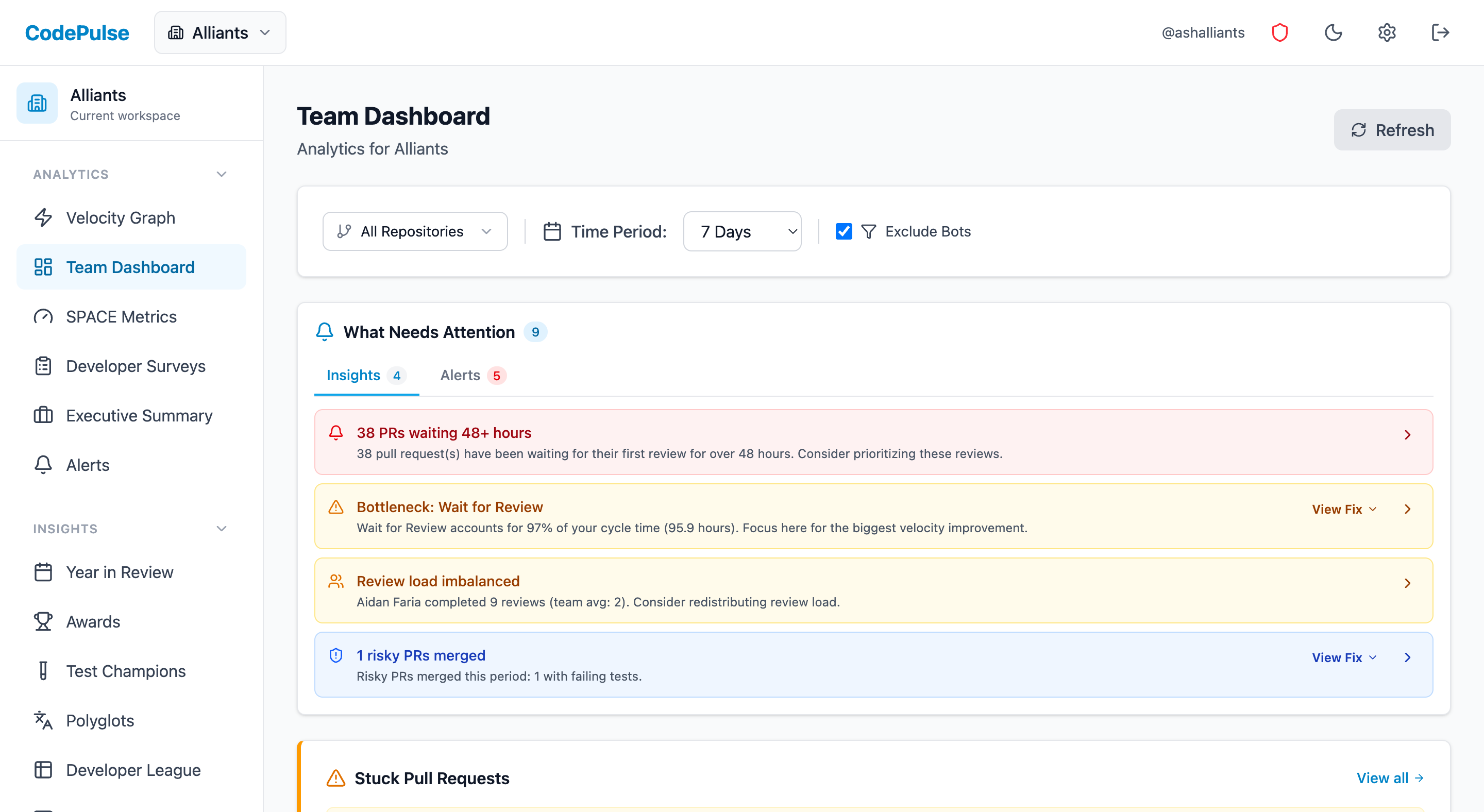
Find out which phase is holding your delivery up
CodePulse splits your cycle time into coding, waiting for review, active review, and merge, so you fix the queue that is actually costing you days. Read-only GitHub, no credit card.
Read-only GitHub · Your code stays yours · Team-level by default · No credit card
See These Features in Action
Track deployment frequency, lead time, and release patterns.
Track all four DORA metrics and benchmark against industry standards.
Related Guides
Infrastructure as Code: Measuring IaC Effectiveness
Infrastructure as Code brings software engineering to infrastructure. This guide covers the metrics that matter for Terraform, Pulumi, and other IaC tools.
DevOps Automation: How to Measure What Actually Matters
DevOps automation promises faster delivery and fewer errors. This guide covers the metrics that prove automation ROI, what to automate first, and how to calculate the business impact.
DORA Metrics Explained: The 4 Keys Without the Hype
A complete breakdown of the four DORA metrics - deployment frequency, lead time, change failure rate, and MTTR - with honest benchmarks and gaming traps to avoid.
Measure Deploy Frequency Without CI/CD (The Hack)
Master DORA deployment frequency and lead time using GitHub data alone, without requiring CI/CD pipeline access.