
Understand the system around the team, not a developer leaderboard
Preview team-level workload, collaboration, and delivery signals designed for process improvement rather than performance grading.
Read-only GitHub · Your code stays yours · Team-level by default · No credit card
You've inherited a struggling engineering team. Deadlines are missed consistently. Morale is cratering. The board wants answers. Leadership is losing patience. You don't have the luxury of a 6-month transformation program. You have 90 days to show measurable improvement - or you're next on the chopping block. Here is the 90-Day Turnaround Protocol.
"Most turnarounds fail not because they lack ambition, but because they try to fix everything at once. The teams that survive focus on three things: stop the bleeding, restore confidence, then rebuild. In that order."
This guide gives you a week-by-week framework for diagnosing what's actually broken, implementing quick wins that restore credibility, avoiding the mistakes that sink most turnarounds, and communicating progress to stakeholders who've lost patience. It's battle-tested from teams that have been where you are now.
🔥 Our Take
Burnout is a management failure, not a personal weakness.
If the team you inherited is burned out, someone failed to set boundaries they couldn't set themselves. According to the Jellyfish 2024 State of Engineering Management report, 65% of engineers experienced burnout in the past year. Even more telling: 46% of engineers report team burnout vs only 34% of executives - a perception gap that explains why so many turnarounds start too late. The signals were visible. Someone chose not to see them.
Phase 0: Diagnosing What's Actually Broken
Before you fix anything, you need to understand what's actually broken - not what people tell you is broken. These are often different things. Stakeholders blame "engineering" as a monolith. Engineers blame "product" or "leadership." Neither is useful. You need data.
The Diagnostic Framework
Struggling teams generally fail for one of four reasons. Your first job is figuring out which one (or combination) you're dealing with:
| Failure Mode | Symptoms | Key Metrics to Check |
|---|---|---|
| Flow Failure | Work starts but doesn't finish. PRs sit for days. Everything feels slow. | Cycle time, wait time for review, WIP count |
| Quality Failure | Things ship but break. Constant firefighting. Incidents every week. | Change failure rate, test failure rate, churn rate |
| Capacity Failure | Too much work, too few people. Everything is urgent. Constant context switching. | WIP per engineer, after-hours commits, review load ratios |
| Direction Failure | Lots of activity, no progress. Priorities change weekly. Half-finished projects everywhere. | Code churn, abandoned PRs, cycle time increasing while output stays flat |
The First-Week Diagnostic Checklist
In your first week, you need answers to these questions. Don't guess. Measure.
🩺First-Week Diagnostic Metrics
Check these metrics before proposing any fixes:
- Cycle Time Breakdown: Where does time go? Is it Coding Time (requirements unclear) or Review Time (process bottleneck)?
- Work in Progress: Count open PRs per engineer. More than 3 per person signals context-switching problems.
- Churn Rate: Are they rewriting code constantly? High churn (>30%) indicates unclear requirements or massive tech debt.
- Review Network: Is one person blocking everyone? Bus factor of 1 is a delivery bottleneck.
- After-Hours Commits: More than 15% after-hours work means the team is already burning out.
What the Data Usually Reveals
In our experience, struggling teams almost always have at least one of these patterns:
Common Turnaround Diagnoses
Pattern 1: The WIP Explosion
- 10 engineers, 50+ open tickets
- Cycle time > 2 weeks
- PRs sitting for 3+ days
- FIX: Aggressive WIP limits, review SLAs
Pattern 2: The Quality Death Spiral
- Churn rate > 30%
- Test failure rate climbing
- "Quick fixes" everywhere
- FIX: Stop shipping, pay down critical debt first
Pattern 3: The Hero Dependency
- One person reviews everything
- One person knows the critical system
- Vacation = team paralysis
- FIX: Knowledge distribution, forced rotation
Pattern 4: The Priority Whiplash
- Direction changes weekly
- Half-finished features everywhere
- High activity, low completions
- FIX: Scope freeze, finish what's started
"The 2024 DORA report shows low-performing teams grew from 17% to 25% year-over-year. If you're in turnaround mode, you're not alone - but you need to act faster than the average team that's slowly declining."
The 90-Day Turnaround Framework
This framework is structured in three phases: Triage (stop the bleeding), Stabilization (create predictability), and Momentum (prove improvement). Each phase has specific goals and success criteria.
Phase 1: Triage (Days 1-30)
Your first job is not to "fix" everything. It's to stop the bleeding and create space to think clearly.
Week 1: Stop and Observe
- Day 1-2: Install visibility. Deploy CodePulse or similar tooling. You cannot fix what you cannot measure.
- Day 3-4: Audit Work in Progress. Count every open ticket, PR, and in-flight project. The number is usually shocking.
- Day 5: Identify the top 3 bottlenecks from your diagnostic metrics. Write them down. These are your triage targets.
Week 2: The Aggressive Cut
- Cut WIP by 50%: This is not optional. "We are pausing these to focus on shipping the other half." Pain now prevents more pain later.
- Cancel the lowest-value 30% of work: If something has been in progress for 3+ weeks with no momentum, it's not happening. Acknowledge it and move on.
- Freeze scope on remaining work: No new requirements until current work ships. Non-negotiable.
Week 3-4: Install Guardrails
- WIP Limits: No one starts new work until their current PR is merged. Hard rule. No exceptions.
- 24-Hour Review SLA: All PRs must have a first review within 24 hours. Set up alerts in CodePulse Alerts.
- Soft Code Freeze: No structural refactoring. Only feature work or P0 bugs. Save the cleanup for Phase 3.
Week 2 Alert Configuration Example:

Alert 1: PR Stuck > 24h
- Trigger: wait_for_review_hours > 24
- Channel: #engineering-leads
- Frequency: Daily digest

Alert 2: WIP Overflow
- Trigger: open_prs_per_developer > 3
- Channel: #engineering-leads
- Frequency: Real-time

Alert 3: After-Hours Work
- Trigger: after_hours_merge_rate > 20%
- Channel: Manager DM
- Frequency: Weekly
Phase 2: Stabilization (Days 31-60)
By now, the chaos should have quieted. Work is finishing instead of just starting. Now create predictability.
Week 5-6: Establish Rhythm
- Weekly shipping cadence: Something ships every week. Even small things. Momentum matters more than size.
- Daily standups (short): 15 minutes max. Focus on blockers, not status reports.
- Weekly metrics review: Share cycle time and completion rate with the team. Celebrate improvements publicly.
Week 7-8: Address Structural Issues
- Break the hero dependency: If one person is doing 3x the reviews, redistribute. See our Review Load Balancing Guide.
- Document the undocumented: Whatever only one person knows, write it down. Now.
- Start pair reviews: Junior developers join senior reviewers on complex code areas.
📊Track Progress in CodePulse
Monitor your stabilization metrics:
- Dashboard shows cycle time trends - you should see a steady decline
- Review Network reveals if review load is becoming more distributed
- File Hotspots identifies risky areas that need documentation
Phase 3: Momentum (Days 61-90)
Work is flowing. Predictability is returning. Now prove that improvement is real and sustainable.
Week 9-10: Demonstrate Progress
- Prepare the metrics story: Compare Day 1 metrics to Day 60. You should see 20-30% improvement in cycle time.
- Celebrate publicly: Show the team the trends. "Look, we're shipping 25% faster than we were 60 days ago."
- Share with leadership: Use the Executive Summary to show board-ready metrics.
Week 11-12: Sustainable Practices
- Now allow controlled refactoring: Pick the highest-value tech debt items. Budget 20% of capacity.
- Hire (if needed): You now know where the gaps are. Don't hire into chaos - hire into a stable system.
- Plan the next 90 days: Turnaround doesn't end at day 90. It transitions into continuous improvement.
Quick Wins vs. Structural Changes
In a turnaround, you need to show progress fast while fixing root causes. That means distinguishing quick wins (visible improvements this week) from structural changes (fixes that take months to pay off).
Quick Wins: Do These First
| Quick Win | Time to Impact | Why It Works |
|---|---|---|
| Cut WIP by 50% | 1 week | Immediate cycle time improvement |
| 24h review SLA | 1-2 weeks | Eliminates the #1 bottleneck (wait time) |
| Cancel stale work | Immediate | Reduces cognitive load, creates focus |
| Daily standups | 1 week | Surfaces blockers before they fester |
| Metrics dashboard | Immediate | Creates shared visibility and accountability |
Structural Changes: Plan for These
| Structural Change | Time to Impact | Why It's Worth It |
|---|---|---|
| Knowledge distribution | 2-3 months | Eliminates bus factor risk |
| Test coverage improvements | 3-6 months | Reduces change failure rate |
| Architecture refactoring | 6+ months | Unlocks velocity improvements |
| Team restructuring | 3-6 months | Aligns capacity with domain complexity |
| Culture change | 6-12 months | Sustains improvements long-term |
"Quick wins buy you time. Structural changes buy you the future. You need both - but in the right order. Leaders who skip quick wins lose credibility before structural changes can pay off."
Common Turnaround Mistakes: What NOT to Do
Most turnarounds fail. Here's why:
Mistake 1: Introducing New Tools During Crisis
Do not introduce complex new tools (new ticketing system, new CI/CD, Kubernetes) during a turnaround. Every new tool adds learning overhead. Learning overhead slows delivery. Slower delivery is the opposite of what you need.
Exception: Visibility tools like CodePulse that overlay your existing stack without requiring workflow changes. Adding measurement doesn't slow you down.
Mistake 2: Hiring Your Way Out
Adding engineers to a broken system makes it more broken, not less. New engineers need onboarding. Onboarding takes time from existing engineers. If your senior developers are already overloaded, hiring juniors accelerates the burnout of the people you can't afford to lose.
Rule: Stabilize first, then hire. Never hire into chaos.
Mistake 3: The Big Rewrite
"If we just rewrite this component, everything will be better" is the siren song of struggling teams. Rewrites take longer than estimated, create more bugs than they fix, and don't address process problems.
Rule: No rewrites during turnaround. Incremental improvement only.
Mistake 4: Blaming Individuals
Struggling teams are rarely caused by individual performers. They're caused by systems: unclear requirements, unrealistic timelines, accumulated debt, missing processes. Firing the "problem engineer" feels good but rarely fixes the underlying issue.
Rule: Fix the system before judging the people in it.
Mistake 5: Ignoring the Perception Gap
According to the Jellyfish 2024 report, 43% of engineers feel leadership is "out of the loop" on engineering challenges. If you announce a turnaround without first understanding what the team thinks is broken, you'll lose them immediately.
Rule: Listen before prescribing. The team often knows what's wrong - they just haven't been asked.
The Turnaround Anti-Pattern Checklist
- "Let's adopt Kubernetes while we're at it"
- "We'll hire 5 more engineers to help"
- "This whole system needs to be rewritten"
- "If we just fire [person], things will improve"
- "I know what's wrong; I don't need to ask"
- "We'll use existing tools, just add visibility"
- "We'll stabilize, then evaluate headcount"
- "We'll incrementally improve the critical paths"
- "We'll fix the system that created this situation"
- "Tell me what you think is broken - I'm listening"
Communication Strategy: How to Talk to Everyone
A turnaround is as much about communication as it is about execution. You need to buy time from executives while maintaining trust with the team.
Talking to the Board/CEO
Executives want to know two things: (1) Do you understand the problem? and (2) When will it be fixed?
Week 1 Executive Update Template:

"We're in Triage Mode.

I've diagnosed the core issues:
- [Issue 1: e.g., WIP is 5x capacity]
- [Issue 2: e.g., Review bottleneck causing 3-day delays]
- [Issue 3: e.g., Critical system knowledge in one person]

I've paused 50% of the roadmap to stabilize delivery.
Velocity will look low for 2-3 weeks, then it will rise.

Here is the dashboard where you can watch the recovery:
[Link to CodePulse Executive Summary]

I'll update you weekly. First improvement signals in 2 weeks.
Full stabilization in 60 days."
Talking to the Team
The team is scared. They know things are broken. They may fear for their jobs. Be honest, specific, and protective.
Week 1 Team Communication Template:

"I'm here to help us get healthy, not to blame anyone.

Here's what I've observed:
- We have too much work in progress
- PRs are waiting too long for review
- Some of you are working unsustainable hours

Here's what's changing immediately:
- We're cutting WIP by 50%. Less starting, more finishing.
- 24-hour review SLA. No PR waits more than a day.
- No after-hours work unless it's a true emergency.

Here's what I need from you:
- Tell me where you're blocked. I'll remove obstacles.
- Trust the process for 30 days. Then we'll evaluate together.

We're going to be okay. Let's prove it."
Weekly Updates During Turnaround
Every week, send updates to both leadership and the team. Same format. Transparency builds trust.
Weekly Turnaround Update Format:

WHAT IMPROVED THIS WEEK:
- Cycle time: [X days] → [Y days] (Z% improvement)
- PRs shipped: [number]
- Blockers cleared: [list]

WHAT WE'RE WORKING ON:
- [Focus area 1]
- [Focus area 2]

WHAT'S STILL CONCERNING:
- [Issue 1: plan to address]
- [Issue 2: plan to address]

HELP NEEDED:
- [Specific ask, if any]
Metrics to Track Progress: How to Know It's Working
You need leading indicators (are we on the right path?) and lagging indicators (did we actually improve?). Track both. If there's an active steering committee involved in the turnaround, our engineering steering committee guide covers the cadence and artifacts that keep committees productive rather than performative.
Leading Indicators (Check Weekly)
| Metric | Target Trend | Where to See It |
|---|---|---|
| Open PRs per Developer | Decreasing, target <3 | Dashboard |
| Wait Time for Review | Decreasing, target <24h | Cycle Time Breakdown |
| After-Hours Commit Rate | Decreasing, target <10% | Risky Changes |
| Review Load Distribution | Flattening (no one >2x average) | Review Network |
Lagging Indicators (Check Monthly)
| Metric | Target | Where to See It |
|---|---|---|
| Cycle Time (Overall) | 20-30% reduction by Day 60 | Dashboard |
| PRs Merged per Week | Increasing (more completion) | Dashboard |
| Change Failure Rate | Stable or decreasing | Quality Metrics |
| Team Health Grade | Improving | Executive Summary |
📈The Turnaround Dashboard in CodePulse
Set up your turnaround tracking:
- Dashboard for cycle time breakdown and velocity trends
- Alerts for SLA violations and after-hours work
- Executive Summary for board-ready progress reports
- Repository Comparison to see which teams/repos are improving fastest
The 90-Day Success Criteria
How do you know if your turnaround worked? Here's what success looks like at Day 90:
Day 90 Turnaround Success Criteria
Delivery (Must Have)
- Cycle time reduced by 25%+
- Weekly shipping cadence established
- WIP under control (< 3 per developer)
- Review SLA consistently met (> 90%)
Health (Must Have)
- After-hours work < 15%
- No single point of failure on reviews
- Team morale improving (qualitative)
Trust (Must Have)
- Executive confidence restored
- Team believes in the process
- Metrics are visible and shared
Sustainability (Stretch)
- 20% time budgeted for tech debt
- Documentation improving
- New hires can be onboarded successfully
"A successful turnaround isn't just about metrics. It's about creating a team that believes they can win - and has the evidence to prove it. Data restores confidence. Confidence enables execution. Execution proves the turnaround worked."
Your Action Plan: Start This Week
Today
- Install visibility: Connect CodePulse to your repositories. You need data before you can diagnose.
- Count WIP: How many open PRs? How many in-flight tickets? Write the number down.
- Identify the top blocker: What's the single biggest reason work isn't finishing?
This Week
- Run the diagnostic framework: Is this a flow, quality, capacity, or direction problem?
- Make the cut: Identify which work to pause or cancel.
- Communicate the plan: Tell leadership and the team what's happening.
This Month
- Implement guardrails: WIP limits, review SLA, scope freeze.
- Track weekly: Are leading indicators improving?
- Adjust as needed: Turnarounds require iteration. Don't be afraid to change approach if data shows it's not working.
For deeper dives on related topics, see our guides on Detecting Burnout Signals in Git Data, Measuring Performance Without Micromanaging, and The Series B Engineering Metrics Handbook.
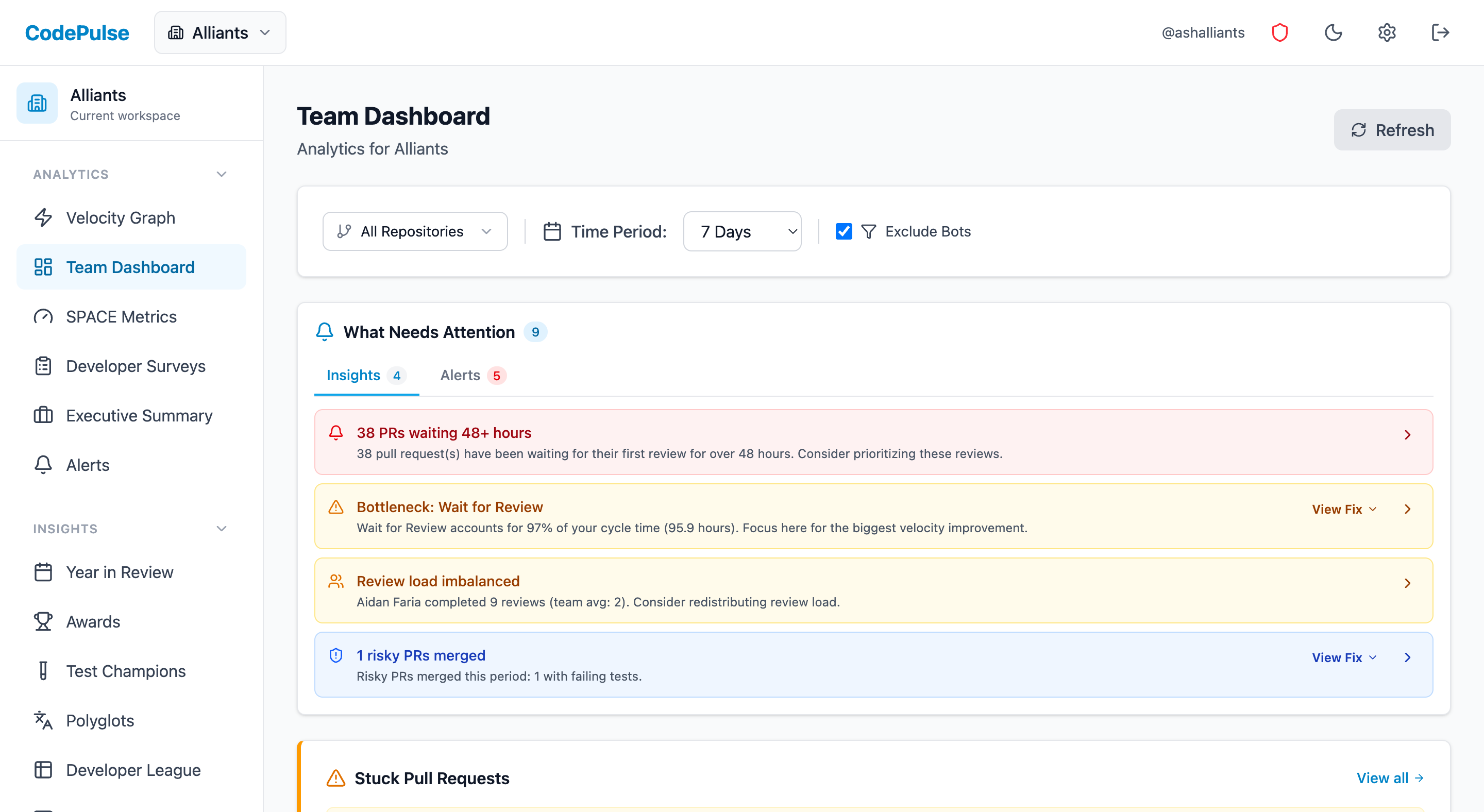
Get this view for your own teams
Connect GitHub for team-level workload, review distribution, and delivery signals. Individual views stay off unless your organisation explicitly turns them on.
Read-only GitHub · Your code stays yours · Team-level by default · No credit card
See These Features in Action
Board-ready engineering performance in a single page.
Break down cycle time into coding, waiting, review, and merge phases.
Interactive graph of review relationships and workload distribution.
Related Guides
Your Git Data Predicts Burnout 6 Weeks in Advance
Use the STRAIN Score framework to detect developer burnout from Git data. Identify after-hours patterns, review overload, and intensity creep before they cause turnover.
Engineering Metrics That Won't Get You Reported to HR
An opinionated guide to implementing engineering metrics that build trust. Includes the Visibility Bias Framework, practical do/don't guidance, and a 30-day action plan.
The 50-Engineer Cliff: Why Everything Breaks After Series B
The definitive guide to engineering metrics for the Series B transition. Learn why Hero Mode breaks at 50 engineers, how to build a tiered metrics stack, what boards actually want to see, and when to hire vs. optimize.
Your Best Engineer Is About to Quit (Check Review Load)
Learn how to identify overloaded reviewers, distribute review work equitably, and maintain review quality without burning out your senior engineers.
The EM Dashboard That Won't Get You Reported to HR
With 83% of developers suffering from burnout and a 12-point perception gap between engineers and executives, EMs need metrics that reveal team health - not just delivery. Here is what to track, what to ignore, and how to use data without destroying trust.
Developer Productivity Engineering: What DPE Does
Developer Productivity Engineering (DPE) is how Netflix, Meta, and Spotify keep engineers productive. Learn what DPE teams do and how to start one.