
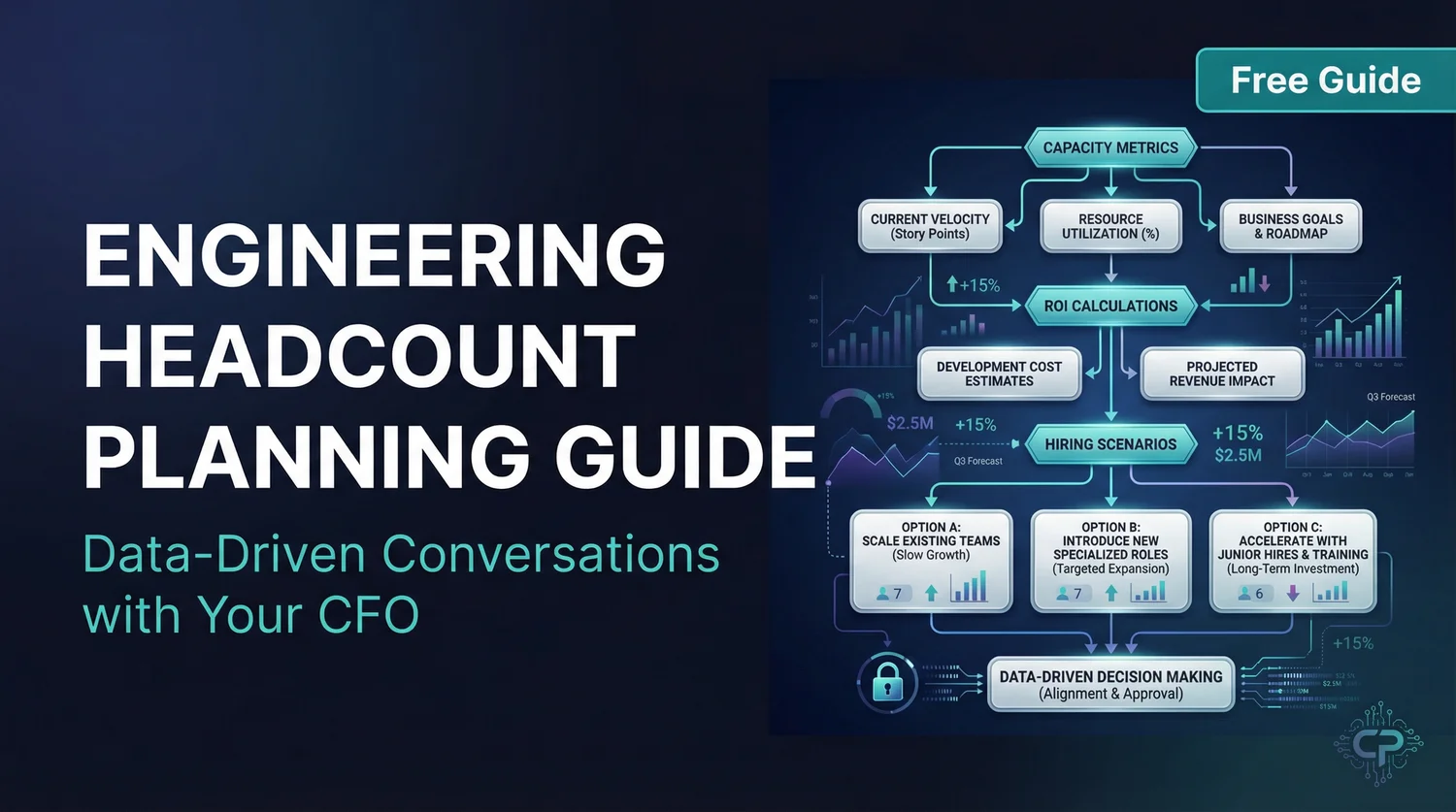
Understand the system around the team, not a developer leaderboard
Preview team-level workload, collaboration, and delivery signals designed for process improvement rather than performance grading.
Read-only GitHub · Your code stays yours · Team-level by default · No credit card
Headcount planning is no longer about gut feelings or guesswork - it's about data-driven decisions that connect staffing needs to business value. This guide shows you how to have productive headcount conversations with your CFO, justify hiring requests with evidence, and avoid the common traps that waste budgets.
Our Take
"We need more engineers" is not a business case. Neither is "we're behind on the roadmap." CFOs hear these requests constantly and have learned to be skeptical. If you want headcount, you need to speak in numbers: capacity utilization, cost-per-feature, and ROI projections. Everything else is just hope dressed up as planning.
Why Headcount Requests Fail
Most engineering headcount requests fail not because the need isn't real, but because the justification doesn't resonate with finance. Engineering leaders think in delivery velocity and technical debt. CFOs think in unit economics and return on investment.
❌ How Engineers Justify Headcount
- "We're behind on the roadmap"
- "The team is burning out"
- "We have too much technical debt"
- "Competitors are hiring more"
- "We just need more people"
✅ How CFOs Evaluate Headcount
- "What's the cost-per-feature trend?"
- "What's capacity utilization?"
- "What's the ROI timeline?"
- "Can we improve efficiency first?"
- "What happens if we don't hire?"
The disconnect is fundamental. Engineers describe symptoms (burnout, delays, technical debt). CFOs need diagnosis and prognosis (root cause, cost impact, projected return).
"Capacity planning gives FP&A teams the data they need to guide decision-making. CFOs get deeper insights into the company from conversations about capacity, team, skills, and headcount. As a result, they can offer more nuanced advice to the CEO."
The Data-Driven Headcount Framework
Before requesting headcount, you need answers to four questions. These form the foundation of any credible business case.

Question 1: What's Your Actual Capacity?
Most engineering leaders dramatically overestimate available capacity. A fintech startup with five developers working 40-hour weeks assumed 200 hours of capacity per sprint. Reality showed only 104 productive hours after accounting for meetings, code reviews, and context switching.
Calculating True Capacity
Gross Hours:        40 hours/week × 5 engineers = 200 hours
- Meetings/Sync:    -30 hours (15%)
- Code Reviews:     -20 hours (10%)
- Context Switch:   -26 hours (13%)
- Admin/Overhead:   -20 hours (10%)
────────────────────────────────────────────────
Net Capacity:       104 hours (52% efficiency)

Many teams operate at 40-60% efficiency.
Before hiring, verify you're measuring capacity correctly.
If your team already operates at 85%+ of true capacity, the only way to hit roadmap targets is by increasing headcount. But if you're below that threshold, there may be efficiency gains to capture first.
Question 2: What Does Each Feature Actually Cost?
Cost-per-feature (or cost-per-story-point) is the metric that speaks directly to finance. It translates engineering output into financial terms and enables meaningful ROI conversations.
| Metric | Calculation | Why CFOs Care |
|---|---|---|
| Cost per Feature | Total eng cost ÷ Features shipped | Unit economics of engineering |
| Cost per Story Point | Team cost ÷ Points delivered | Enables project-level ROI |
| Revenue per Engineer | ARR ÷ Engineering headcount | Benchmarking efficiency |
| Time to Value | Idea → Revenue generation | Speed of investment return |
"One fintech startup built comprehensive team capacity vs. velocity tracking and provided the CFO with cost per story point metrics. This resulted in reduced development costs by 25% and secured approval for 3 additional developers based on data."
Question 3: What's the Roadmap Demand?
Compare your current delivery velocity to future roadmap demands. If the roadmap requires 150% of your current capacity, you have a concrete gap to fill.
Roadmap Analysis Example:

Current velocity:     120 story points/month
Q2 roadmap demand:    180 story points/month
Gap:                  60 story points (50% shortfall)

Options:
1. Hire: 2-3 engineers (6-8 weeks ramp-up)
2. Cut scope: Remove 60 points from roadmap
3. Extend timeline: Deliver in Q3 instead
4. Contractors: Bridge short-term gap

Each option has different cost/risk profiles.
Present all options, let finance decide.
Question 4: What's the ROI of Hiring?
Every hire is an investment. CFOs want to know when that investment pays back. Structure your headcount request with explicit ROI projections.
Sample ROI Calculation
Investment:
- 2 Senior Engineers @ $180K/year = $360K
- Recruiting costs: $50K
- Ramp-up period: 3 months at 50% productivity
- Total Year 1 Cost: ~$440K

Return:
- Enables Feature X: Projected $800K ARR
- Reduces churn by 5%: $200K retention value
- Faster time-to-market: 2 months earlier launch
- Total Year 1 Value: ~$1.2M

ROI: 173% in Year 1
Payback Period: ~5 months post-ramp
Build Your Headcount Case with Data
CodePulse provides the metrics you need for headcount conversations: capacity utilization, velocity trends, and delivery predictability. Get the evidence that convinces CFOs.
Having the CFO Conversation
The headcount conversation with finance is a negotiation. Come prepared with options, not just requests.
Present Multiple Scenarios
CFOs want options, not ultimatums. Build multiple scenarios that show different trade-offs. This demonstrates strategic thinking and makes collaboration easier.
| Scenario | Headcount | Roadmap Coverage | Risk Level |
|---|---|---|---|
| Conservative | +0 | 60% | High (miss targets) |
| Moderate | +2 | 85% | Medium (tight) |
| Recommended | +4 | 100% | Low (buffer) |
| Growth | +6 | 100% + new initiatives | Low (expansion) |
Anticipate Finance Questions
Prepare for the questions CFOs always ask. Having data-backed answers builds credibility.
"Can't we just improve efficiency instead of hiring?"
Answer with data: "We've improved cycle time by 30% over the last year. Our utilization is now at 87% - above industry benchmarks. The remaining gains require infrastructure investment of $X, which has longer payback than hiring."
"What happens if we don't approve this headcount?"
Answer with data: "We'll need to cut Feature X and Y from the roadmap, representing $500K in projected ARR. Alternatively, we'll miss the market window by 4 months, which our analysis shows reduces capture by 40%."
"Why can't contractors handle this?"
Answer with data: "For a 6-month project, contractors cost $180K vs. $90K for an FTE at equivalent productivity (after ramp). Contractors also create knowledge silos - our last project required 3 months of knowledge transfer."
Our Take
Don't treat the CFO as an obstacle. They're a stakeholder who needs different information than you typically provide. The CFO who pushes back on your headcount request is doing their job - your job is to give them the data that makes approval the obvious choice.
When NOT to Request Headcount
Sometimes the answer isn't more people. Recognizing when headcount won't solve your problem saves credibility for when it matters.
Signs You Have a Process Problem, Not a Headcount Problem
- High work-in-progress (WIP): If engineers are juggling 3+ projects simultaneously, adding people won't help - you need to limit WIP
- Long review queues: If PRs sit waiting for review for days, hiring more coders just creates more PRs to review
- Frequent context switches: If interruptions eat 30%+ of productive time, that's a planning problem
- Unclear requirements: If engineers spend 40% of their time clarifying scope, better requirements are the fix
Signs You Have a Skills Problem, Not a Volume Problem
- Single points of failure: If one person is a bottleneck for everything, you need to spread knowledge, not add generalists
- Technology transitions: Moving to a new stack requires specialized hires or training, not more of the same
- Quality issues: If bugs dominate, hiring more coders produces more bugs - invest in testing and code quality
The Annual Planning Process
Headcount planning shouldn't happen once a year in a scramble. Build a continuous process that makes annual planning straightforward.
Quarterly Capacity Reviews
Every quarter, assess:
- Utilization: What percentage of capacity is being used?
- Velocity trend: Is delivery accelerating, stable, or slowing?
- Roadmap fit: Are we on track to deliver planned work?
- Bottlenecks: Where are constraints appearing?
- Attrition risk: Are we losing people we need to replace?
Building the Annual Plan
When annual planning arrives, you should already have the data. The process becomes:
Annual Headcount Planning Checklist:

1. Historical Analysis
   □ Average velocity by quarter (last 12 months)
   □ Capacity utilization trend
   □ Cost-per-feature trend
   □ Attrition rate and replacement costs

2. Future Demand
   □ Roadmap requirements (story points or features)
   □ New initiative estimates
   □ Technical debt budget
   □ Maintenance and support needs

3. Gap Analysis
   □ Current capacity vs. demand
   □ Skills gaps vs. role requirements
   □ Geographic/timezone needs
   □ Seniority mix requirements

4. Scenario Modeling
   □ Conservative (no hire) impact
   □ Moderate growth scenario
   □ Recommended staffing level
   □ Stretch/expansion scenario

5. ROI Projections
   □ Revenue enabled by new capacity
   □ Cost savings from efficiency
   □ Risk mitigation value
   □ Payback period calculations
Automate Your Capacity Data
CodePulse tracks velocity, utilization, and delivery trends automatically. Export reports that show exactly what your engineering organization delivers - no manual data gathering required.
The Efficiency Alternative
Before requesting headcount, prove you've optimized what you have. This builds credibility and might actually solve the problem without hiring.
"Organizations implementing workforce management software report average labor cost savings of 7% and productivity increases of 68% following implementation."
Quick Efficiency Wins
| Intervention | Typical Impact | Time to Implement |
|---|---|---|
| Reduce meeting load | +10-15% capacity | Immediate |
| Limit work-in-progress | +20-30% throughput | 2-4 weeks |
| Improve review turnaround | -30% cycle time | 2-4 weeks |
| Automate testing/deployment | +15-25% velocity | 1-3 months |
| Better requirement clarity | -20% rework | Ongoing |
Document efficiency improvements before requesting headcount. "We improved velocity by 25% through process changes, and we still have a gap" is far more compelling than "we need more people."
Building Your Headcount Metrics Dashboard
Create a dashboard that tracks the metrics CFOs care about:
Capacity Metrics
- Utilization rate (%)
- Available capacity (hours/points)
- Capacity trend (3-month rolling)
- Bottleneck identification
Financial Metrics
- Cost per feature/story point
- Revenue per engineer
- Engineering cost as % of revenue
- Cost of delay (per week)
Delivery Metrics
- Velocity (points/features per sprint)
- Roadmap delivery %
- Cycle time trend
- Predictability score
Health Metrics
- Attrition rate
- Time to productivity (new hires)
- Knowledge distribution
- Burnout indicators
Conclusion: Headcount is a Business Decision
Headcount planning is ultimately a business decision, not a technical one. The engineering leader who treats it as such - with data, scenarios, and ROI projections - gets the resources they need.
Start by measuring your true capacity. Build cost-per-feature tracking. Create multiple scenarios for planning discussions. Anticipate finance questions with data answers. And remember: sometimes the answer isn't more people - it's better processes.
Final Take
The best headcount conversations don't start with "we need more people." They start with "here's what we can deliver with current resources, here's what we could deliver with additional investment, and here's the ROI of each scenario." Let the data make your case.
Related Resources
- VP Engineering Metrics: What Belongs on Your Dashboard
- Engineering Effectiveness: Why Fast Teams Still Fail
- Capacity Planning Using PR Data
- Building the Business Case for Engineering Metrics
Get the Data CFOs Need
CodePulse provides capacity utilization, velocity trends, and delivery metrics - the evidence that makes headcount conversations productive.
Read-only GitHub · Your code stays yours · Team-level by default · No credit card
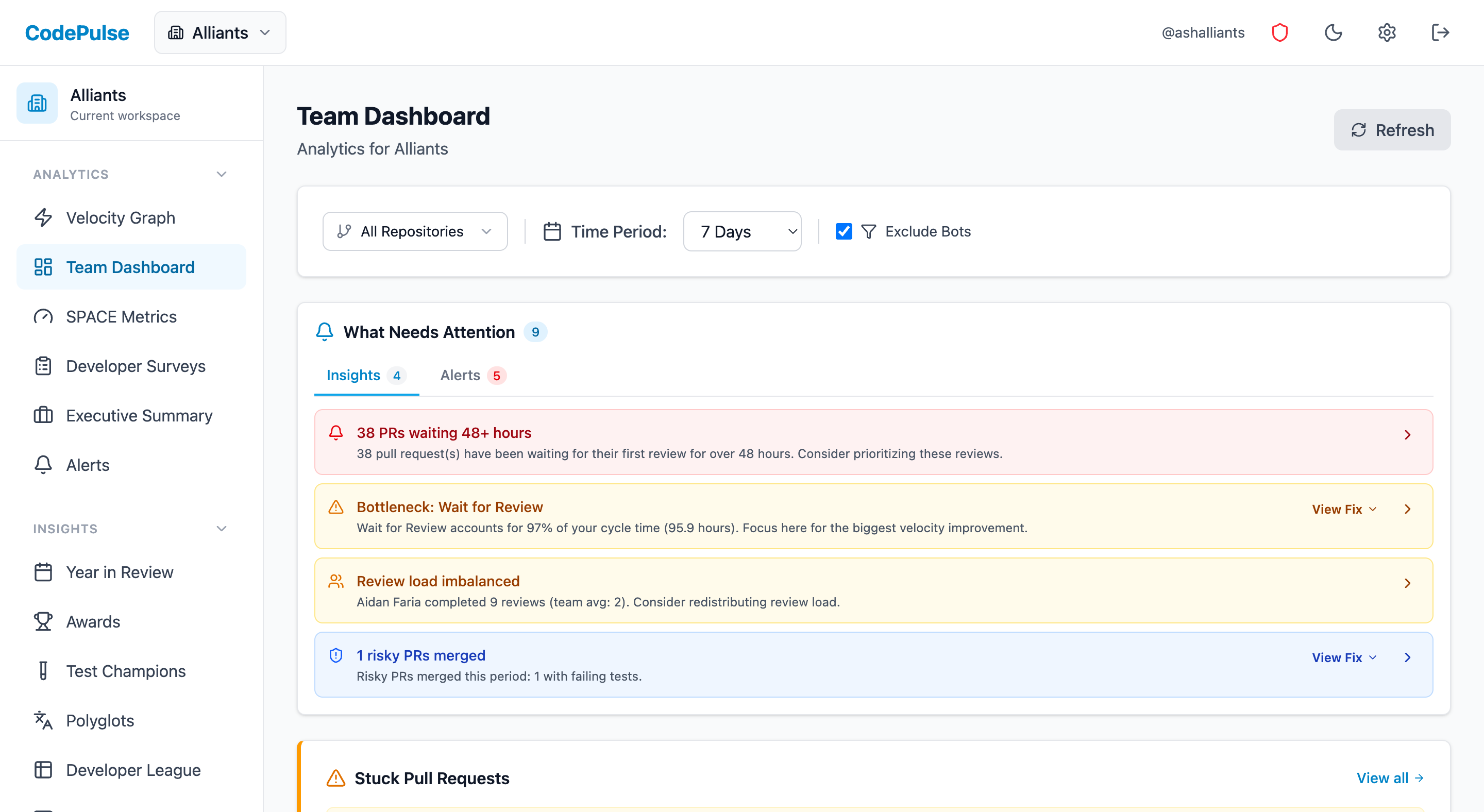
Get this view for your own teams
Connect GitHub for team-level workload, review distribution, and delivery signals. Individual views stay off unless your organisation explicitly turns them on.
Read-only GitHub · Your code stays yours · Team-level by default · No credit card
See These Features in Action
Predict delivery timelines based on historical velocity trends.
Board-ready engineering performance in a single page.
Related Guides
Stop Guessing Capacity. Your PRs Already Know
Use PR metrics to build data-driven capacity models, plan sprints realistically, and communicate engineering capacity to stakeholders.
Software Project Planning: Stop Guessing, Start Forecasting
Most project plans fail because they're based on estimates, not data. This guide shows how to plan software projects using git metrics, historical velocity, and probabilistic forecasting.
How I Got Engineering Metrics Budget Approved in 1 Meeting
Learn how to justify engineering analytics investment to CFOs, CEOs, and boards by translating technical value into business outcomes.
VP Engineering Board Metrics: 7 Numbers That Defend Headcount
The 7 metrics VPs of Engineering need for board presentations: delivery predictability, investment allocation, and team health - with the language to present them.
Brooks's Law: Why Adding Engineers Slows Delivery
What Fred Brooks actually wrote in 1975, the three mechanisms behind the law, what 580k+ commits of modern data show, whether AI changes it, and how to see it in your own Git history.