
See exactly where your delivery flow is waiting
Preview the phase-by-phase report for review pickup, active review, and merge time. Connect in about five minutes; the initial analysis runs after sync.
Read-only GitHub · Your code stays yours · Team-level by default · No credit card
Most software project plans are fantasy documents written once and never looked at again. They fail because they're based on estimates, not data. This guide shows how to plan software projects using actual git metrics, historical velocity, and probabilistic forecasting - so your plans have a chance of matching reality.
"The best project plan isn't the most detailed one - it's the one most likely to be updated when reality changes."
Why Software Project Plans Fail
Traditional project plans fail for predictable reasons:
| Failure Mode | Root Cause | Data-Driven Fix |
|---|---|---|
| Optimistic estimates | Planning based on best case | Use historical cycle time distributions |
| Hidden dependencies | Didn't map code dependencies | Analyze code ownership and hotspots |
| Resource conflicts | Assumed 100% availability | Use actual PR throughput per developer |
| Scope creep | Requirements weren't specific | Track lines of code vs. original estimate |
| Technical debt surprise | Didn't account for refactoring | Check file hotspots and churn rates |
/// Our Take
The fundamental problem with traditional project planning is that it treats software development like construction. But construction has known specifications; software has evolving requirements.
Instead of asking "when will this be done?", ask "what can we deliver by this date?" and "what's the probability distribution of completion times?" These questions lead to better outcomes than false precision.
Data-Driven Planning Framework
Step 1: Gather Historical Data
Before planning a new project, collect these metrics from your git history:
- Average cycle time - How long from first commit to merge?
- Cycle time distribution - What's the 50th, 75th, 95th percentile?
- PR throughput - How many PRs per developer per week?
- Code churn - What percentage of code gets rewritten?
- Review bottlenecks - Who's overloaded with reviews?
Step 2: Assess Project Complexity
Use git data to estimate complexity factors:
| Factor | Low Complexity | High Complexity |
|---|---|---|
| Files to modify | Isolated to 1-2 modules | Cross-cutting, 10+ files |
| Code hotspots | Touching stable code | Touching frequently-changed code |
| Knowledge silos | Well-documented, many contributors | Single expert, undocumented |
| Test coverage | High coverage, good tests | Low coverage, brittle tests |
| Dependencies | Internal only | External APIs, vendor integrations |
Step 3: Create Probabilistic Estimates
Instead of single-point estimates, use ranges:
Probabilistic Estimate Template
───────────────────────────────────────

Feature: User authentication system

Breakdown:
├── API endpoints (4 endpoints)
│   ├── 50% chance: 2-3 PRs, 4-6 days
│   ├── 80% chance: 3-5 PRs, 6-10 days
│   └── 95% chance: 4-7 PRs, 8-14 days
│
├── Database schema (2 migrations)
│   ├── 50%: 1 PR, 1-2 days
│   ├── 80%: 2 PRs, 2-4 days
│   └── 95%: 3 PRs, 3-7 days
│
├── Frontend UI (3 screens)
│   ├── 50%: 3-4 PRs, 5-8 days
│   ├── 80%: 4-6 PRs, 8-12 days
│   └── 95%: 5-8 PRs, 10-18 days
│
└── Integration & testing
    ├── 50%: 1-2 PRs, 2-3 days
    ├── 80%: 2-3 PRs, 3-5 days
    └── 95%: 3-5 PRs, 5-10 days

TOTAL (80% confidence): 14-24 days
TOTAL (95% confidence): 26-49 daysUsing Git Metrics for Planning
Cycle Time as Planning Input
Your team's historical cycle time tells you how fast work flows through your system. Use this to set realistic expectations:
- If median cycle time is 24 hours, a 5-PR feature takes ~1 week
- If 95th percentile is 5 days, budget for delays
- If cycle time varies widely, your estimates will be uncertain
Throughput for Capacity Planning
Track how many PRs each team member merges per week. This reveals actual capacity:
- If a developer merges 3 PRs/week, don't plan for 5
- Account for reviews, meetings, and context switching
- Leave buffer for unexpected work (20-30% typical)
Hotspots for Risk Assessment
Files that change frequently are harder to modify safely:
- High-churn files need extra testing time
- Files with many contributors may have conflicts
- Complex files (high cyclomatic complexity) slow development
📊 How to See This in CodePulse
Use CodePulse to gather planning inputs:
- Dashboard for cycle time distribution and throughput
- File Hotspots to identify high-risk areas
- Knowledge Silos to see bus factor and expertise gaps
- Developer Comparison to understand individual capacity
Project Plan Template
SOFTWARE PROJECT PLAN
───────────────────────────────────────

PROJECT: [Name]
OWNER: [Name]
CREATED: [Date]
LAST UPDATED: [Date]

─────────────────────────────────────────

1. OBJECTIVE
   What are we building and why?
   [Clear, measurable objective]

2. SUCCESS CRITERIA
   How will we know we're done?
   □ [Criterion 1 - measurable]
   □ [Criterion 2 - measurable]
   □ [Criterion 3 - measurable]

3. SCOPE
   In scope:
   - [Feature 1]
   - [Feature 2]

   Out of scope:
   - [Not doing this]
   - [Also not this]

4. TEAM & CAPACITY
   Based on last 30 days git data:
   - Team size: [N] developers
   - Avg throughput: [X] PRs/week
   - Avg cycle time: [Y] hours
   - Expected availability: [Z]%

5. RISKS & MITIGATIONS
   ┌─────────────────────────────────────┐
   │ Risk             │ Likelihood │ Plan │
   ├─────────────────────────────────────┤
   │ [Risk 1]         │ High       │ ...  │
   │ [Risk 2]         │ Medium     │ ...  │
   └─────────────────────────────────────┘

6. MILESTONES
   ┌─────────────────────────────────────┐
   │ Milestone │ Target   │ Confidence │
   ├─────────────────────────────────────┤
   │ Alpha     │ [Date]   │ 80%       │
   │ Beta      │ [Date]   │ 70%       │
   │ Launch    │ [Date]   │ 60%       │
   └─────────────────────────────────────┘

7. DEPENDENCIES
   - External: [APIs, vendors]
   - Internal: [Other teams, shared code]

8. TRACKING
   - Daily: Check PR status
   - Weekly: Review throughput vs. plan
   - Bi-weekly: Update milestones based on actuals
Planning Anti-Patterns
The Detailed Fantasy
A 50-page plan with task-level granularity for 6 months. It looks professional but is useless because everything changes after week 2. Reality: detailed plans work for 2-4 weeks max.
The Commitment Theater
Teams pressured to "commit" to dates they don't believe in. The plan exists for management, not for guiding work. Everyone knows it's fiction.
The Bottom-Up Rollup
Ask each person for estimates, add them up, add 20% buffer. This misses integration time, dependencies, and the fact that individual estimates are optimistic.
The No-Plan Plan
"We're agile, we don't need plans." This isn't agile - it's chaos. Agile means adapting plans frequently, not having no plans.
"A plan is useless until you've updated it three times based on what you learned. Planning is everything; the plan is nothing."
Adaptive Planning Process
Weekly Plan Review
Every week, update your plan based on actual progress:
- How many PRs merged vs. expected?
- What unexpected work appeared?
- Are cycle times stable or changing?
- Any blockers affecting multiple people?
- Update milestone confidence levels
Re-Planning Triggers
Major re-planning when:
- Throughput drops below 70% of plan for 2+ weeks
- Scope changes by more than 20%
- Key team member leaves or joins
- External dependency timeline shifts
- Major technical discovery changes architecture
Communicating Changes
When plans change, communicate with data:
Plan Update Communication
─────────────────────────────────────

STATUS: 🟡 Yellow (was 🟢 Green)

What changed:
- Discovered auth integration more complex than expected
- Requires 3 additional PRs for edge cases

Impact:
- Alpha milestone: was Jan 20 → now Jan 27
- Confidence: was 80% → now 70%

Data supporting change:
- Cycle time for auth PRs: 4.2 days (vs. 2.1 days typical)
- 2 PRs required re-review due to security concerns

Mitigation:
- Moving non-critical features to beta
- Adding security review earlier in process

No change to final launch date yet.
Related Guides
- Stop Estimating, Start Forecasting - Probabilistic approaches to delivery prediction
- Capacity Planning with PR Data - Using throughput for headcount planning
- Code Hotspots and Knowledge Silos - Identifying high-risk areas before planning
- Engineering Team Turnaround Plan - When projects need rescue
Conclusion
Software project planning isn't about predicting the future - it's about making better decisions with uncertainty. Data-driven planning uses your team's actual performance (cycle time, throughput, churn) to create realistic expectations.
- Use historical data - past performance predicts future
- Create ranges, not points - probability distributions, not commitments
- Plan adaptively - update weekly based on actuals
- Communicate with data - show why, not just what changed
- Stay humble - no one can predict software accurately
Start by pulling your team's metrics from CodePulse. Look at cycle time, throughput, and hotspots. Then build your next project plan on data instead of hope.
"The goal isn't to predict exactly when you'll be done. The goal is to understand your delivery system well enough to make good tradeoff decisions when reality diverges from the plan."
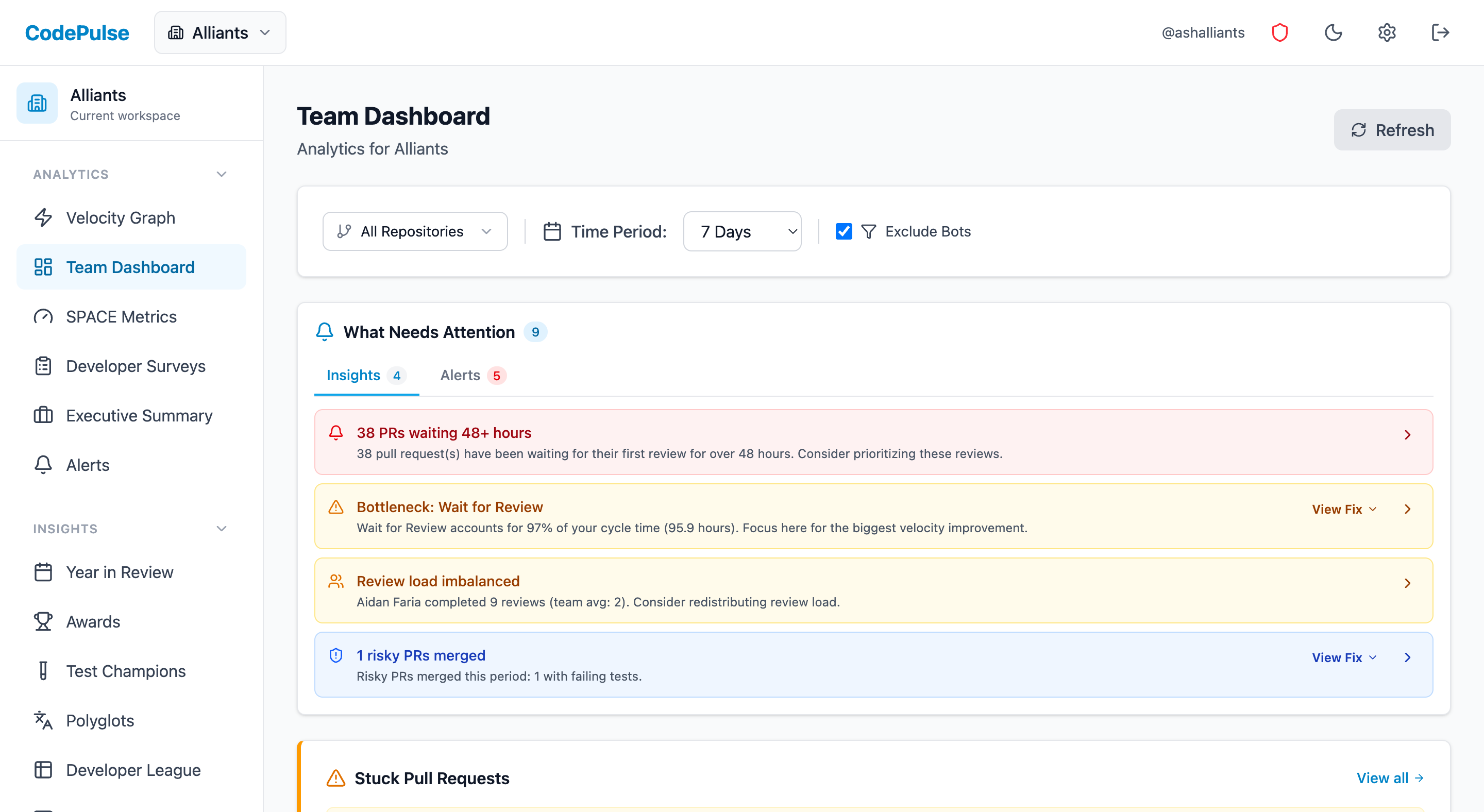
Find out which phase is holding your delivery up
CodePulse splits your cycle time into coding, waiting for review, active review, and merge, so you fix the queue that is actually costing you days. Read-only GitHub, no credit card.
Read-only GitHub · Your code stays yours · Team-level by default · No credit card
See These Features in Action
Predict delivery timelines based on historical velocity trends.
Break down cycle time into coding, waiting, review, and merge phases.
Related Guides
Story Points Are a Scam. Here's What Actually Works
Story points are often waste. Learn how to use historical throughput and cycle time to forecast delivery dates with higher accuracy and less meeting time.
Stop Guessing Capacity. Your PRs Already Know
Use PR metrics to build data-driven capacity models, plan sprints realistically, and communicate engineering capacity to stakeholders.
Engineering Headcount Planning: The CFO Conversation
Headcount requests fail when they lack data. This guide shows you how to calculate true capacity, build cost-per-feature metrics, and present scenarios that CFOs actually approve.
The 'Bus Factor' File That Could Kill Your Project
Use the Bus Factor Risk Matrix to identify where knowledge concentration creates hidden vulnerabilities before someone leaves.