
Understand the system around the team, not a developer leaderboard
Preview team-level workload, collaboration, and delivery signals designed for process improvement rather than performance grading.
Read-only GitHub · Your code stays yours · Team-level by default · No credit card
The daily standup is the most common - and most commonly misused - meeting in software development. When done well, it's a 15-minute sync that surfaces blockers and creates accountability. When done poorly, it's a status update ritual that wastes everyone's time. This guide shows you how to run standups that actually help.
"If your standup could be replaced by a Slack message, it should be replaced by a Slack message."
What is a Daily Standup?
A daily standup (also called a daily scrum or daily huddle) is a short, recurring meeting where team members sync on progress and blockers. The name comes from the practice of standing to keep it short.
The Classic Format
Each person answers three questions:
- What did I do yesterday?
- What will I do today?
- What's blocking me?
The meeting should be 15 minutes or less. Deep dives happen after standup, not during.
Why Standups Fail
| Problem | Symptom | Fix |
|---|---|---|
| Status reports | People recite task lists to the manager | Focus on blockers, not activities |
| Too long | Meetings run 30+ minutes | Strict 15-min limit; take deep dives offline |
| One-way communication | People talk at the team, not with them | Ask "who needs help?" not "what did you do?" |
| Wrong time | People are distracted, checking in remotely | Find a time that works for the whole team |
| No follow-through | Blockers mentioned but never resolved | Assign owners to blockers immediately |
/// Our Take
The "what did you do yesterday" question is usually waste. If work is tracked in PRs and tickets, yesterday is visible. Standups should focus on the future.
Try replacing the classic three questions with: "What's your focus today?" and "What's in your way?" That's it. If you need to know what happened yesterday, look at the board or the Git log.
Better Standup Formats
The Focus Format
Each person answers two questions:
- What's my focus today? (One thing, not a list)
- What's blocking me?
This format cuts meeting time in half by eliminating backward-looking updates.
Walk the Board
Instead of person-by-person updates, walk through work items from right to left (closest to done first):
- Start with items in "Review" or "Testing" - what's blocking them?
- Move to "In Progress" - any help needed?
- Check "To Do" - what's starting today?
This focuses on the work, not the people, and naturally surfaces blocked items.
Exception-Based Standup
Default assumption: everyone is on track. The meeting is only for exceptions:
- I'm blocked
- I finished something major
- I need help
- Something changed priorities
If no one has exceptions, the standup takes 2 minutes. This works best for experienced teams with visible work tracking.
Async Standups for Distributed Teams
Synchronous standups don't work when teams span multiple time zones. Async alternatives:
Slack Bot Standups
Tools like Geekbot or Standuply post questions in Slack at each person's local morning. Responses are collected in a channel for visibility.
Example Async Standup (Slack)

#standup-engineering
────────────────────────────────
🤖 Standuply Today at 9:00 AM

@sarah
• Focus: Finishing auth API tests
• Blockers: None

@james
• Focus: Code review for payment PR
• Blockers: Waiting on design specs for checkout flow

@priya
• Focus: Investigating prod latency spike
• Blockers: Need access to APM dashboard

────────────────────────────────
💬 Thread: @priya I can grant APM access - DM me
When to Keep Sync Standups
Even distributed teams sometimes benefit from synchronous time. Consider a weekly sync standup (not daily) for:
- New team formation (building relationships)
- Complex projects with high coordination needs
- When blockers are common and need discussion
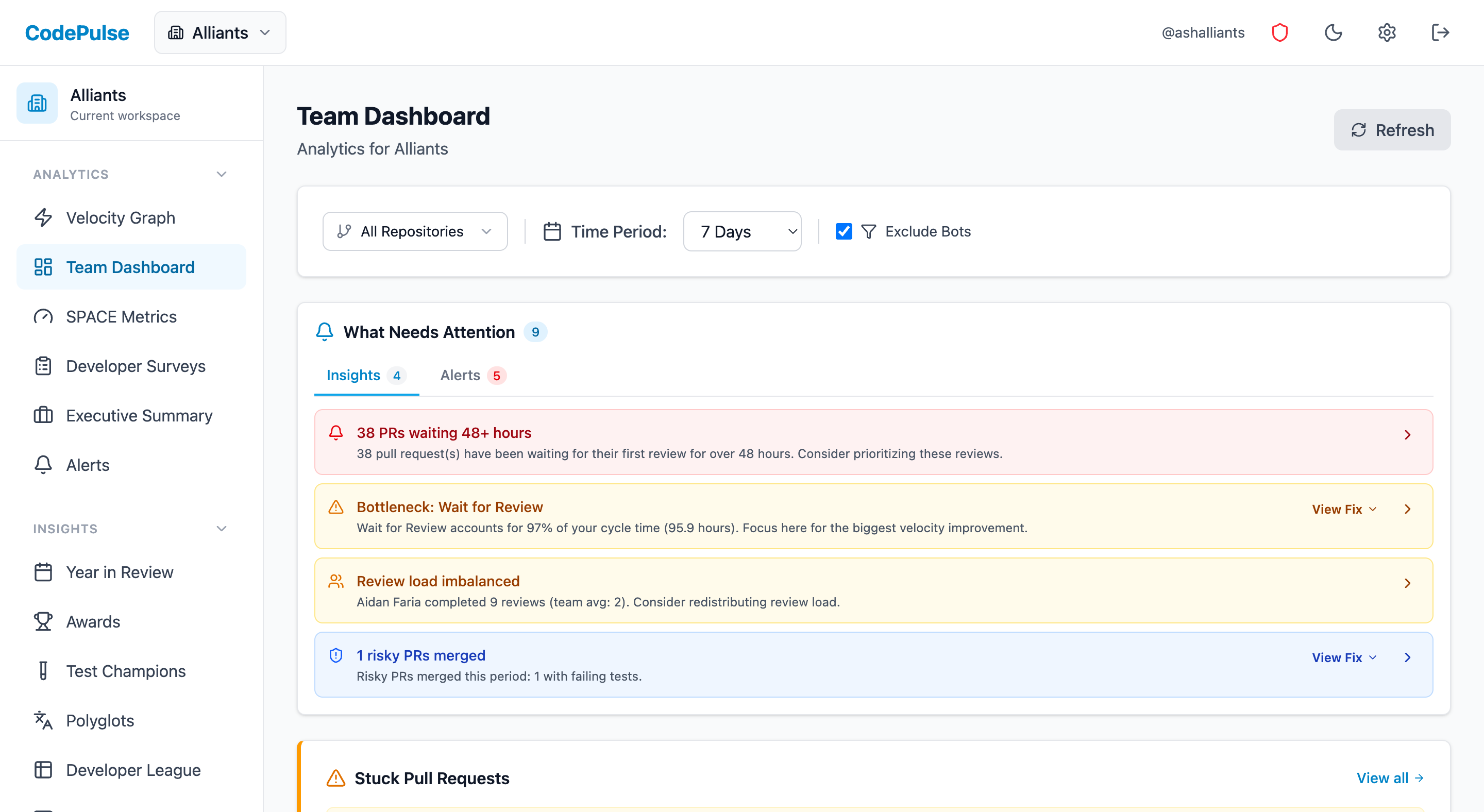
📊 How to See This in CodePulse
Use CodePulse to make standups data-informed:
- PRs awaiting review: Check Dashboard for aging PRs that need attention
- Review load: Review Network shows who's overloaded with reviews
- Blockers: Set up Alerts for PRs stuck more than 24 hours
Standup Rules That Work
Time Rules
- Start on time - Don't wait for latecomers
- 15 minutes max - Set a timer
- Same time daily - Make it a habit
Communication Rules
- Talk to the team, not the manager - This isn't a report
- One speaker at a time - No side conversations
- Deep dives after - Say "let's talk after" and move on
Follow-up Rules
- Blockers get owners immediately - Don't wait
- Actions tracked - Somewhere visible
- Skip if useless - If there's nothing to share, cancel
Standup Anti-Patterns
The Status Report
Everyone talks at the manager about what they did. No one listens to each other. The manager asks follow-up questions, extending the meeting.
The Problem-Solving Session
Someone mentions a technical issue and the whole team starts debugging together. Twenty minutes later, you're still standing in a circle.
The Attendance Check
People say "I'm working on X" just to say something. No blockers, no help needed, no value from the meeting.
The Guilt Trip
People feel pressure to report impressive-sounding work. "Yesterday I just did code review" becomes shameful instead of valuable.
"The best standup is one where someone says 'I'm blocked' and someone else says 'I can help.' If that's not happening, question whether you need the meeting."
Related Guides
- Async Code Review for Distributed Teams - Working effectively across time zones
- Working Agreements Guide - Setting team norms and expectations
- Context Switching Patterns - Protecting focus time around meetings
Conclusion
Daily standups should make your team more effective, not less. If your standup feels like a chore, change it:
- Focus on blockers and help - not status reports
- Try async formats - especially for distributed teams
- Keep it under 15 minutes - or question if you need it daily
- Walk the board - focus on work, not people
- Skip when unnecessary - not every day needs a meeting
Use tools like CodePulse to surface blockers (aging PRs, review bottlenecks) before standup so the meeting can focus on action, not discovery.
Get this view for your own teams
Connect GitHub for team-level workload, review distribution, and delivery signals. Individual views stay off unless your organisation explicitly turns them on.
Read-only GitHub · Your code stays yours · Team-level by default · No credit card
See These Features in Action
Break down cycle time into coding, waiting, review, and merge phases.
Board-ready engineering performance in a single page.
Related Guides
Engineering Team Management: Using Data to Lead Without Micromanaging
Managing software teams requires balancing delivery, quality, team health, and individual growth. This guide shows how to use data for visibility while avoiding surveillance, with practical scenarios and communication patterns.
Remote Code Reviews Are Broken. Here's the 3-Timezone Fix
How to run effective code reviews across time zones without sacrificing quality or velocity.
Working Agreements That Actually Work (Template)
Working agreements define how your team collaborates. This guide provides templates, examples, and a process for creating agreements around code review, communication, and availability.
Context Switching Costs You $47K Per Developer Per Year
Learn to detect context switching costs from PR data, distinguish productive breadth from harmful fragmentation, and help developers maintain focus.