

See exactly where your delivery flow is waiting
Preview the phase-by-phase report for review pickup, active review, and merge time. Connect in about five minutes; the initial analysis runs after sync.
Read-only GitHub · Your code stays yours · Team-level by default · No credit card
Your burndown chart shows a perfect diagonal line trending toward zero. Your sprint is going to miss by 30%. These two things happen simultaneously on most agile teams, and nobody talks about why. The problem is not your team. The problem is that burndown charts measure the wrong thing. They track story point completion against an imaginary ideal line, and that ideal line was wrong the moment someone drew it. This guide breaks down exactly where burndown charts fail, what metrics actually predict delivery, and how to transition your team in 30 days.
"A burndown chart is a graph of how wrong your estimates were, plotted over time. It does not tell you anything about delivery. It tells you about the gap between optimism and reality."
According to the 18th State of Agile Report (2025), 36% of teams are measured on velocity and 25% are judged by their sprint burndown. Meanwhile, only 29% of teams focus on actual value delivered. That ratio explains a lot about why engineering organizations feel busy but struggle to ship outcomes that matter.
What Burndown Charts Show (And Hide)
A burndown chart plots remaining work (usually story points) on the Y-axis against time on the X-axis. The "ideal line" shows a constant rate of completion from sprint start to sprint end. The actual line shows reality, which almost never matches.
Here is what a burndown chart actually shows you:
- The gap between planned work and completed work at any point in the sprint
- Whether scope was added mid-sprint (the line goes up)
- Whether the team is ahead or behind the ideal pace
Here is what it hides:
- Quality of completed work. A burndown does not distinguish between a well-tested feature and a hack that will generate three bugs next sprint.
- Cycle time per item. Two items might both be "done," but one took 2 hours and the other took 4 days of back-and-forth review. The chart treats them identically.
- Work in progress bottlenecks. Five items could be 90% done and the chart shows almost no progress until they all close on the last day.
- Scope accuracy. The chart assumes the original scope was correct. It never was.
- Value delivered. Completing 40 story points of internal refactoring and 40 story points of customer-facing features look identical.
As DX's engineering research found, burndown charts "hid scope creep and late testing, masking poor delivery behind a smooth trend line" for some organizations. The chart can look healthy while the sprint is failing.
Burndown Chart Reality Check
=============================

What it measures:     Story points remaining vs. time
What it assumes:      Points are sized accurately
                      Scope is fixed at sprint start
                      All points represent equal value
                      Linear completion is achievable

What it ignores:      Cycle time per item
                      Review bottlenecks
                      Rework / churn
                      Value delivered to users
                      Work-in-progress limits
                      Developer context switching

Accuracy of velocity predictions: +/- 25-40%
Accuracy of throughput forecasting: +/- 10-15%
The Burndown Rate Problem: Why Sprints Always Miss
Burndown rate is the speed at which your team completes story points. In theory, if your team has a stable burndown rate, you can predict when work finishes. In practice, burndown rate is one of the least stable metrics in software engineering.
High-performing teams hit sprint completion rates above 85%. Most teams sit at 60-78% completion. The recommended "healthy" target is the 80/20 rule: aim for 80% and accept the rest carries over. Think about what that means. The industry best practice is to plan for failure.
Three structural problems make burndown rate unreliable:
1. Story Points Are Not Additive
As Ben Northrop's research demonstrated, story points are ordinal values. A 2-point story is bigger than a 1-point story, but it is not necessarily twice as big. You cannot add ordinal values and get meaningful results. Burndown charts do exactly that. They sum story points and treat the total as a reliable number. It is not.
2. Velocity Becomes a Target
The Scrum.org analysis is blunt: "Focusing on velocity can distract teams from their ultimate goal: delivering measurable business and customer outcomes." Once managers start tracking velocity, teams start inflating estimates. One documented case involved a client with story points embedded in their contract, mandating specific point delivery per sprint. The team manipulated numbers to hit targets. The burndown looked great. The product did not.
3. The Estimation Ceremony Is the Problem
Planning poker, t-shirt sizing, fibonacci sequences. These all share the same flaw: they are group exercises in guessing. The first estimate anchors the discussion. Social pressure discourages pessimism. And the resulting number gets treated as a commitment, even though everyone in the room knows it was a rough guess. Industrial Logic's "Stop Using Story Points" makes the case that this ceremony consumes hours of engineering time per sprint while producing predictions less accurate than simply counting items.
🔥 Our Take
Velocity as a goal is where engineering organizations go to die. The moment you reward velocity, you get smaller PRs, less valuable work, and more meaningless motion.
We have seen this pattern at dozens of organizations. A VP asks "why is velocity flat?" The EM pressures teams. Teams split one feature into five tickets. Velocity doubles. Nothing ships faster. The burndown chart looks perfect. Customers see zero improvement. This is Goodhart's Law in action: when a measure becomes a target, it ceases to be a good measure. Velocity was designed as a planning input for teams, not a performance metric for managers. The moment it leaves the team room, it becomes toxic.
Agile Velocity vs Capacity: The Distinction Everyone Gets Wrong
Velocity and capacity are different things. Almost every agile team conflates them. The confusion creates planning failures that burndown charts then visualize as "missed sprints."
Velocity is backward-looking: how many story points did we complete last sprint? Capacity is forward-looking: how much work can we actually absorb next sprint, given vacations, on-call rotations, meetings, support tickets, and the inevitable production incident?
Most teams use last sprint's velocity as next sprint's capacity. This fails because:
| Factor | Impact on Capacity | Visible in Burndown? |
|---|---|---|
| Team member on vacation | -15% to -25% per person | No |
| On-call rotation | -20% to -40% for on-call engineer | No |
| Sprint planning + retro + standups | -10% to -15% of total sprint hours | No |
| Unplanned production issue | -10% to -50% depending on severity | Only after it happens |
| Cross-team dependency blocked | Entire work item stalled | Shows as flat line, no root cause |
| Context switching between 3+ projects | -20% to -40% per engineer | No |
The burndown chart sees none of these capacity reducers until they manifest as "behind the ideal line." By then, the sprint is already compromised.
"Velocity tells you how fast the team ran last week. Capacity tells you how fast they can run this week. Using one as a proxy for the other is how you plan sprints that are dead on arrival."
The better approach: measure actual throughput (items completed per week) and actual cycle time (how long each item takes from start to merge). These numbers include all the overhead, interruptions, and context switching because they measure completions, not estimates. When a team member was on vacation last sprint, your throughput automatically reflected that. No adjustment needed. No guessing. If you want to size next sprint before pulling the history, our free sprint capacity calculator accounts for vacations, on-call, and meeting overhead in a couple of minutes.
For a deeper dive into forecasting without estimates, see our guide on replacing estimation with probabilistic forecasting.
What Elite Teams Use Instead of Burndown Charts
The DORA research program studied thousands of engineering organizations over a decade. Their findings are clear: the metrics that distinguish elite performers from the rest are deployment frequency, lead time for changes, change failure rate, and time to restore service. Notice what is missing: story points, velocity, and burndown charts.
Here is a direct comparison of what burndown-based and throughput-based approaches actually measure:
| Dimension | Burndown / Velocity Approach | Throughput / Cycle Time Approach |
|---|---|---|
| What it measures | Story points remaining vs. time | Items completed per unit of time |
| Data source | Manual estimates (planning poker) | Actual PR and deployment history |
| Can be gamed? | Yes: inflate points, split tickets | Hard: requires actual completions |
| Accounts for overhead | No: meetings, support, on-call invisible | Yes: throughput reflects actual available time |
| Forecasting accuracy | +/- 25-40% (multiple studies) | +/- 10-15% with Monte Carlo simulation |
| Setup cost | Hours per sprint (estimation meetings) | Zero: data comes from your repo |
| Bottleneck visibility | Flat line, no root cause | Cycle time breakdown shows exact phase |
| Cross-team comparison | Meaningless: points differ per team | Comparable: hours and item counts are universal |
| DORA alignment | None | Direct: throughput maps to deployment frequency |
Cumulative Flow Diagrams Over Burndown
A cumulative flow diagram (CFD) tracks total work across all stages: backlog, in progress, in review, done. Unlike a burndown chart, a CFD shows work-in-progress at each stage, making bottlenecks visible immediately. If your "in review" band is growing wider while "done" stays flat, you have a review bottleneck. A burndown chart would just show a flat line with no explanation.
Monte Carlo Simulation Over Estimation
Instead of asking "how many points can we do?" ask "based on our last 8 weeks of throughput, what is the probability we finish these 12 items by March 15?" Monte Carlo forecasting runs thousands of simulations using your historical data and returns probability distributions. "There is an 85% chance we finish by March 15 and a 95% chance we finish by March 22." That is more useful than any burndown chart because it acknowledges uncertainty instead of pretending the ideal line is real.
As Lucas da Costa explains, "When averaging data, the variation is effectively thrown away. With Monte Carlo, the goal is to make use of any variation to deduce a more useful and reliable range."
Cycle Time Breakdown Over Velocity
Velocity tells you "we completed 35 points." Cycle time breakdown tells you "items spend an average of 4 hours in coding, 18 hours waiting for review, 3 hours in review, and 2 hours merging." One of these tells you where to intervene. The other just gives you a number for the next planning meeting. For teams that have adopted cycle time as their primary metric, Siemens achieved a 42% reduction in cycle time by shifting to flow-based metrics.
To understand how cycle time phases work in practice, see our sprint spillover analysis guide or the detailed engineering velocity metrics breakdown.
See This in Action with CodePulse
CodePulse replaces burndown charts with metrics that actually predict delivery. The Velocity Score combines throughput, cycle time, review quality, and collaboration into a single composite metric. No story points. No estimation meetings. Just data from your GitHub repos. The Dashboard shows cycle time breakdown by phase so you can see exactly where work gets stuck, instead of staring at a flat burndown line wondering what went wrong.
From Burndown to Throughput: A 30-Day Transition Plan
You cannot rip out burndown charts overnight. Teams are comfortable with them, stakeholders expect them, and project managers have built their reporting around them. Here is a practical 30-day plan that introduces throughput metrics alongside burndown before replacing it entirely.
Week 1: Establish Baseline
- Count the number of PRs merged per week for the last 8 weeks. This is your throughput baseline.
- Calculate the average cycle time (first commit to merge) for the same period.
- Record current sprint completion rate (story points done / story points planned).
- Share these three numbers with the team. Do not change anything about your process yet.
Week 2: Run Parallel Metrics
- Keep your burndown chart. Add a weekly throughput chart beside it.
- At standup, start asking "how many items are in review?" instead of only "are we on track for the burndown?"
- Track WIP (work in progress) count daily. If WIP exceeds team size, something is blocked.
- Note where the burndown and throughput metrics disagree. These gaps reveal hidden problems.
Week 3: Introduce Forecasting
- Take your 8-week throughput history and run a simple Monte Carlo simulation. Free tools like The Burndown's calculator or spreadsheet-based approaches work fine.
- Compare the Monte Carlo forecast to your sprint plan. Which is more accurate?
- Start using cycle time breakdown to identify bottlenecks. If "waiting for review" is your longest phase, fix that first.
- Read our guide on capacity planning with PR data for a detailed framework.
Week 4: Make the Switch
- Present results to stakeholders: "Here is what burndown predicted. Here is what throughput predicted. Here is what actually happened."
- Replace the burndown chart in your sprint review with a cumulative flow diagram.
- Stop estimating in story points. Size work as "small," "medium," or "large" for planning purposes only. Do not track points.
- Set a WIP limit. A good starting point: number of developers minus one.
30-Day Transition Scorecard
============================

Week 1: Baseline
  [ ] 8-week throughput history collected
  [ ] Average cycle time calculated
  [ ] Current sprint completion rate recorded
  [ ] Numbers shared with team

Week 2: Parallel Metrics
  [ ] Throughput chart added beside burndown
  [ ] Daily WIP count tracked
  [ ] Burndown vs. throughput disagreements noted
  [ ] "Items in review" added to standup

Week 3: Forecasting
  [ ] Monte Carlo simulation run
  [ ] Forecast vs. sprint plan compared
  [ ] Cycle time bottleneck identified
  [ ] Action taken on longest phase

Week 4: Switch
  [ ] Stakeholder comparison presented
  [ ] CFD replaces burndown in sprint review
  [ ] Story points retired
  [ ] WIP limit set and enforced
"The teams that successfully drop burndown charts do not start by removing them. They start by adding better metrics beside them and letting the data make the case."
For more on building a developer velocity practice that goes beyond burndown, check out our developer velocity guide.
Frequently Asked Questions
Not completely. They can show scope creep when the line goes up mid-sprint. But for their primary purpose, predicting whether a sprint will finish on time, they fail more often than they succeed. Throughput-based forecasting using Monte Carlo simulation is measurably more accurate with less effort.
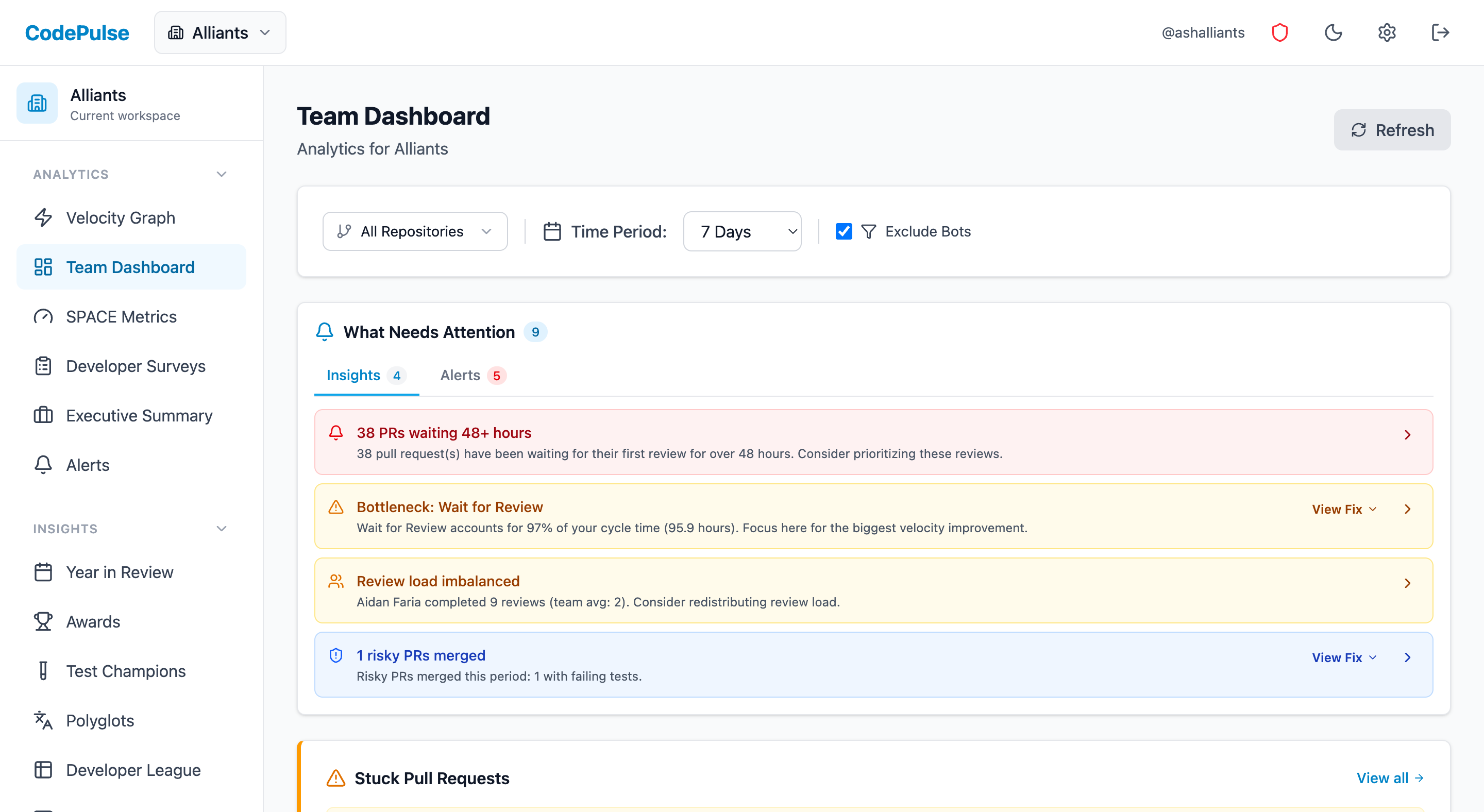
Find out which phase is holding your delivery up
CodePulse splits your cycle time into coding, waiting for review, active review, and merge, so you fix the queue that is actually costing you days. Read-only GitHub, no credit card.
Read-only GitHub · Your code stays yours · Team-level by default · No credit card
See These Features in Action
Data-backed retros with concrete metrics for each sprint.
Predict delivery timelines based on historical velocity trends.
Related Guides
Story Points Are a Scam. Here's What Actually Works
Story points are often waste. Learn how to use historical throughput and cycle time to forecast delivery dates with higher accuracy and less meeting time.
Sprint Spillover Analysis: Why 70% of Sprints Miss and How to Fix It
Analyze sprint spillover patterns to predict and prevent missed commitments. Use PR data to build an early warning system for sprint risk.
Stop Guessing Capacity. Your PRs Already Know
Use PR metrics to build data-driven capacity models, plan sprints realistically, and communicate engineering capacity to stakeholders.
Story Points Are Dead. What Elite Teams Measure
Move beyond story points. Learn modern velocity metrics that measure real delivery speed, how to improve velocity sustainably, and avoid common pitfalls.
Engineering Velocity: 5 Metrics Without Burnout
Learn how to measure engineering velocity in ways that predict delivery success without creating gaming, burnout, or false productivity.