
Compare the finished analysis before you choose a platform
CodePulse turns your GitHub or Azure DevOps history into root-cause insights, not just dashboards, so you see where delivery stalls and why. Set up in about five minutes at one flat price. Free to start, no credit card.
Read-only GitHub · Your code stays yours · Team-level by default · No credit card
Azure DevOps and Jira are the two dominant project management platforms for engineering teams. Both excel at work item tracking and agile workflows, but they take fundamentally different approaches. This guide compares them to help you choose the right tool for your organization.
What is the difference between Azure DevOps and Jira?
Jira tracks work and leaves the rest of the toolchain to you. Azure DevOps - commonly abbreviated to ADO - bundles the board (Azure Boards), Git hosting (Repos), and CI/CD (Pipelines) into one Microsoft suite. So the honest comparison is not feature against feature: it is one tool plus an ecosystem you assemble against one suite you adopt wholesale. Jira wins on configurability and marketplace depth, Azure DevOps wins on everything working together out of the box, and the tie-breaker is usually which ecosystem your organization already runs on. Whichever you pick, the delivery data that matters most sits in Git rather than the tracker.
"Jira won the agile project management market. Azure DevOps won the Microsoft enterprise market. The real question is which ecosystem you're building around."
Platform Overview
| Aspect | Azure DevOps | Jira |
|---|---|---|
| Vendor | Microsoft | Atlassian |
| Primary Strength | Integrated DevOps platform | Flexible project management |
| Core Audience | Microsoft/Azure shops | Any engineering organization |
| Hosting Options | Cloud + Server (Azure DevOps Server) | Cloud + Data Center |
| Pricing Model | Per-user, free tier for 5 users | Per-user, free tier for 10 users |
Work Item Tracking Comparison
Both platforms provide robust work item tracking, but with different philosophies:
| Feature | Azure DevOps (Boards) | Jira |
|---|---|---|
| Work Item Types | Epics, Features, User Stories, Tasks, Bugs | Customizable (Epic, Story, Task, Bug + custom) |
| Customization | Process templates (Agile, Scrum, CMMI) | Highly flexible schemes and workflows |
| Hierarchy | Fixed 4-level hierarchy | Flexible parent-child relationships |
| Workflow Builder | XML-based, less intuitive | Visual workflow editor |
| Field Customization | Good, requires admin access | Excellent, project-level control |
Work Item Flexibility
Jira's greatest strength is customization. You can create entirely new issue types, define custom workflows per project, and adapt the tool to match your process. Azure DevOps offers process templates but changing them requires more administrative effort.
Azure DevOps' work items are tightly integrated with its other services (Repos, Pipelines, Test Plans). This integration is smooth if you're using the full Azure DevOps suite, but less valuable if you're using GitHub for source control.
Agile Planning Support
Sprint Planning
| Capability | Azure DevOps | Jira |
|---|---|---|
| Sprint Boards | Native, well-designed | Native, highly customizable |
| Backlog Grooming | Drag-and-drop prioritization | Drag-and-drop with ranking |
| Capacity Planning | Built-in, per-team | Via plugins or Advanced Roadmaps |
| Velocity Tracking | Native charts | Native + enhanced via plugins |
| Story Points | Supported | Supported + configurable estimation |
Kanban vs Scrum
Both platforms support Kanban and Scrum methodologies:
- Azure DevOps: Choose a process template at project creation (Agile, Scrum, or CMMI). Changing templates later is complex.
- Jira: Switch between Scrum and Kanban boards at any time. More flexibility for teams evolving their process.
"Azure DevOps assumes you'll pick one methodology and stick with it. Jira assumes your process will evolve. Both assumptions are valid - which matches your organization?"
Reporting and Analytics
| Feature | Azure DevOps | Jira |
|---|---|---|
| Built-in Reports | Burndown, velocity, cumulative flow | Similar + more out-of-box options |
| Custom Dashboards | Widget-based, decent flexibility | Gadget-based, very flexible |
| Advanced Analytics | Analytics Service + Power BI | JQL + third-party tools |
| Query Language | WIQL (Work Item Query Language) | JQL (Jira Query Language) |
| Export Options | Excel, CSV, OData feeds | CSV, various export apps |
Analytics Depth
Azure DevOps has a significant advantage in enterprise reporting. The Analytics Service provides OData feeds that integrate directly with Power BI, enabling sophisticated cross-project reporting and executive dashboards.
Jira's reporting is more accessible out of the box, but advanced analytics often require plugins like eazyBI, Structure, or BigPicture. The JQL query language is powerful and widely known among engineering teams.
/// Our Take
Neither platform excels at engineering delivery metrics.
Both Azure DevOps and Jira focus on project management metrics (story points, velocity, burndown). Neither provides deep insights into code flow, PR cycle time, or review patterns. That's the gap engineering analytics tools fill. If your team uses GitHub for source control, consider adding a dedicated analytics layer regardless of which PM tool you choose.
The market for that analytics layer is crowded and the vendors position similarly. Our Plandek alternative comparison walks through how Plandek, Jellyfish, LinearB, and others differ on data sources, cycle-time depth, and enterprise fit - useful context regardless of whether your PM sits in Azure DevOps or Jira.
Integrations and Ecosystem
Source Control Integration
| Integration | Azure DevOps | Jira |
|---|---|---|
| GitHub | Good (Microsoft owns both) | Excellent (native integration) |
| GitLab | Limited | Good (GitLab for Jira app) |
| Bitbucket | Limited | Excellent (same vendor) |
| Azure Repos | Native, tightly integrated | Via third-party apps |
Ecosystem and Marketplace
Jira: The Atlassian Marketplace has thousands of apps covering everything from time tracking to advanced reporting. Popular choices include Tempo (time tracking), Structure (hierarchy), and Advanced Roadmaps (planning).
Azure DevOps: The Azure DevOps Marketplace is smaller but includes quality extensions for testing, security, and CI/CD. The real value is in Azure ecosystem integrations - Azure AD, Microsoft 365, Power Platform.
Communication Tools
| Platform | Azure DevOps | Jira |
|---|---|---|
| Slack | Basic notifications | Rich integration |
| Microsoft Teams | Excellent (native) | Good (app available) |
| Comprehensive notifications | Comprehensive notifications |
CI/CD and DevOps Integration
This is where the platforms diverge significantly:
| Capability | Azure DevOps | Jira |
|---|---|---|
| Built-in CI/CD | Yes (Azure Pipelines) | No (requires Bitbucket Pipelines or others) |
| Release Management | Full release pipeline support | Deployment tracking via integrations |
| Test Plans | Native Test Plans service | Requires plugins (Zephyr, Xray) |
| Artifact Management | Azure Artifacts (native) | Via JFrog, Nexus, etc. |
Azure DevOps is a complete DevOps platform - source control, work tracking, CI/CD, testing, and artifacts in one product. Jira is focused on project management and integrates with specialized tools for other capabilities.
"If you want everything in one place, Azure DevOps wins. If you want best-of-breed tools that integrate together, Jira is the better hub."
Pricing Comparison
| Tier | Azure DevOps | Jira |
|---|---|---|
| Free | First 5 users free | Up to 10 users |
| Entry paid tier | Basic, $6/user/month after the first 5 | Standard, tiered by user count (no flat published rate) |
| Higher tier | Basic + Test Plans, $52/user/month | Premium, tiered by user count |
| Enterprise | Custom pricing | Custom pricing, annual billing |
The two vendors do not price the same way, and that matters more than any single number. Microsoft publishes a flat per-user rate you can multiply by headcount. Atlassian does not publish a flat per-user price for Standard or Premium at all: pricing is tiered, with "discounts per user as you grow", so your effective rate falls as you add seats and the only reliable figure comes from Atlassian's own pricing calculator for your exact seat count. Any comparison quoting a single Jira per-user price is quoting one point on a sliding scale.
Azure DevOps figures are taken from Microsoft's published pricing. Jira has no flat published per-user rate, so check Atlassian's pricing page for your seat count. Vendor pricing changes; verify both before budgeting.
Hidden Costs
- Azure DevOps: Additional charges for parallel jobs, large artifacts, and Premium services (Test Plans, Artifacts).
- Jira: Many essential features require marketplace apps, which add per-user costs. Advanced Roadmaps, Tempo, and Structure can significantly increase total cost.
Engineering analytics tools layered on top of either platform have their own pricing curves worth budgeting for. Our Swarmia pricing review is one representative breakdown of how per-seat analytics costs scale with team size and which tiers actually unlock the features most teams need.
Decision Framework
Choose Azure DevOps When:
- You're heavily invested in the Microsoft ecosystem (Azure, Teams, .NET)
- You want an all-in-one DevOps platform
- You need tight integration with Azure cloud services
- You require Power BI for enterprise reporting
- You're using Azure Repos for source control
- You need built-in test management without extra cost
Choose Jira When:
- You want maximum flexibility in workflows and issue types
- Your team uses GitHub or GitLab for source control
- You need a large ecosystem of integrations and plugins
- You're using other Atlassian products (Confluence, Bitbucket)
- You want to evolve your agile process over time
- Your organization already has Jira expertise
Consider Both When:
- Large organizations with different team preferences
- Acquisitions or mergers bringing different toolsets
- Azure DevOps for CI/CD, Jira for project management
Whichever PM platform you choose, the engineering-analytics layer is a separate decision. See our DORA metrics tools comparison for how the major options (LinearB, Jellyfish, Swarmia, CodePulse, Plandek) differ on data depth, ease of setup, and reporting fit.
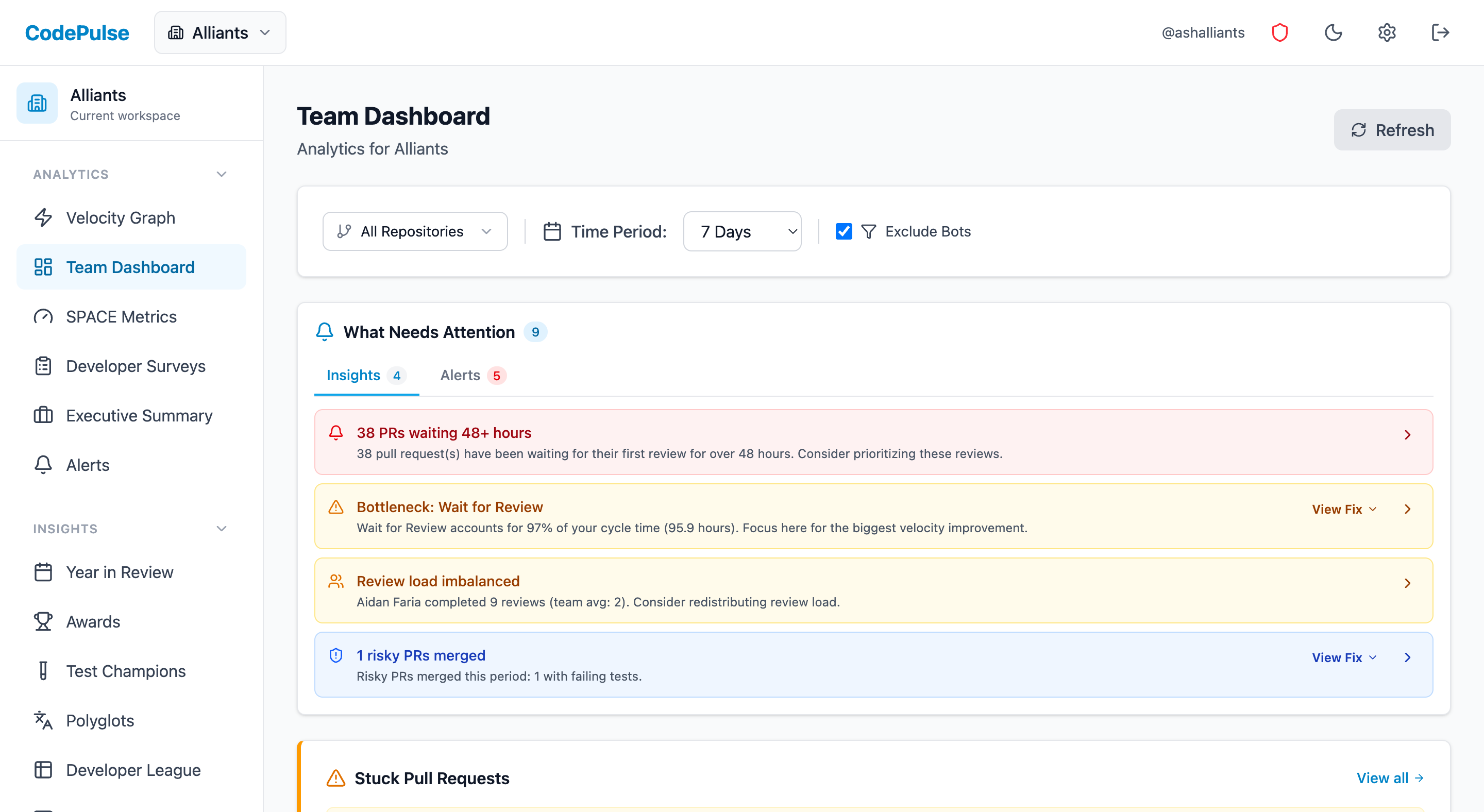
📊 How to Track in CodePulse
Regardless of which PM tool you choose, CodePulse provides engineering analytics for GitHub-based teams:
- PR cycle time breakdown (coding, waiting, review, merge)
- DORA metrics without CI/CD integration requirements
- Review load balancing and collaboration patterns
- Code hotspots and knowledge silo detection
Project management tools track what teams plan to do. CodePulse tracks what actually ships. See the Dashboard.
Migration Considerations
Moving between Azure DevOps and Jira is possible but requires planning:
Azure DevOps to Jira
- Work items map to issues, but field mapping requires configuration
- Attachments and comments can be migrated
- History is partially preserved
- Pipelines don't migrate (different systems)
- Tools available: Exalate, Trello (as intermediate), custom scripts
Jira to Azure DevOps
- Issues map to work items with field mapping
- Jira's flexible hierarchy may not map cleanly to Azure DevOps templates
- Custom fields need recreation
- Marketplace: OpsHub, Tasktop, custom Azure DevOps extensions
Migration Best Practices
- Start with a pilot project before full migration
- Map workflows and fields before migrating data
- Consider archiving historical data rather than migrating it all
- Plan for a parallel running period
- Train users on the new platform before migration
How Do Azure DevOps and Jira Compare for Enterprise Agile Teams?
At enterprise scale, the comparison shifts from feature checklists to how well each platform holds a backlog together across dozens of teams and multiple program layers.
Azure DevOps ships with a two-level portfolio hierarchy (Epics and Features sitting above the team backlog), but large organizations rarely stop there. Per Microsoft's own documentation, admins can add custom portfolio backlogs up to a total of five levels, which is enough to model Initiatives, Epics, and Features above the sprint backlog for multi-team program tracking. Jira takes the opposite approach: the core product stays flat, and enterprises reach for Advanced Roadmaps (bundled in Jira Premium) to layer cross-project initiatives on top of standard epics and stories.
The gap widens on CI/CD. Azure Pipelines ships in the box, so enterprise teams get build, release, and artifact management without adding a vendor. Jira has no native pipeline engine - Atlassian's own CI/CD integration runs through Bitbucket Pipelines, and teams on other stacks wire in Jenkins, GitLab, or GitHub Actions via marketplace apps and webhooks. That is a real advantage for Azure DevOps shops that want one procurement line item, but it also means Jira's CI/CD depth is only as good as whichever external tool an enterprise standardizes on. Our Azure DevOps vs GitHub guide goes deeper on Azure Pipelines' built-in CI/CD model for teams weighing that trade-off directly.
For enterprise agile backlog management specifically: Azure DevOps wins on structure and built-in DevOps tooling, Jira wins on flexibility and the maturity of its plugin ecosystem for scaled frameworks like SAFe.
Frequently Asked Questions
Jira is a project management and issue tracking product that connects to whatever build and source control tools you already use. Azure DevOps (often shortened to ADO) is a full delivery suite where the board, the Git repositories, and the CI/CD pipelines all ship together from Microsoft. The practical difference is scope: with Jira you assemble a toolchain and own the integrations, with Azure DevOps you adopt one and accept its opinions.
Related Guides
- Azure DevOps vs GitHub Guide - Comparing Azure DevOps and GitHub platforms
- Progress Tracking Without Jira - Track engineering progress using Git data alone
- Engineering Analytics Tools Comparison - Compare dedicated analytics platforms
- DORA Metrics Guide - Measuring delivery performance metrics
Conclusion
Azure DevOps and Jira are both excellent platforms, but they serve different organizational philosophies:
Azure DevOps is the right choice for Microsoft-centric organizations that want an integrated DevOps platform. Its strength is in providing everything from source control to deployment in one product with deep Azure ecosystem integration.
Jira is the right choice for organizations that value flexibility and best-of-breed integrations. Its strength is in customizable workflows, a massive plugin ecosystem, and widespread adoption that means most engineers already know how to use it.
Neither platform provides full engineering delivery metrics out of the box. For teams using GitHub for source control, consider adding CodePulse to get the cycle time analysis, review insights, and DORA metrics that help you ship faster - regardless of which project management tool you choose.
Evaluate CodePulse against your own delivery history
CodePulse turns your GitHub or Azure DevOps history into root-cause insights, not just dashboards, so you see where delivery stalls and why. Set up in about five minutes at one flat price. Free to start, no credit card.
Read-only GitHub · Your code stays yours · Team-level by default · No credit card
See These Features in Action
Board-ready engineering performance in a single page.
Break down cycle time into coding, waiting, review, and merge phases.
Related Guides
Azure DevOps vs GitHub: 2026 Comparison (Both Tested)
Azure DevOps vs GitHub compared: pricing, CI/CD, AI features, project management, analytics, and migration paths. Side-by-side guide for engineering leaders choosing between Microsoft platforms.
No Jira Access? Here's What Your Git Data Already Knows
Track and report engineering progress using pull request data when you don't have access to project management tools.
Jellyfish vs LinearB vs Swarmia: Full 2026 Comparison
Compare Jellyfish, LinearB, Swarmia, Allstacks, Haystack and more engineering analytics tools. Features, pricing, cycle time benchmarks, and integrations.
DORA Metrics Explained: The 4 Keys Without the Hype
A complete breakdown of the four DORA metrics - deployment frequency, lead time, change failure rate, and MTTR - with honest benchmarks and gaming traps to avoid.