
Compare the finished analysis before you choose a platform
CodePulse turns your GitHub or Azure DevOps history into root-cause insights, not just dashboards, so you see where delivery stalls and why. Set up in about five minutes at one flat price. Free to start, no credit card.
Read-only GitHub · Your code stays yours · Team-level by default · No credit card
GitHub is the stronger platform for most engineering teams in 2026. With over 100 million developers and exclusive access to Copilot Workspace and Autofix, GitHub has pulled ahead on AI-assisted development while Azure DevOps remains the better choice for enterprise project management. Microsoft's own 2025 migration playbook recommends moving repositories to GitHub for AI capabilities. One gap both platforms share: neither provides the engineering analytics that VPs and EMs need. CodePulse covers that gap for GitHub teams with DORA metrics, cycle time breakdowns, and review load analysis from your pull request data. This guide compares pricing, CI/CD, AI features, project management, analytics, and migration paths side by side.
Should you use Azure DevOps or GitHub in 2026?
For most teams starting new projects, GitHub is the better choice. It has the larger developer community (100M+ users), native AI features through Copilot, and simpler CI/CD via Actions. Azure DevOps is still stronger for enterprise project management (Azure Boards), complex release pipelines with approval gates, and organizations with legacy TFVC repositories. Many enterprise teams use both: GitHub for source control and CI/CD, Azure Boards for sprint planning. GitHub Enterprise Cloud includes free Azure DevOps Basic access, making the hybrid approach cost-effective.
"GitHub won the source control battle. Azure DevOps won the enterprise project management battle. The real question: which gap is harder for your team to fill?"
How Do Azure DevOps and GitHub Compare?
Both platforms come from Microsoft, but they have very different DNA. GitHub started as a developer collaboration platform and grew into CI/CD. Azure DevOps started as an enterprise ALM (Application Lifecycle Management) tool and evolved into a modular DevOps suite. That heritage shapes everything about how they work.
| Aspect | GitHub | Azure DevOps |
|---|---|---|
| Primary Strength | Developer collaboration, open source, AI tooling | Enterprise project management, release orchestration |
| Core Audience | Developers, open source, AI-forward teams | Enterprises, Microsoft/.NET shops, regulated industries |
| Architecture | Monolithic platform (repos + Actions + Projects) | Modular services (Repos, Boards, Pipelines, Test Plans, Artifacts) |
| Ownership | Microsoft (acquired 2018) | Microsoft (built internally, evolved from TFS) |
| AI Integration | Copilot, Copilot Workspace, Autofix (native) | Limited, no Copilot Autofix planned |
How Do GitHub and Azure DevOps Compare Feature by Feature?
Source Control (Azure Repos vs GitHub)
Source control is where GitHub dominates. Over 100 million developers use GitHub, making it the default for open source and increasingly for enterprise private repos. Azure Repos still supports TFVC (Team Foundation Version Control) for legacy codebases, which matters if your organization has decades of TFVC history.
| Feature | GitHub | Azure DevOps (Repos) |
|---|---|---|
| Git Support | Excellent (native) | Excellent (Git + TFVC legacy support) |
| Pull Request UX | Excellent, with social features | Functional, more enterprise-focused |
| Code Review | Inline suggestions, threaded discussions | Approval workflows, required reviewers |
| Security Scanning | Dependabot + CodeQL (native, free for public) | Azure Advanced Security (paid add-on) |
| Branch Policies | Branch protection rules, rulesets | Granular policies per branch/path |
| Copilot Integration | Native: code completion, PR summaries, Autofix | Limited, no Autofix |
| Community / OSS | Dominant platform (100M+ developers) | Rare for public projects |
Security scanning is the row that trips up most migrations: GitHub's Dependabot and CodeQL are free for public repos but require GitHub Advanced Security for private ones, whereas Azure DevOps bundles Azure Advanced Security as a paid add-on with different per-committer pricing. The linked guide walks through what changes for Azure DevOps teams moving to GHAS.
CI/CD (GitHub Actions vs Azure Pipelines)
Both platforms offer mature CI/CD with YAML-based pipeline definitions. GitHub Actions has a larger community marketplace. Azure Pipelines offers more granular release management with dedicated release pipelines, approval gates, and deployment groups, making it stronger for teams that need complex release orchestration across multiple environments.
| Feature | GitHub Actions | Azure Pipelines |
|---|---|---|
| YAML Definition | Yes (.github/workflows/) | Yes (azure-pipelines.yml) + classic UI editor |
| Marketplace | 20,000+ community actions | Large, Microsoft ecosystem-focused |
| Self-hosted Runners | Yes, straightforward setup | Yes, more enterprise options (deployment groups) |
| Matrix Builds | Yes | Yes |
| Release Management | Basic (via environments + deployments) | Advanced (dedicated release pipelines) |
| Approval Gates | Environment protection rules | Multi-stage gates, manual interventions, pre/post checks |
| Artifact Management | GitHub Packages (npm, Docker, NuGet) | Azure Artifacts (npm, NuGet, Maven, Python, universal) |
Project Management (GitHub Projects vs Azure Boards)
This is where the gap is widest. Azure Boards is a full enterprise work tracking system with sprint planning, capacity management, hierarchical work items, and Power BI reporting. GitHub Projects is a lightweight kanban-style board that works well for smaller teams but lacks the depth that enterprise Agile shops need.
| Feature | GitHub Projects | Azure DevOps Boards |
|---|---|---|
| Work Items | Issues (flat structure) | Epics, Features, User Stories, Tasks, Bugs (hierarchy) |
| Board Views | Table, Board, Roadmap (beta) | Kanban, Scrum, custom process templates |
| Sprint Planning | Limited (iterations via custom fields) | Native: sprints, capacity, velocity, burndown |
| Reporting | Basic Insights (beta) | Analytics Service, OData, Power BI integration |
| Portfolio Management | No native support | Portfolio backlogs, delivery plans |
| Custom Fields | Yes (flexible, newer) | Yes (mature, process templates) |
| Enterprise Hierarchy | Organization, Repos | Organization, Project, Team, Area/Iteration paths |
How Far Ahead Is GitHub on AI Features?
This is the biggest shift in the Azure DevOps vs GitHub comparison. Microsoft is investing its AI capabilities almost exclusively in GitHub. If AI-assisted development matters to your team, this section should decide your platform choice.
| AI Feature | GitHub | Azure DevOps |
|---|---|---|
| Copilot Code Completion | Native, all languages | Available via VS/VS Code (not in ADO UI) |
| Copilot Workspace | Yes: plan, implement, test from an issue | Not available |
| Copilot Autofix | Yes: auto-remediate security vulnerabilities | No plans announced |
| PR Summaries | Copilot generates PR descriptions | Not available |
| Code Review AI | Copilot reviews code, suggests fixes | Not available |
In February 2025, Microsoft published an official migration playbook recommending teams move repositories to GitHub to "unlock Agentic DevOps" capabilities. Azure DevOps remains supported for Boards and Pipelines, but GitHub is where Microsoft is building the future of AI-assisted development.
"The AI features gap between GitHub and Azure DevOps isn't closing. It's widening every quarter. If you're evaluating platforms today, this is the factor that will matter most in two years."
What Does Azure DevOps Cost Compared to GitHub?
The two platforms structure pricing differently. GitHub charges per user with generous free tiers. Azure DevOps gives five users free, then charges per user plus per-service costs.
| Tier | GitHub | Azure DevOps |
|---|---|---|
| Free | Unlimited public repos, 2,000 Actions min/mo, 500 MB Packages | First 5 users free (Basic), 1 parallel job (1,800 min/mo), unlimited stakeholders |
| Team / Basic | $4/user/mo, 3,000 Actions min/mo | $6/user/mo (after first 5) |
| Enterprise | $21/user/mo (GHEC), 50,000 Actions min/mo | $52/user/mo (Basic + Test Plans) |
| Additional CI/CD | $0.008/min overage (Linux) | $40/mo per additional parallel job (Microsoft-hosted) |
| Security Scanning | Free for public repos, GHAS add-on for private | Azure Advanced Security: $49/active committer/mo |
One detail most comparison articles miss: GitHub Enterprise Cloud includes free Azure DevOps Basic access when your organization uses Entra ID (formerly Azure AD). This means GHEC customers can use Azure Boards and Pipelines at no additional per-user cost, making the "use both" strategy genuinely free for enterprise teams.
Which Platform Has Better Engineering Analytics?
Neither platform provides the engineering analytics that VPs and EMs actually need. Azure DevOps has more built-in reporting (Analytics Service, Power BI), but it's focused on project management data, not developer workflow metrics. GitHub's native analytics are basic and still evolving. Our GitHub Insights vs CodePulse comparison breaks down exactly which engineering questions native GitHub analytics can and can't answer today.
| Capability | GitHub | Azure DevOps |
|---|---|---|
| Built-in Analytics | Insights (basic, improving) | Analytics Service (advanced, OData-based) |
| DORA Metrics | Not native | Available via Analytics + Power BI |
| Custom Dashboards | Limited | Yes (widget-based dashboards + Power BI) |
| API Access | REST + GraphQL (excellent developer experience) | REST + OData (good, more enterprise-oriented) |
| Third-party Tool Support | Most tools support GitHub first | Good support, but less ubiquitous |
| Cycle Time Tracking | Not native (needs third-party tools) | Available via Analytics widgets |
"GitHub has better data for developer workflow. Azure DevOps has better data for project tracking. Most engineering leaders need both, and neither platform gives them a unified view."
📊 How to Get Complete Analytics with CodePulse
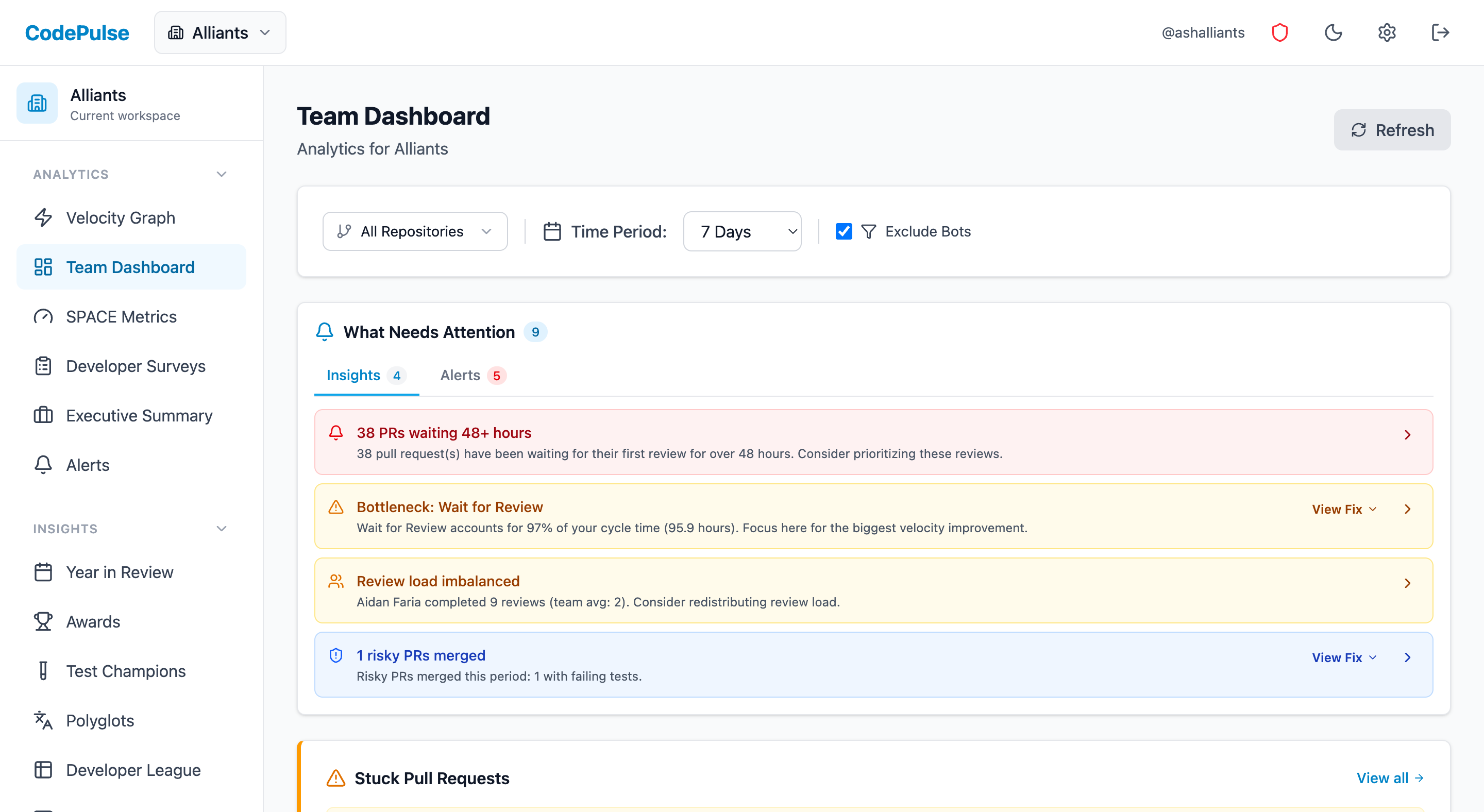
CodePulse fills the analytics gap for GitHub-based teams. Navigate to the Dashboard to see:
- DORA metrics (deployment frequency, lead time, change failure rate)
- Cycle time breakdown across coding, waiting, review, and merge phases
- Review load balancing and collaboration patterns
- Developer recognition with 15 award categories
- File hotspot analysis for identifying high-risk code
If your team uses GitHub for source control, CodePulse provides the engineering intelligence layer that GitHub's native Insights don't cover.
How Do You Choose Between Azure DevOps and GitHub?
The right choice depends on what your team values most. This decision framework covers the most common scenarios:
| Your Situation | Best Choice | Why |
|---|---|---|
| Open source or external contributors | GitHub | 100M+ developers already use it; community PRs, Discussions, and Sponsors are native |
| AI-first development (Copilot, Autofix) | GitHub | All AI investment goes to GitHub; Azure DevOps has no Copilot Workspace or Autofix |
| Modern CI/CD with large action marketplace | GitHub | 20,000+ community actions, simpler YAML, faster iteration cycle |
| Enterprise sprint planning and capacity management | Azure DevOps | Azure Boards has hierarchical work items, burndowns, and Power BI reporting |
| Microsoft/.NET shop with Azure infrastructure | Azure DevOps | Tight integration with Azure, Teams, Visual Studio, and Entra ID |
| Complex release orchestration with approval gates | Azure DevOps | Dedicated release pipelines, deployment groups, pre/post deployment checks |
| Legacy TFVC repositories | Azure DevOps | Only platform that still supports TFVC; convert to Git before migrating |
| Enterprise team wanting the best of both | Hybrid | GitHub for code and CI, Azure Boards for PM; GHEC includes free ADO Basic access |
Choose GitHub When:
- Developer experience and AI tooling are top priorities
- You're building open source or have external contributors
- You want Copilot, Copilot Workspace, and Autofix capabilities
- Your project management needs are lightweight (Issues + Projects suffice)
- You want the largest ecosystem of integrations and community actions
Choose Azure DevOps When:
- You need enterprise project management (sprints, capacity planning, burndown charts)
- You're a Microsoft shop (Azure, .NET, Teams, Power BI) and want tight integration
- You need advanced release management with multi-stage approval gates
- You have TFVC repositories that can't be migrated to Git
- You need Azure Test Plans for structured manual and exploratory testing
- Compliance requires fine-grained audit logs and process controls
Use Both (The Hybrid Approach):
This is the approach Microsoft itself recommends. Use GitHub for source control and AI-powered development. Use Azure Boards for enterprise project management. The two platforms integrate natively: Azure Boards links to GitHub commits and PRs, and GitHub Enterprise Cloud includes free Azure DevOps Basic access.
- Developers get GitHub's superior collaboration UX and Copilot
- Managers get Azure Boards' sprint planning, capacity, and Power BI reporting
- You're gradually migrating and need both platforms during the transition
- Different teams have different workflow maturity levels
📊 Once You Choose GitHub, Close the Analytics Gap
Azure DevOps ships with built-in analytics dashboards, Power BI connectors, and OData feeds. GitHub does not. When you move to GitHub, you lose that visibility unless you replace it.
CodePulse gives GitHub teams the engineering visibility that Azure DevOps built in: DORA metrics, cycle time breakdowns, review load balancing, file hotspot analysis, and proactive risk alerts. Five-minute setup, no pipelines to configure, no Power BI queries to write.
Is GitHub Replacing Azure DevOps?
No. Azure DevOps has an active roadmap extending through 2026 and beyond, and Microsoft continues shipping new features. But the platforms are diverging in purpose.
Here's what's happening: Microsoft is positioning GitHub as the AI-native development platform and Azure DevOps as the enterprise orchestration layer. All AI investments (Copilot, Workspace, Autofix, Agentic DevOps) are going to GitHub. Azure DevOps keeps its strengths in Boards, Pipelines, Test Plans, and Artifacts.
Key timeline events:
- April 2025: Azure DevOps stopped accepting new OAuth app registrations (migration to Entra ID)
- 2025-2026: Full Azure DevOps OAuth platform retirement (teams must move to Entra ID)
- February 2025: Microsoft published an official migration playbook recommending repos move to GitHub
- Ongoing: Copilot features (Workspace, Autofix, code review) remain GitHub-exclusive
If your team relies on Azure Boards and Pipelines, they're not going away. But if you want AI-assisted development, your repositories need to be on GitHub. The "hybrid bridge" is Microsoft's recommended path.
🔥 Our Take
GitHub for code and AI. Azure DevOps Boards for enterprise process. The hybrid approach isn't a compromise: it's Microsoft's own recommendation, and it gives your team the best of both platforms.
We see the most productive enterprise teams running this exact pattern: GitHub repos with Copilot for developers, Azure Boards for sprint planning and executive reporting, and a third-party analytics tool (like CodePulse) to bridge the metrics gap that neither platform fills natively. Stop debating "either/or" and use both.
How Do You Migrate from Azure DevOps to GitHub?
For teams moving from Azure DevOps to GitHub or adopting the hybrid approach, here's what each component involves:
Repository Migration (Easiest)
Git repositories transfer cleanly because Git is Git. Microsoft provides the GitHub Enterprise Importer and the gh-ado2gh CLI extension for automated migration. Full history, branches, and tags come over intact. TFVC repositories need conversion to Git first.
Work Item Migration (Hardest)
This is where most teams struggle. Azure DevOps work items (Epics, Features, User Stories, Tasks, Bugs) have a richer data model than GitHub Issues. You'll lose sprint history, capacity data, and custom process fields. The conceptual model also differs: Azure DevOps organizes by Project/Team/Area, while GitHub organizes by Repository/Label/Milestone. Open-source tools like azure-devops-migration-tools help with this, but expect manual mapping work.
Pipeline Migration (Rewrite Required)
Despite both using YAML, the syntax and concepts are different enough that you'll need to rewrite pipelines rather than port them. Azure Pipelines uses stages, jobs, and tasks with a different schema than GitHub Actions' workflows, jobs, and steps. Plan for 1-2 days per complex pipeline.
User and Permission Mapping
Azure DevOps and GitHub have different permission models. During migration, user accounts are imported as "mannequins" (placeholder accounts) that you then remap to real GitHub identities. Plan your identity mapping before starting the migration. Security tooling also shifts significantly: Azure Advanced Security maps to GitHub Advanced Security but with different SKUs, scanning coverage, and policy enforcement, so include a security review in your migration plan.
Recommended Migration Approach
- Start with the hybrid: Connect Azure Boards to GitHub repos before moving anything else
- Migrate repos in waves: Start with less critical repositories to build confidence
- Keep Azure Boards: Don't try to migrate work items to GitHub Issues unless your PM needs are simple
- Rewrite pipelines incrementally: Run old and new pipelines in parallel during transition
- Set up analytics early: Use CodePulse from day one to track your migrated repos
📊 Keep Your Delivery Metrics Through the Migration
The hidden cost of an Azure DevOps to GitHub migration is losing your delivery baseline: cycle time trends, review patterns, and DORA history reset to zero in most analytics tools. CodePulse connects to Azure DevOps and GitHub, so the before and after live in one dashboard:
- Connect the Azure DevOps org before you migrate to capture the baseline
- Connect the GitHub org as repos move - both sync side by side
- Compare cycle time and review metrics across the cutover, repo by repo
- Azure Boards stays supported as an issue tracker if you keep the hybrid setup
"The biggest migration mistake is trying to move everything at once. Migrate repos first, keep Boards, rewrite pipelines incrementally. The hybrid approach isn't a stepping stone: for most teams, it's the destination."
Related Guides
- Evaluating GitHub as a platform: strengths, weaknesses, and costs
- GitHub Metrics Guide - What to measure in GitHub and how to track developer workflow
- Engineering Analytics Tools Comparison - How CodePulse, LinearB, Swarmia, and others compare
- DORA Metrics Guide - Delivery metrics that work across both platforms
- Azure DevOps vs Jira - If you're also considering Jira for project management
- DevOps Toolchain Guide - How to build a complete DevOps toolchain around your platform choice
- DevOps Transformation Guide - Planning a broader DevOps transformation beyond platform selection
Frequently Asked Questions
Connect an analytics tool to both platforms before the cutover. CodePulse syncs Azure DevOps and GitHub side by side, so cycle time, review metrics, and DORA history carry across the migration instead of resetting to zero. Capture at least a quarter of Azure DevOps baseline data first, then compare the same metrics on GitHub after each batch of repos moves.
Conclusion
Azure DevOps and GitHub aren't competing head-to-head anymore. They're converging into a complementary stack: GitHub for developer-facing work (source control, CI, AI-assisted coding) and Azure DevOps for enterprise-facing work (project management, release orchestration, test management).
If you're choosing one platform: GitHub is the default for most teams in 2026. The AI capabilities alone make it the forward-looking choice. If you need enterprise project management, add Azure Boards (free with GHEC).
For engineering analytics that neither platform provides natively, use CodePulse to get DORA metrics, cycle time breakdowns, review load analysis, and team insights from your GitHub data.
Evaluate CodePulse against your own delivery history
CodePulse turns your GitHub or Azure DevOps history into root-cause insights, not just dashboards, so you see where delivery stalls and why. Set up in about five minutes at one flat price. Free to start, no credit card.
Read-only GitHub · Your code stays yours · Team-level by default · No credit card
See These Features in Action
Board-ready engineering performance in a single page.
Track all four DORA metrics and benchmark against industry standards.
Related Guides
GitHub Metrics That Matter: A No-Vanity Shortlist
GitHub is a goldmine of engineering data. This guide shows which GitHub metrics actually matter (PR cycle time, review load, knowledge distribution), how to build a useful dashboard, and which vanity metrics to avoid.
Jellyfish vs LinearB vs Swarmia: Full 2026 Comparison
Compare Jellyfish, LinearB, Swarmia, Allstacks, Haystack and more engineering analytics tools. Features, pricing, cycle time benchmarks, and integrations.
DORA Metrics Explained: The 4 Keys Without the Hype
A complete breakdown of the four DORA metrics - deployment frequency, lead time, change failure rate, and MTTR - with honest benchmarks and gaming traps to avoid.
Azure DevOps vs Jira: Which Wins for Dev Teams?
Azure DevOps and Jira are the dominant project management platforms for engineering teams. Compare work item tracking, agile support, reporting, integrations, and pricing.
The DevOps Toolchain: What to Measure at Each Stage
A DevOps toolchain enables continuous delivery. This guide maps all stages (plan, code, build, test, release, deploy, operate, monitor) with tools and metrics.
DevOps Transformation: Why Most Fail (How to Win)
DevOps transformation is one of the most commonly failed initiatives in enterprise software. This guide shows how to avoid the pitfalls, measure success with real metrics, and achieve lasting cultural change.
Evaluating GitHub as a Code Collaboration Platform
An engineering leader's evaluation of GitHub as a code collaboration and DevOps platform: what it does well, where it falls short, and what analytics to layer on top.