
Find quality and ownership risk before it becomes an incident
Preview how CodePulse combines review depth, risky changes, hotspots, and knowledge concentration without turning activity into individual scores.
Read-only GitHub · Your code stays yours · Team-level by default · No credit card
Fast-moving teams ship quickly - but speed without guardrails leads to regressions. This guide shows how to use PR patterns, risk signals, and review strategies to catch potential regressions before they reach production.
Why Fast Teams Introduce More Regressions
Speed and quality aren't inherently opposed, but faster delivery does increase regression risk in several ways:
- More changes, more risk: Each PR is a potential regression vector
- Shorter review windows: Less time for thorough review
- Context switching: Developers working on multiple features simultaneously
- Pressure to merge: "Ship it" culture can deprioritize caution
- Incomplete testing: Test coverage may not keep pace with code
The Regression Tax
Every regression costs more than just the fix:
True Cost of a Regression
Each regression has both direct and indirect costs that quickly add up.
Examples:
Risk Signals from PR Patterns
Certain PR characteristics correlate strongly with regression risk:
High-Risk PR Indicators
| Signal | Risk Level | Why It Matters |
|---|---|---|
| Large PR size (500+ lines) | High | Harder to review thoroughly, more surface area |
| Touches hotspot files | High | High-change files are often fragile |
| Single reviewer | Medium-High | Less diverse perspective on changes |
| No test changes | Medium | Behavior changes without test coverage |
| Quick approval (<10 min) | Medium | May indicate superficial review |
| Unfamiliar author | Medium | Less context on codebase patterns |
| End-of-sprint merge | Medium | Deadline pressure reduces review quality |
| Many files changed | Medium | Wide blast radius if something breaks |
Combining Risk Factors
Individual factors are warnings; combinations are alarms:
- Large PR + hotspot file + single reviewer: High regression risk - requires careful attention
- New contributor + critical path + no tests: Should not merge without additional review
- Friday afternoon + large change + quick approval: Classic "Monday morning bug" setup
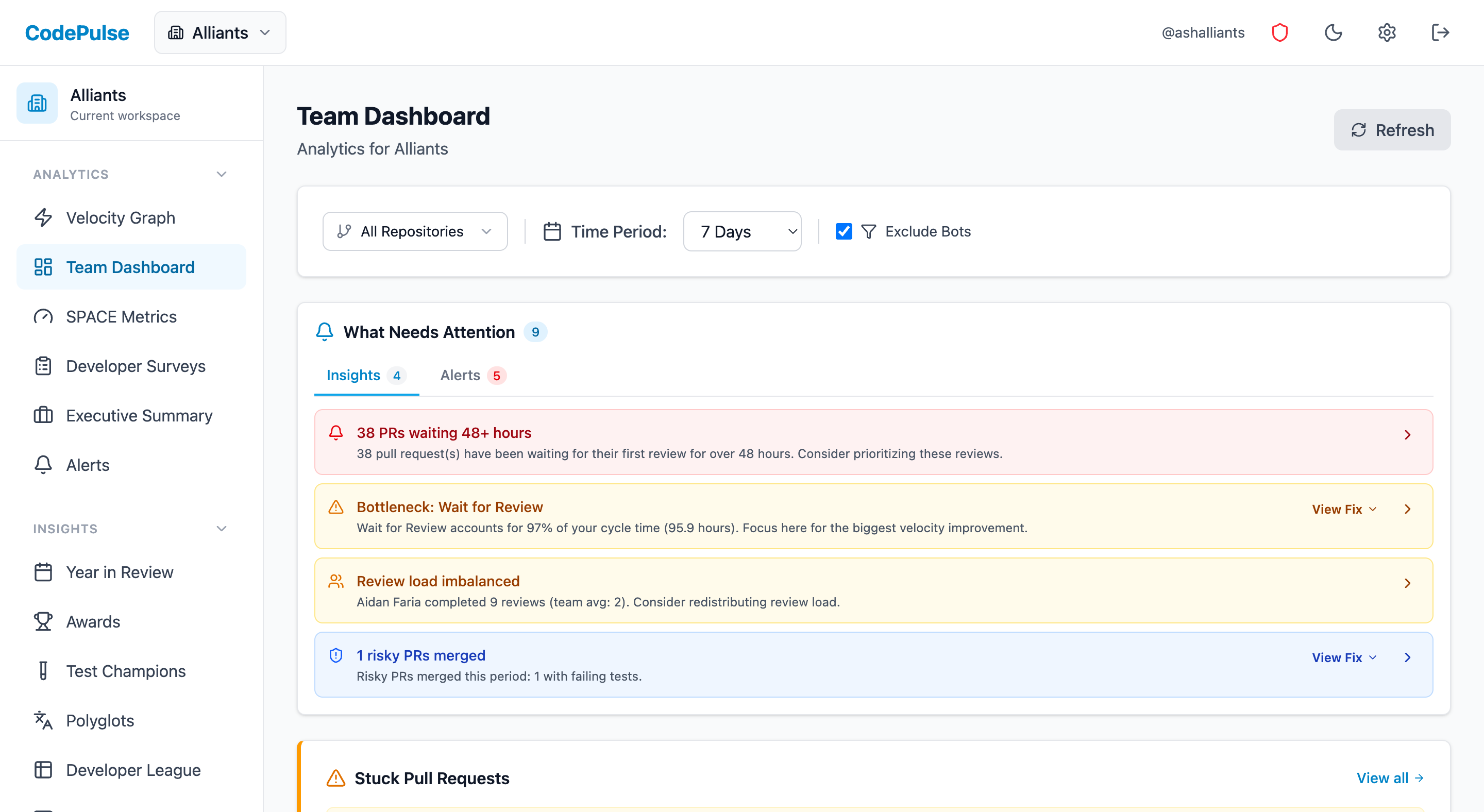
⚠️Identify Risky Changes in CodePulse
Use CodePulse to surface high-risk PRs:
- File Hotspots identifies frequently-changed files that warrant extra scrutiny
- Dashboard shows average PR size - large PRs need more careful review
- Review coverage metric catches PRs that bypassed review
- Test failure rate reveals if changes are breaking builds
Review Strategies for High-Risk Changes
Tiered Review Requirements
Not all PRs need the same scrutiny. Implement tiered review based on risk:
| Risk Level | Review Requirements | Example Changes |
|---|---|---|
| Low | 1 reviewer, standard process | Small fixes, documentation, tests |
| Medium | 1-2 reviewers, explicit test check | New features, moderate refactoring |
| High | 2+ reviewers including domain expert | Core logic, hotspots, security |
| Critical | Team lead + architect review | Database migrations, auth changes |
Before a high-risk PR lands in someone's queue, it helps to set expectations on how long a thorough review will actually take. Our free code review time estimate turns PR size and complexity into a realistic number so reviewers can block out enough focus.
Review Checklist for High-Risk PRs
High-Risk PR Review Checklist
Understanding
- Understand the "why" - is this change necessary?
- Check blast radius - what could break?
Quality Verification
- Verify test coverage - are edge cases covered?
- Review error handling - what happens when things fail?
- Validate performance - any concerns with scale?
Safety & Maintenance
- Check backwards compatibility - will this break existing users?
- Consider rollback - can we easily revert if needed?
- Security review - any new attack vectors?
- Documentation - will others understand this change?
When to Request Additional Review
- Author is new to the area: Have someone familiar with the code review
- Change affects shared utilities: Get input from other teams that use them
- Complex business logic: Include someone who understands the domain
- Performance-critical paths: Involve someone with performance expertise
Building Prevention into Process
Pre-Merge Gates
Automate what you can:
- Required CI passing: No merge without green tests
- Minimum review count: At least one approval required
- PR size limits: Flag or block PRs over threshold
- Required test changes: Warn if code changed but tests didn't
- CODEOWNERS: Auto-request review from domain experts
Hotspot-Based Review Rules
Use hotspot data to identify files that need extra review:
- Identify your top 10-20 hotspot files
- Create CODEOWNERS rules requiring senior review for these files
- Add automated comments when PRs touch hotspots
- Review hotspot list quarterly and update rules
Post-Merge Monitoring
Prevention doesn't stop at merge:
- Deploy with monitoring: Watch error rates after each deploy
- Canary deployments: Roll out to subset of users first
- Quick rollback capability: Ensure you can revert within minutes
- Alerting on anomalies: Automated detection of unusual patterns
Team Practices That Reduce Regressions
Smaller, Focused PRs
The single most effective regression prevention strategy. See our PR Size Optimization Guide for tactics.
- Aim for PRs under 200 lines
- Split features into reviewable chunks
- Extract refactoring into separate PRs
- Use feature flags for incremental delivery
Test-First Mindset
- Write tests before or alongside code, not after
- Require tests for any behavior change
- Review test quality, not just coverage percentage
- Maintain fast test suite to encourage running tests
Blameless Regression Reviews
When regressions do happen:
- Fix first, analyze second
- Conduct blameless postmortem
- Ask: "What process gap allowed this?"
- Implement systemic fix, not just code fix
- Share learnings with team
Knowledge Sharing
Regressions often occur when authors don't fully understand the code they're changing. Reduce knowledge silos:
- Rotate reviewers across codebase areas
- Pair programming for complex changes
- Document non-obvious behavior
- Tech talks on critical system components
See our guide on Knowledge Silos for more strategies.
Measuring Regression Prevention Success
Metrics to Track
| Metric | Target | How to Measure |
|---|---|---|
| Regression rate | <2% of PRs cause regressions | Track revert rate, hotfix frequency |
| Time to detect | <1 hour | Time from deploy to regression identification |
| Time to fix | <4 hours | Time from detection to fix deployed |
| Test failure rate | <5% | PRs failing CI on first push |
| Review coverage | >95% | PRs receiving at least one review |
Leading Indicators
Don't wait for regressions to know you have a problem. Watch for:
- Rising average PR size
- Declining review depth (fewer comments)
- Increasing test failure rate
- Growing hotspot count
- Reviews completed in under 5 minutes
See which files and owners carry your real risk
Connect GitHub and get your churn hotspots, single-owner modules, and review-depth signals ranked by exposure. No repository cloning, no file contents read.
Read-only GitHub · Your code stays yours · Team-level by default · No credit card
See These Features in Action
Flag large PRs, single-owner changes, and untested modifications.
Track deployment frequency, lead time, and release patterns.
Related Guides
The PR Pattern That Predicts 73% of Your Incidents
Learn how to identify high-risk pull requests before they cause production incidents.
Your CI Is Crying for Help. Here's What It's Telling You
Understand what test failure rate measures, identify patterns causing CI failures, and implement strategies to improve your pipeline reliability.
The 'Bus Factor' File That Could Kill Your Project
Use the Bus Factor Risk Matrix to identify where knowledge concentration creates hidden vulnerabilities before someone leaves.
The 300-Line Rule: Why Big PRs Are Sabotaging Your Team
The research-backed case for smaller pull requests, how to measure PR size effectively, and practical strategies for breaking down large changes.
GitHub Code Quality: Skip SonarQube, Use Git History
Learn how to extract actionable code quality metrics from your GitHub repository, including churn rate, hotspots, review coverage, and more.
The Tech Lead Dashboard Your Manager Shouldn't See
The metrics that matter for tech leads - code quality, technical debt, architecture decisions, and delivery. Different from EM metrics, focused on technical excellence.