

See exactly where your delivery flow is waiting
Preview the phase-by-phase report for review pickup, active review, and merge time. Connect in about five minutes; the initial analysis runs after sync.
Read-only GitHub · Your code stays yours · Team-level by default · No credit card
Your branching strategy isn't just a workflow preference - it's a mathematical cap on your deployment frequency. Data from thousands of engineering teams shows a clear correlation: as branch lifespan increases, DORA metrics plummet. Here is the data-backed reality of how GitFlow, GitHub Flow, and Trunk-Based Development actually impact your team's velocity.
🔥 Our Take
GitFlow is legacy code. Stop using it.
GitFlow was designed in 2010 for boxed software with monthly release cycles. In a CI/CD world, it is an active liability. Every "release branch" and "hotfix branch" is a barrier between your code and your customers. If you aren't building shrink-wrapped software, GitFlow is slowing you down by design.
How Branching Strategy Shapes Your Metrics
Most engineering managers treat branching models as a neutral choice. They aren't. Your branching model dictates your Lead Time for Changes and your Recovery Time.
According to the State of DevOps Reports, elite performers are 3.1x more likely to use Trunk-Based Development than low performers. Why? Because long-lived branches introduce three hidden costs:
- Merge Conflict Tax: The probability of a merge conflict increases non-linearly with branch age.
- Context Switching Tax: Managing multiple active branches forces developers to constantly switch contexts between "dev", "release-1.2", and "hotfix".
- Inventory Tax: Code sitting in a branch is inventory. It has value (cost to write) but zero revenue (not in production).
The Cost of GitFlow: A Data Analysis
GitFlow relies on long-lived feature branches and complex merge chains (`feature` → `develop` → `release` → `main`). Let's look at the data impact.
"Code developed on branches that live longer than 24 hours takes 33% longer to review and merge."
Why Trunk-Based Development Wins on DORA
Trunk-Based Development (TBD) mandates that developers merge into `main` at least daily. There are no long-lived feature branches. This constraint forces positive behaviors:
- Smaller Batches: You can't merge a week's worth of work in one go. You must break it down.
- Continuous Code Review: Reviews happen on small diffs, which are easier to understand and safer to merge.
- Feature Flags: Incomplete code is hidden behind flags, decoupling deployment from release.
The result is a drastic reduction in Lead Time for Changes. Instead of waiting for a "release train," code goes to production as soon as it passes CI.
Transitioning Strategies: From Long-Lived to Short-Lived
Moving from GitFlow to TBD is hard. It requires a culture shift. Here is the 3-step migration plan:
Step 1: The "GitHub Flow" Half-Step
Before going full trunk-based, simplify GitFlow. Remove the `release` and `develop` branches. Adopt GitHub Flow:
- Master is always deployable.
- Feature branches come from master.
- Deploy from the feature branch to verify (optional).
- Merge to master triggers production deploy.
Step 2: Feature Flags as a Default
Developers rely on branches because they are afraid of breaking production with unfinished code. Feature flags remove this fear. Implement a lightweight flagging system (or use LaunchDarkly/Split). Rule: "If it changes user behavior, flag it."
Step 3: Track "Branch Age" as a KPI
What gets measured gets managed. Start tracking the average age of open branches.
Measuring the Impact of Your Strategy
How do you know if your strategy is working? Look for these signals in your engineering data:
One practical note before you measure: if you run an issue tracker, your branch naming convention decides whether that data joins up at all. Issue keys are read from the branch name, so linking pull requests to Jira issues is largely a branch naming decision, and short-lived trunk-based branches map to one issue far more cleanly than long-lived ones.
📊 Tracking Branch Impact in CodePulse
Navigate to the Dashboardand check the Cycle Time Breakdown.
- High "Coding Time"? This often indicates long-lived branches where developers are hoarding changes.
- High "Pickup Time"? Large PRs (from long branches) scare reviewers, causing delays.
- Spiky Deployment Frequency? If you see deployments only on Fridays, you're likely batching too much (GitFlow style).
Hybrid Approaches That Work
Short-Lived Feature Branches (Scaled Trunk-Based):
This is the most common model for modern high-performing teams. Developers create branches, but they must merge within 24-48 hours. It keeps the isolation of branches but the velocity of trunk-based development.
Stacked PRs (The Meta/Uber Model):
Advanced teams use "stacked diffs" or "stacked PRs". Instead of one giant PR, a feature is broken into 5-10 dependent PRs that are reviewed and merged sequentially. This requires tooling (like Graphite or specialized git commands) but eliminates the "massive PR" bottleneck.
Conclusion
Your branching strategy is the transmission system of your engineering engine. GitFlow is a manual transmission with 18 gears - powerful for towing heavy loads slowly, but useless for a race car. Trunk-Based Development is direct drive.
If your DORA metrics are stagnant, stop blaming the developers and look at the branching model. Kill the `develop` branch, adopt feature flags, and watch your cycle time collapse.
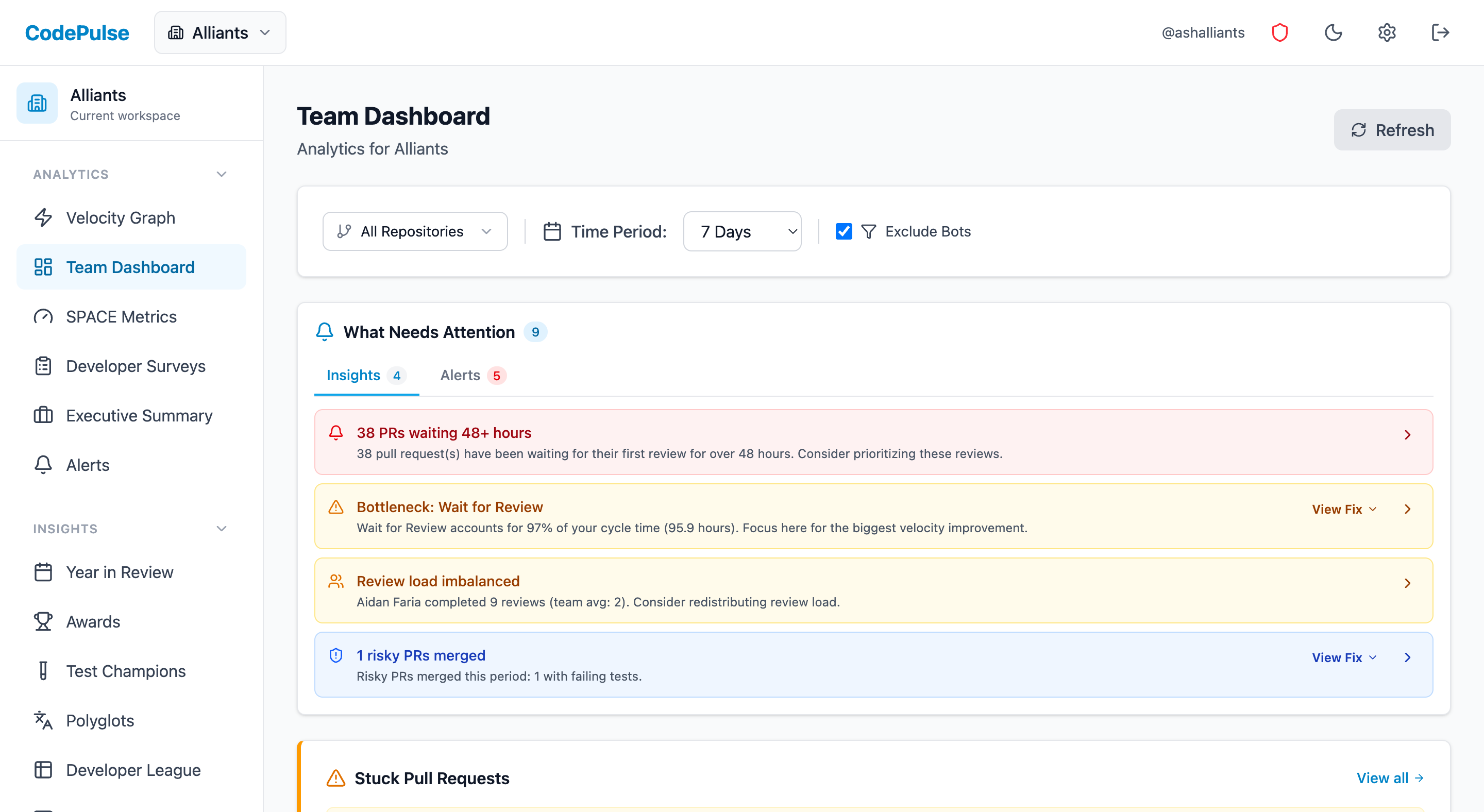
Find out which phase is holding your delivery up
CodePulse splits your cycle time into coding, waiting for review, active review, and merge, so you fix the queue that is actually costing you days. Read-only GitHub, no credit card.
Read-only GitHub · Your code stays yours · Team-level by default · No credit card
See These Features in Action
Track all four DORA metrics and benchmark against industry standards.
Break down cycle time into coding, waiting, review, and merge phases.
Related Guides
We Cut PR Cycle Time by 47%. Here's the Exact Playbook
A practical playbook for engineering managers to identify bottlenecks, improve review processes, and ship code faster - without sacrificing review quality.
Measure Deploy Frequency Without CI/CD (The Hack)
Master DORA deployment frequency and lead time using GitHub data alone, without requiring CI/CD pipeline access.
Delivery Excellence: Shipping Fast and Reliably (Without the Heroics)
Delivery excellence is more than shipping fast - it's consistent value delivery with predictability, quality, and sustainability. This guide breaks down the four pillars and how to measure and achieve excellence.
DORA Metrics Explained: The 4 Keys Without the Hype
A complete breakdown of the four DORA metrics - deployment frequency, lead time, change failure rate, and MTTR - with honest benchmarks and gaming traps to avoid.
Identifying Stuck Pull Requests Before They Rot
Detect and unblock stuck PRs before they become abandoned. Learn the 5 patterns that cause PRs to stall and build automated alerts for early intervention.
Why Features Aren't Shipping Faster: The 7 Hidden Bottlenecks
Diagnose why your team isn't shipping faster with data. Learn the 7 hidden bottlenecks and how to identify your specific slowdown without guessing.