
Understand the system around the team, not a developer leaderboard
Preview team-level workload, collaboration, and delivery signals designed for process improvement rather than performance grading.
Read-only GitHub · Your code stays yours · Team-level by default · No credit card
A steering committee (or "steerco") is a governance body that provides oversight, guidance, and decision-making for engineering initiatives. When run well, steering committees unblock projects, align priorities, and ensure resources match strategy. When run poorly, they become bottlenecks and theater. This guide shows you how to make steering committees actually useful.
"A steering committee that only hears good news is useless. The whole point is to surface problems before they become crises."
What is a Steering Committee?
A steering committee (steerco) is a group of senior leaders who meet regularly to:
- Provide strategic direction - Ensure initiatives align with business goals
- Make decisions - Resolve cross-team conflicts, approve scope changes
- Remove blockers - Use organizational authority to unblock teams
- Allocate resources - Approve budget and headcount requests
- Manage risk - Review status and intervene when projects go off track
Steering committees typically include VPs, Directors, and key stakeholders. They meet bi-weekly or monthly, depending on project complexity.
When Do You Need a Steering Committee?
| Scenario | Steering Committee? | Why |
|---|---|---|
| Major platform migration | Yes | Multiple teams, high risk, executive visibility needed |
| New product initiative | Yes | Cross-functional coordination, strategic importance |
| Single-team feature | No | Team can self-manage; steerco would be overhead |
| Security/compliance program | Yes | Requires executive authority, audit trail |
| Technical debt reduction | Maybe | Depends on scope; large initiatives may need oversight |
/// Our Take
Most organizations have too many steering committees, not too few. Every new steerco adds meetings, reporting overhead, and decision latency.
Before creating a steerco, ask: Can existing leadership meetings handle this? Do we actually need this level of oversight? The default should be "no steerco" unless there's a clear need for dedicated governance.
Running Effective Steering Committee Meetings
Before the Meeting
- Send materials 48 hours in advance - No one should read status reports in the meeting
- Flag decisions needed - Make it clear what you need from the committee
- Pre-align on contentious issues - Steercos shouldn't be where debates happen
During the Meeting
- Start with decisions needed - Not status updates
- Timebox status to 10 minutes - Focus on exceptions, not reporting
- Document decisions in real-time - Assign someone to capture outcomes
- End with clear actions - Who does what by when
After the Meeting
- Send notes within 24 hours - Decisions, actions, owners, deadlines
- Follow up on action items - Don't wait for the next meeting
- Escalate blockers immediately - If something's stuck, don't wait
Metrics to Present to a Steering Committee
Steering committees don't need every metric - they need the right metrics. Focus on:
Recommended Metrics
| Category | Metrics | Why |
|---|---|---|
| Progress | Milestones completed, % complete, burn-down | Are we on track? |
| Quality | Bug rate, test coverage, incidents | Are we building it right? |
| Velocity | Cycle time, deployment frequency | How fast are we moving? |
| Risk | Blockers, dependencies, staffing gaps | What could derail us? |
| Budget | Spend vs. plan, runway | Are we within resources? |
📊 How to See This in CodePulse
Use CodePulse to provide objective data for steering committee meetings:
- Executive Summary for a high-level health grade
- Dashboard for cycle time and deployment metrics
- Repository Comparison for cross-team visibility
Common Steering Committee Problems
1. Status Theater
Teams spend more time preparing presentations than building software. Everyone reports Green to avoid hard questions.
Fix: Require pre-reads, limit status time, ask "what are you worried about?"
2. Decision Avoidance
Committee discusses issues but doesn't decide. "Let's take that offline" becomes a pattern.
Fix: Require decision requests in the agenda. No decision request = no discussion.
3. Too Many Attendees
Steerco becomes a large audience, not a working group. No one wants to speak up.
Fix: Limit to 6-8 people. Others can attend as observers but can't speak.
4. Micromanagement
Committee dives into technical details that teams should own. Engineers feel second-guessed.
Fix: Stay at the "what" and "why" level. Leave "how" to the teams.
Steering Committee Meeting Template
STEERING COMMITTEE MEETING - [PROJECT NAME]
Date: [DATE] | Duration: 60 minutes

ATTENDEES
- [Name, Role] (Chair)
- [Names of other members]

─────────────────────────────────────────────────────
AGENDA

1. DECISIONS NEEDED (20 min)
   □ Decision 1: [Description]
     - Recommendation: [Option A/B/C]
     - Trade-offs: [Brief summary]
     - Decision: [APPROVED/REJECTED/DEFERRED]
     - Action: [Owner, deadline]

   □ Decision 2: [Description]
     ...

2. STATUS SUMMARY (10 min)
   Overall: [🟢/🟡/🔴]

   Key Metrics:
   - Milestone Progress: X% complete
   - Cycle Time: XX hours (target: XX)
   - Team Health: [Green/Amber/Red]

   Changes Since Last Meeting:
   - [Highlight 1]
   - [Highlight 2]

3. RISKS & BLOCKERS (15 min)
   Risk 1: [Description]
   - Impact: High/Medium/Low
   - Mitigation: [Action being taken]
   - Ask: [What you need from steerco]

4. UPCOMING (5 min)
   Next 2 weeks:
   - [Key milestone/deliverable]
   - [Key milestone/deliverable]

5. OPEN DISCUSSION (10 min)

─────────────────────────────────────────────────────
ACTION ITEMS
[ ] [Action] - [Owner] - [Due Date]
[ ] [Action] - [Owner] - [Due Date]

NEXT MEETING: [Date/Time]
Related Guides
- Board-Ready Engineering Metrics - Presenting metrics to executives
- RAG Status Reporting - Using Red/Amber/Green effectively
- Engineering Health Scorecard - Building comprehensive health dashboards
Conclusion
Steering committees exist to make decisions and remove blockers - not to receive status updates. If your steerco is mostly listening to presentations, something is wrong.
- Pre-read materials so meetings focus on decisions
- Limit attendees to people who can decide
- Use objective metrics from tools like CodePulse
- Document decisions and follow up on actions
- Question whether you need the steerco at all
"The best steering committee is one that works itself out of a job. If a project needs permanent oversight, something else is broken."
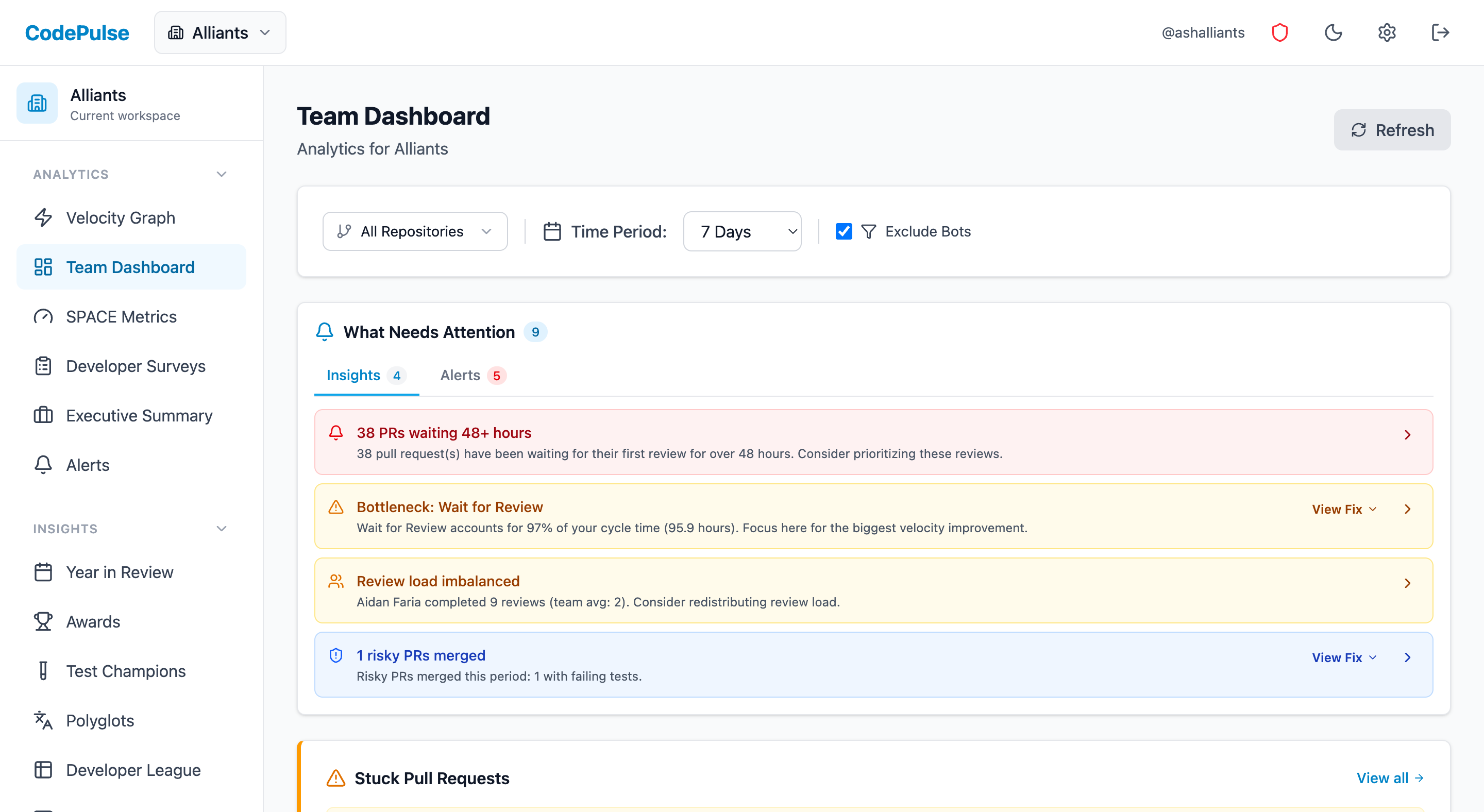
Get this view for your own teams
Connect GitHub for team-level workload, review distribution, and delivery signals. Individual views stay off unless your organisation explicitly turns them on.
Read-only GitHub · Your code stays yours · Team-level by default · No credit card
See These Features in Action
Explore all featuresRelated Guides
I Got $2M in Budget With These 5 Engineering Metrics
Learn how to create engineering metrics presentations that resonate with board members, investors, and C-suite executives.
7 KPIs That Separate Great VPs From Struggling Ones
The essential metrics for VPs of Engineering, Directors, and CTOs. Covers executive dashboards, DORA metrics, team health, and stakeholder communication.
VP Engineering Board Metrics: 7 Numbers That Defend Headcount
The 7 metrics VPs of Engineering need for board presentations: delivery predictability, investment allocation, and team health - with the language to present them.
RAG Status Meaning: Red, Amber, Green Explained
RAG status - Red, Amber, Green - is everywhere in engineering reporting. This guide shows how to use it effectively, avoid common traps, and supplement it with objective metrics.